

Contact Form 7 vs Fluent Forms: Which one should you go for?

The right form plugin for WordPress depends less on which one is “better” and more on how you like to work. Both Contact Form 7 and Fluent Forms build great forms. They just take different approaches to build them.
Contact Form 7 is the lightweight veteran with more than 10 million active installs. It hands you a blank canvas and some markup. Fluent Forms is the visual builder with 700,000+ installs, a drag-and-drop editor, and a lot packed into its free version.
TL;DR
- Contact Form 7 is free, open source, and very light. It suits simple contact forms and people who don’t mind a little setup.
- Contact Form 7 entered a feature freeze after version 6.2, so it gets security fixes but no new features.
- Fluent Forms is a drag-and-drop builder with a strong free tier and a Pro tier for advanced needs.
- Contact Form 7 builds forms with form-tag markup. Fluent Forms builds them visually with a live preview.
- Contact Form 7 does not store submissions by default and needs the free Flamingo plugin. Fluent Forms stores and reports on entries natively.
- Fluent Forms includes conditional logic, conversational forms, an AI builder, and Stripe payments in its free version.
- Contact Form 7 stays free forever. Fluent Forms Pro starts at $79 per year or $349 for a lifetime license.
- Pick Contact Form 7 for lightweight simplicity; pick Fluent Forms for more features, without stacking plugins.
Contact Form 7 vs Fluent Forms at a Glance
Before the detail, here’s how the two plugins stand on the points people ask about most.
Contact Form 7 keeps things minimal, and Fluent Forms adds more features.
| Feature | Contact Form 7 | Fluent Forms |
|---|---|---|
| Pricing model | Free Open source | Freemium Free + Pro |
| Active installs | 10M+ | 700,000+ |
| WordPress.org rating | ||
| Development status | Feature freeze After version 6.2 | Active Frequent updates |
| Builder type | Form-tag markup | Drag-and-drop with live preview |
| Input fields | 10+ | 65+ |
| Entry storage | No Needs Flamingo | Yes Built in |
| Conditional logic | Add-on | Free Field level free, settings level Pro |
| Calculation | Add-on | Pro |
| Conversational forms | Add-on | Free |
| Payments | Stripe form-tag | Stripe free; 8 gateways in Pro |
| Templates | One default form | Hundreds |
| Integrations | Approximately 6 built in | 60+ plus Zapier |
| Spam protection | Akismet, reCAPTCHA, and Turnstile | Akismet, reCAPTCHA, Turnstile, hCaptcha, honeypot, CleanTalk, and more |
| Multi-step forms | No | Pro |
| Quiz and survey | Basic quiz field | Pro Advanced scoring |
| Best for | Simple, lightweight forms | Feature-rich forms without code |
What Changed at WordCamp Asia 2026: The Contact Form 7 Feature Freeze
Contact Form 7 has stopped adding new features. At WordCamp Asia 2026 in Mumbai, creator Takayuki Miyoshi confirmed that version 6.2 is the last release to add new functionality. From there, the plugin moves into a feature freeze.
The plugin stays stable. Miyoshi committed to ongoing bug fixes and security patches, so your existing forms keep working and stay patched. They just won’t gain modern features like conditional logic or an AI builder.
What it means for you
- If you only need a simple contact form and like Contact Form 7’s approach, it remains a viable, lightweight choice.
- If you’ve ever wanted drag-and-drop building, conditional logic, or payments, you’ll need add-ons or an actively developed plugin like Fluent Forms.
- Migrating while your forms are simple is easier than waiting until they grow complex.
Contact Form 7: The Lightweight Veteran
Contact Form 7 is one of the oldest and most installed form plugins for WordPress, with over 10 million active installs. It’s built and maintained by Takayuki Miyoshi under the philosophy of free, open source software that stays simple but flexible.
You build forms by placing form-tags in a text editor, then embed the form with a block or shortcode. There’s no visual canvas. You write the structure, save, and check the result on the front end.
What Contact Form 7 does well
- It’s completely free with no upsell and no locked features.
- The footprint is tiny, so a basic form adds very little weight to a page.
- Form-tags give developers precise, predictable control over markup.
- It works without JavaScript for non-Ajax submissions, which helps on locked-down setups.
- It’s tested across millions of sites and every major theme.
Where Contact Form 7 falls short
- No drag-and-drop and no live preview, so editing means save-and-check cycles.
- No native entry storage. Submissions arrive by email unless you add Flamingo.
- No built-in conditional logic, multi-step forms, or visual styling.
- Advanced needs require third-party add-ons, which add their own weight and upkeep.
Fluent Forms: The Modern All-Rounder
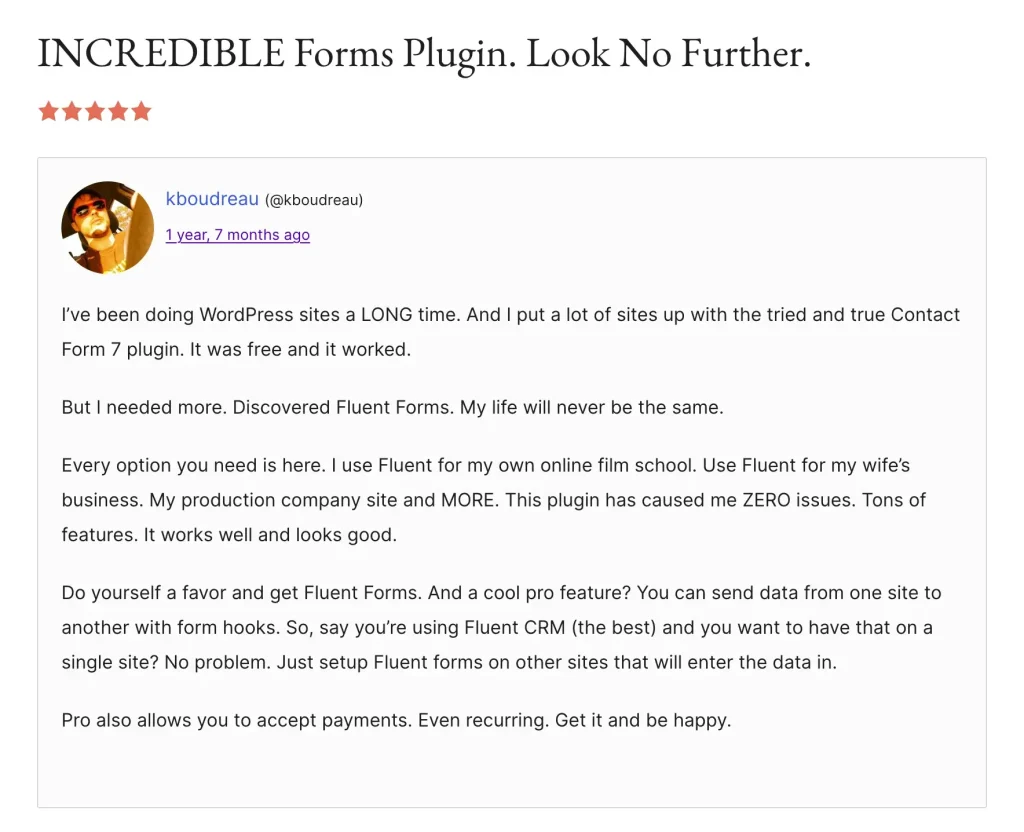
Fluent Forms is a drag-and-drop form builder from WPManageNinja, with 700,000+ active installs and a 4.8-star rating on WordPress.org. It’s built as a no-code tool equipped to help advanced users.
You drag fields onto a canvas, click to configure them, and watch changes in real time. Speed is a design goal: a standard form loads under 30KB of combined CSS and JS, and assets load only on pages that use a form.
What Fluent Forms does well
- The visual builder and live preview allow form creation in minutes.
- The free version already includes multicolumn layout, conditional logic, conversational forms, an AI builder, PDF generation, and 35+ fields.
- Entries are stored, searchable, exportable, and shown in visual reports.
- Hundreds of templates give you a running start instead of a blank form.
- One-click migration pulls in Contact Form 7, WPForms, Gravity Forms, and more.
Where Fluent Forms falls short
- Some advanced features, like multi-step forms, calculation, and quiz scoring, sit behind Pro.
- The free-tier Stripe payments carry a 1.9% transaction fee on top of Stripe’s own charges.
- The larger feature set means a slightly bigger learning surface than a simple contact form.
- It’s relatively newer than Contact Form 7, so it has a shorter track record.
Feature Comparison
Form building and ease of use
Fluent Forms is faster to build with; Contact Form 7 gives more raw control.
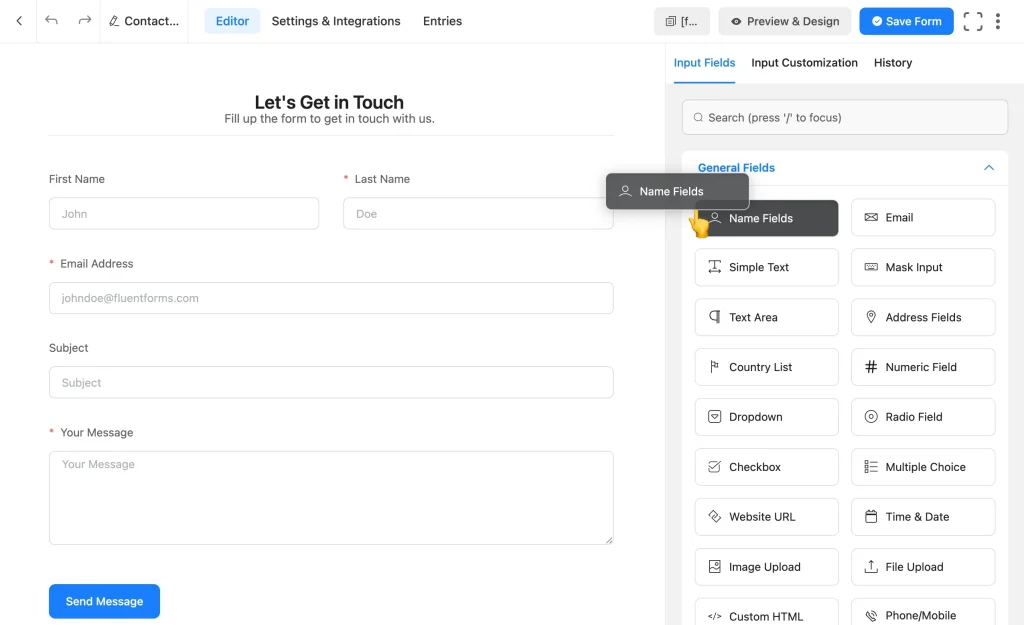
In Contact Form 7, you add fields as form-tags and position your cursor carefully, since it isn’t a drag-and-drop builder. You also write label markup yourself, and there’s no live preview, so you save and check the front end to see the result.
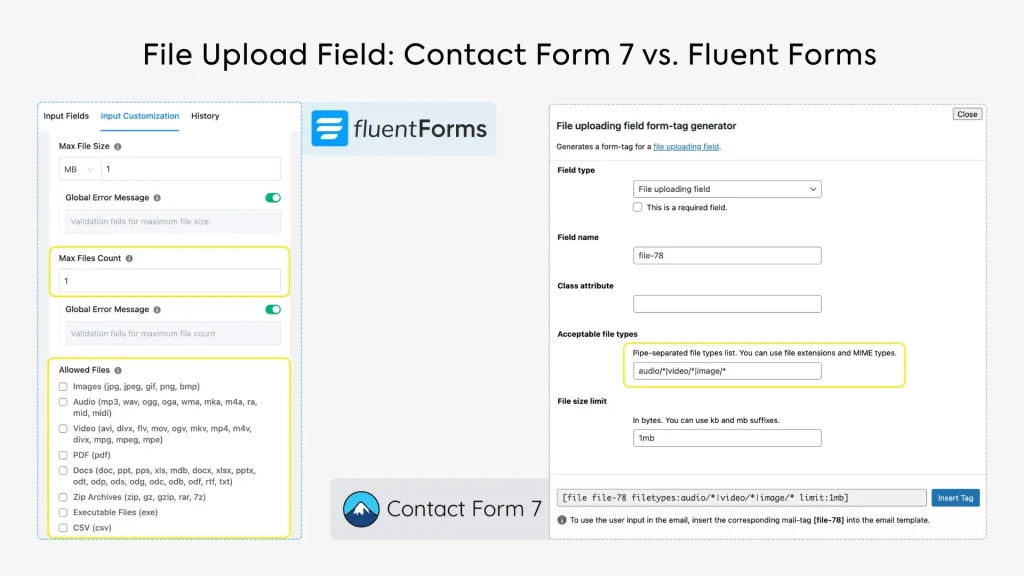
Fluent Forms shows a field panel you drag from, click-to-edit options, and real-time changes. You can open the Preview & Design tab before you place the form on a page.
Fields and form types
Fluent Forms offers more field types without add-ons.
Contact Form 7 ships a core set: text, email, URL, number, date, dropdown, checkbox, radio, file upload, and a basic quiz tag. That covers standard contact forms well.
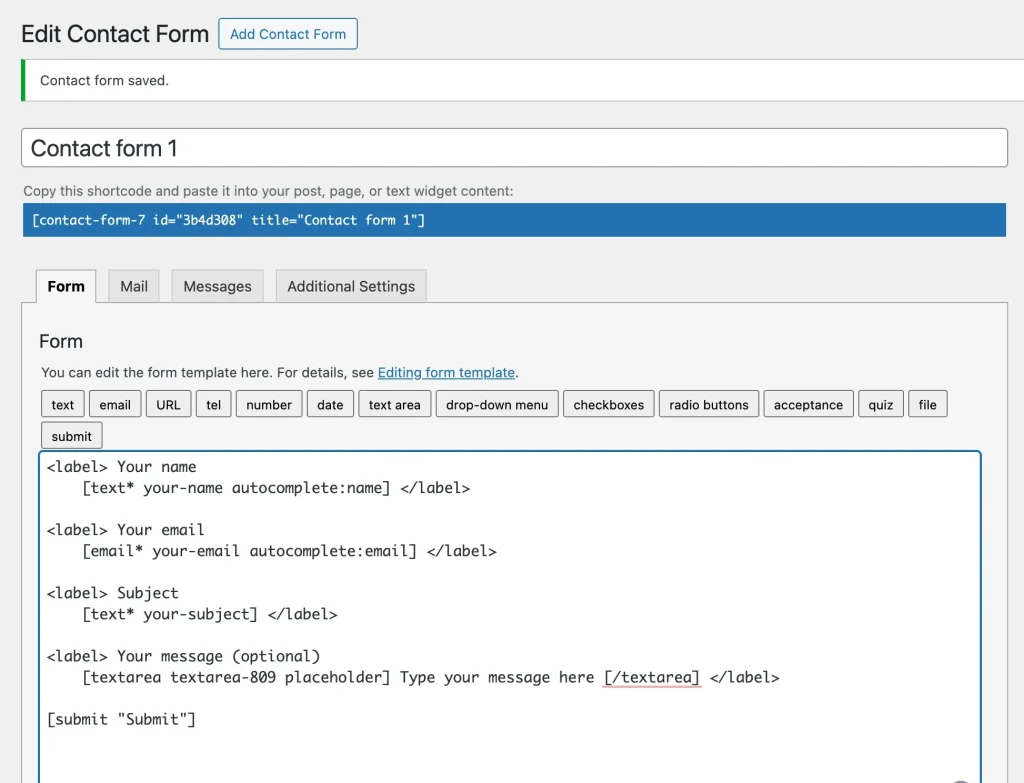
Fluent Forms Pro gives you 65+ fields (35+ in free), including address blocks, phone, ratings, range sliders, repeat fields, chained selects, and payment fields. It also builds conversational forms and multi-step forms that Contact Form 7 doesn’t offer natively.
Entry management and reporting
Fluent Forms offers it for free; Contact Form 7 needs Flamingo or another add-on.
Contact Form 7 doesn’t save submissions. You get them by email, and for a stored database, you install Flamingo (made by the same developer) or another add-on.
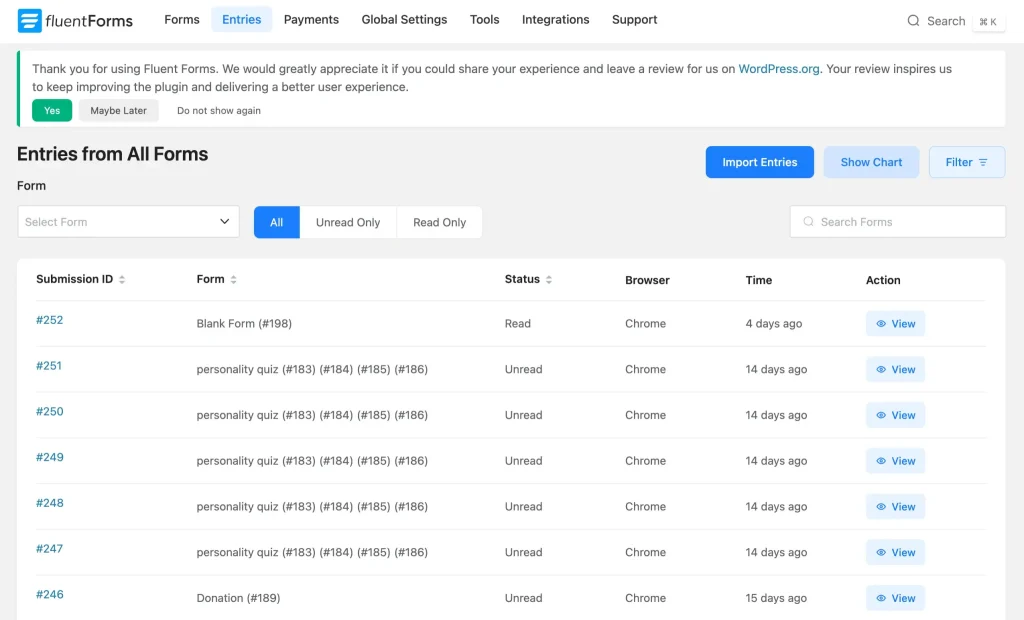
Fluent Forms stores every entry in a searchable table, shows individual submission details with IP and device data, and renders results as pie and bar charts. You can also select and export specific entries. If you rely on your form data, that built-in visibility matters.
Conditional logic
Fluent Forms includes it free; Contact Form 7 needs an add-on.
Conditional logic shows or hides fields based on earlier answers, which keeps forms clean and relevant. Fluent Forms lets you set rules like equals, greater than, contains, and regex match, and you can apply them to email notifications and confirmation messages too.
Contact Form 7 has no native conditional logic. You can add it through third-party plugins, but that’s another dependency to verify and maintain.
Payments
Fluent Forms treats payments as flexible fields; Contact Form 7 uses a single Stripe tag.
Contact Form 7 offers a Stripe form-tag where you set currency and amount in the smallest unit, and the Stripe button becomes the submit button. It works, but it’s rigid.

Fluent Forms breaks payments into fields like payment items, quantity, custom amount, and subscriptions and connects to Stripe, PayPal, Mollie, Razorpay, Paddle, Square, Paystack, and Authorize.net. Free-tier Stripe carries a 1.9% fee that Pro removes.

Spam protection
Both cover the essentials; Fluent Forms offers more.
Contact Form 7 supports Akismet, Google reCAPTCHA, Cloudflare Turnstile, and a disallowed keyword and IP list. Those handle most spam if you configure them.
Fluent Forms adds hCaptcha, a built-in honeypot, empty-submission blocking, and CleanTalk along with the options covered in Contact Form 7. Most of them are easy to configure (uses toggle).
Everything You Need in a Form Builder Plugin
Integrations
Fluent Forms connects to far more services out of the box.
Contact Form 7 integrates with about six tools by default: Akismet, reCAPTCHA, and Turnstile for security, Brevo and Constant Contact for email, and Stripe for payments.
Fluent Forms offers 60+ integrations across CRM, email marketing, automation, payments, messaging, etc., plus Zapier for a thousand more. If your form feeds other tools, this saves a lot of time and effort.
Bonus: Embed Forms in Videos with FluentPlayer
Fluent Forms connects natively with FluentPlayer, so you can embed a form inside a video and capture leads or sell products at the moment a viewer is most engaged.
FluentPlayer is a recently launched video player plugin for WordPress from WPManageNinja. Its Fluent Forms layer allows you to embed any Fluent Forms form into a video at a timestamp you set.
Submissions go to your usual Fluent Forms workflow. Every form feature carries over, including conditional logic, payments, and file uploads.The best part is it works on both free versions.
FluentPlayer’s free plugin plus the free version of Fluent Forms are enough to add your video, add a Forms layer, pick a form, and start collecting entries.

Templates and styling
Fluent Forms gives you a head start; Contact Form 7 starts blank.
Contact Form 7 provides one default contact form and inherits your theme’s styles, so custom looks mean writing CSS yourself.
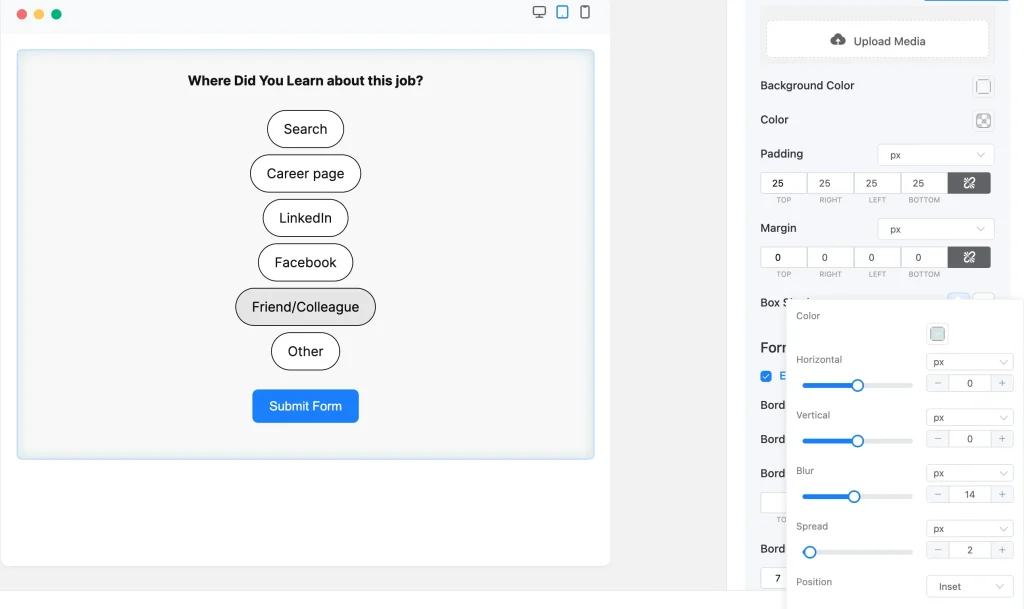
Fluent Forms comes with hundreds of templates and an advanced form styler for colors, spacing, borders, and backgrounds, with multi-column layouts built in. You still get custom CSS and JS if you want them. There’s a Gutenberg block styler as well.
Performance and Page Speed
Contact Form 7 is minimal by design, and Fluent Forms is engineered to stay light.
A bare Contact Form 7 form loads very little. Fluent Forms cites under 30KB of combined CSS and JS for a standard form and loads assets only on pages that use one.

Contact Form 7’s advantage goes away once you install add-ons for other functionalities. Each add-on brings its own scripts, so a heavily extended Contact Form 7 setup can end up heavier than one Fluent Forms install that does the same jobs.
Pricing Comparison
Contact Form 7 pricing
Contact Form 7 is completely free and donation-supported. Every feature is available at no cost, and there’s no paid tier. Your only added costs come from any premium add-ons you choose.
Fluent Forms pricing
Fluent Forms has a free version that covers most needs. Pro unlocks the advanced feature set. Every plan includes all Pro features, differing only in the number of sites.
| License | Annual | Lifetime |
|---|---|---|
| Single site | $79 / year | $349 |
| Agency (5 sites) | $159 / year | $599 |
| Unlimited sites | $299 / year | $899 |
Support and Community
Fluent Forms offers dedicated support; Contact Form 7 relies on community channels.
Contact Form 7 provides docs, an FAQ, and the WordPress.org support forum, maintained largely by one developer.
Fluent Forms provides docs, developer docs, tutorial blogs and videos, a priority ticket system, WordPress.org support forum, and a dedicated community space.
How to Choose Between Contact Form 7 and Fluent Forms
Choose Contact Form 7 if
- You need a simple contact form and nothing more.
- You want a free, open source tool with zero upsell.
- You’re a developer who likes controlling markup and writing your own CSS.
- You’re comfortable adding and maintaining 3rd-party plugins for storage, spam, and styling.
Choose Fluent Forms if
- You want a visual builder that shows changes in real time.
- You need entries stored, searchable, and visualized without extra plugins.
- You want conditional logic, multi-step forms, quizzes, or payments in one tool.
- You’d rather start with more native features than install them from add-ons.

Moving from Contact Form 7 to Fluent Forms
If you’re leaning toward Fluent Forms but worry about your existing forms, the switch is quick. Fluent Forms includes a one-click migrator.
- Install and activate the Fluent Forms plugin for WordPress.
- Go to Fluent Forms > Tools > Migrator in your dashboard.
- Find the Contact Form 7 section and click Import Form to bring over your forms.
- Click Import Entries to migrate existing submissions where available.
- Open each form in the builder to confirm fields and settings, then publish.
You can test all of this on the free version first, so there’s no commitment while you compare the builder against Contact Form 7’s classic approach.
Want to Migrate from Contact Form 7 to Fluent Forms?
Pick the Plugin that Will Support You Long Term
Both plugins build solid forms, so the choice comes down to how you want to work and where your site is headed.
Contact Form 7 is the right call if you want something free, light, and simple. Or if you don’t mind installing add-ons or a bit of code when needs grow. It’s stable and well-tested.
Fluent Forms is the better fit if you’d rather build visually, keep your entries and reports in one place, and grow with features like conditional logic, calculations, payments, and multi-step forms without stacking plugins. It’s also actively developed, so it stays compatible with WordPress.


Sarika creates helpful content for Fluent Forms & FluentPlayer. Endlessly curious, she loves connecting over diverse interests & unique perspectives. Off the clock, she’s exploring art or relaxing with a binge-worthy show.
-

Top 10 BookingPress Alternatives: WordPress Booking Plugins (2026)
Discover the best BookingPress alternatives for WordPress. Compare features, pricing, -

Single-Step Form vs. Multi-Step Form: Which One Is the Best and Why
Single-step vs multi-step form, which format converts better? Learn how -

All in One SEO vs Yoast: Which WordPress SEO Plugin Wins in 2026?
All in One SEO vs Yoast SEO Plugins compared across

Comments
-
I always was interested in this subject and still am, thankyou for posting .
-
[…] WP FLUENT FORM VS. CONTACT FORM 7 – WHICH ONE IS THE BEST? […]
-
I’d must check with you here. Which isn’t something It’s my job to do! I love to reading an article that may make people think. Also, thank you allowing me to comment!
-
You’re welcome, Freddy
-
-
*This web site is really a walk-through for all of the info you wanted about this and didn’t know who to ask. Glimpse here, and you’ll definitely discover it.
-
Hi Lonna, love for your appreciation
-
-
Many thanks for placing up this post, I feel every person will thanks for that.
-
Thank you, Ed
-
-
[…] Know the difference between WP Fluent Form and Contact Form 7 […]
-
[…] A comparison between WP Fluent Forms and Contact Form 7 […]



Leave a Reply
You must be logged in to post a comment.