

All in One SEO vs Yoast: Which WordPress SEO Plugin Wins in 2026?

Choosing between All in One SEO and Yoast SEO is one of the most common decisions WordPress site owners put off longer than they should. Both plugins cover the fundamentals well enough that either one will outperform doing nothing.
The question is which one fits how you actually work, what your site needs, and what you are willing to pay for. Download counts alone will not tell you which one is right for your site. Your workflow, your budget, and your site type matter more.
In this blog, we will break down the interface, features, pricing, schema support, and AI tools of both plugins so you can make a confident choice.
TL;DR
- AIOSEO uses a numeric TruSEO score and ships more generous free features, including basic WooCommerce SEO and extra schema types.
- Yoast uses a red, yellow, green traffic light system and remains the most installed SEO plugin in the WordPress directory.
- AIOSEO’s paid plans scale by site count, which suits agencies. Yoast charges per site, which suits single-site owners.
- Both plugins now ship AI-assisted tools built for search engines and AI answer engines alike.
- Neither plugin replaces a real content and internal linking strategy.
What Are All in One SEO and Yoast SEO?
All in One SEO and Yoast SEO are WordPress plugins that manage on-page search optimization from inside the block editor. They handle meta titles, meta descriptions, XML sitemaps, canonical tags, schema markup, and social sharing previews without requiring any code.
AIOSEO launched in 2007 and was rebuilt in 2020 after Awesome Motive acquired it. Yoast launched in 2010 and has been part of Newfold Digital since 2021. Both plugins offer a free version plus a paid tier that unlocks redirects, internal linking tools, and advanced schema options for growing sites.
| Features | AIOSEO | Yoast |
|---|---|---|
| Active installs | 3 million+ | 10 million+ |
| Scoring system | Numeric TruSEO score | Traffic light indicators |
| Parent company | Awesome Motive | Newfold Digital |
| AI visibility tracking | Yes, AI Keyword Report | Yes, AI Brand Insights |
| Starting paid price | $99/year, 1 site | $119/year, 1 site |
Install counts and pricing come from each plugin’s official listing on WordPress.org and public pricing pages, current as of July 2026.
Interface and Scoring
AIOSEO’s TruSEO Score
AIOSEO combines keyword usage, readability, and technical checks into one score out of 100.
- TruSEO score: a single number that reflects overall page health and updates as you write.
- Setup wizard: guides new users through site type, homepage title, and Google Search Console connection in a few clicks. The layout groups Basic SEO, Title and Readability into separate tabs, which some reviewers find cleaner than one long scrolling checklist.
Yoast’s Traffic Light System
Yoast splits feedback into SEO analysis and readability analysis. Traffic lights: green, yellow, and red icons flag what needs fixing before you hit publish.
Single keyphrase: free users can target one focus keyword per post, with related keyphrase suggestions shown alongside it. The system is instantly recognizable to anyone who has used WordPress before, and that familiarity shortens the learning curve for teams already trained on it.
Free vs Premium Features
| Features | AIOSEO Free | AIOSEO Pro | Yoast Free | Yoast Premium |
|---|---|---|---|---|
| Focus keyphrases | Unlimited analysis | Unlimited | 1 | Multiple |
| Redirect manager | No | Yes, 19 types | No | Yes, 5 types |
| Internal link suggestions | No | Pro plan and up | No | Yes |
| WooCommerce schema | Basic | Full | No | Paid add-on |
| Local SEO | No | Plus plan and up | No | Paid add-on |
The table above highlights the core trade-off. AIOSEO packs more into its Pro tier, from redirect depth to WooCommerce schema, while Yoast Premium stays narrower but leans harder into internal linking.
For a content-heavy blog, working internal links often matter more day-to-day than a long list of redirect types most owners rarely touch once a site has been live for years.
Schema and Technical SEO
AIOSEO and Yoast both generate schema markup automatically, but the depth differs once you move past the basics.
| Technical Feature | AIOSEO | Yoast SEO |
|---|---|---|
| Schema types, free tier | Article, Product, FAQ, and more | Article and basic types only |
| Advanced schema (Recipe, Course, Event) | Included, no code needed | Requires developer filters |
| Sitemap types, free tier | XML, RSS, and image | XML and image only |
AIOSEO’s schema generator needs no code for advanced types like Recipe, Course or Event, while Yoast expects developers to extend coverage through custom filters for anything beyond the basics.
Both plugins generate XML sitemaps automatically, but AIOSEO includes RSS sitemap support in its free tier, a format Yoast does not offer. If your site already struggles with thin schema or crawl errors, this SEO mistakes guide is worth reviewing before you install either plugin.
WooCommerce and Local SEO
WooCommerce and Local SEO tools matter most once a plugin choice starts affecting revenue as well as rankings. AIOSEO’s WooCommerce schema covers product price, stock status, and reviews, which can help pages qualify for rich snippets in search results.
AIOSEO’s Local SEO module also supports multiple business locations on its higher tiers, useful for franchises or multi-branch stores.
Yoast covers the same ground through separate paid extensions rather than bundled modules, which adds to the total cost for store owners who need both. Whichever plugin you pick, schema alone will not fix thin product descriptions or a slow checkout, so pair it with a WooCommerce SEO guide for the fundamentals.
AI and GEO Features in 2026
Search has changed since these plugins first launched, and both now build for AI Overviews and chat-based answer engines, not just classic search results. AIOSEO and Yoast both offer AI-written title and meta description drafts inside their paid plans, which makes both count as AI SEO tools alongside their classic optimization role.
AIOSEO ships an AI Keyword Report that checks whether content surfaces in ChatGPT and Gemini answers, and Yoast has added a comparable AI Brand Insights tool along with LLMs.txt management for the same purpose.
Neither feature set replaces a clear content strategy built around real search intent and structured, crawlable pages. For a deeper look at this shift, see this breakdown of GEO strategy for WordPress sites.
What WordPress Users Actually Say
Community threads on Reddit and WordPress support forums show a consistent pattern in how people move between the two plugins. Users who switch from Yoast to AIOSEO usually point to the cleaner dashboard and free WooCommerce features.
Users who stay on Yoast usually mention familiarity and its internal linking suggestions. A recurring complaint about AIOSEO is that renewal pricing jumps after the first discounted year. A recurring complaint about Yoast is the frequent update prompts and upsells in the dashboard.
Responsive Tables and SEO
Comparison content reads better in table format than in dense paragraphs, especially since most readers open articles like this one on a phone. A table that collapses cleanly on small screens is easier to scan than one that forces horizontal scrolling.
If you plan to publish your own comparison or pricing tables in WordPress, Ninja Tables is a no-code table builder made for this, and its output stays as real, crawlable text rather than an image, so the data remains visible to both readers and search engines.
Which Plugin Should You Choose
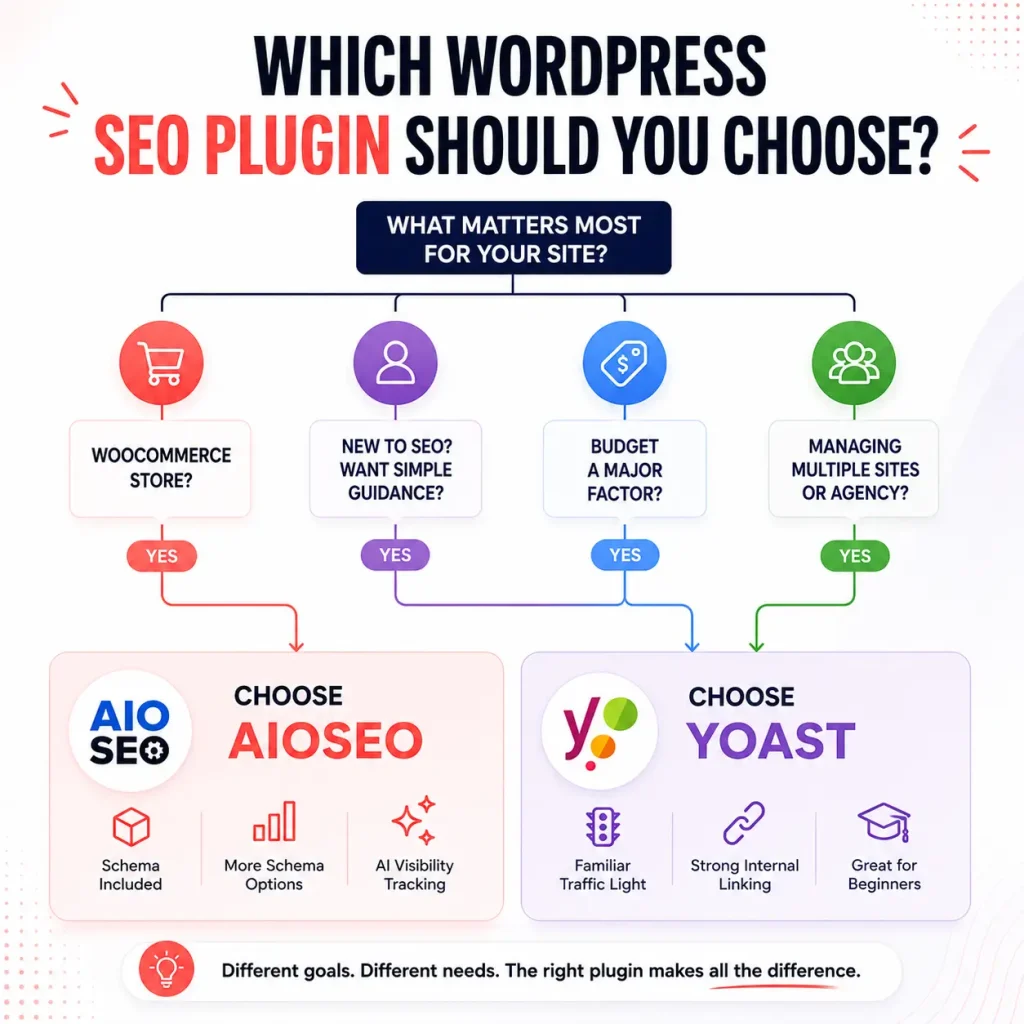
Choose AIOSEO If
You run a WooCommerce store and want schema included for free. And manage several sites and prefer pricing tiers based on site count. You want a broader schema catalog and AI content visibility tracking without hunting for add-ons.
Choose Yoast If
Your team already knows the traffic light workflow and retraining would cost more than switching saves. You need strong internal linking suggestions for a large content library. New site owners often pick Yoast as an SEO plugin for beginners, since the traffic light guidance needs no technical background.
Wrapping Up
All in One SEO and Yoast SEO both handle the fundamentals of on-page SEO well. AIOSEO tends to win on free features, WooCommerce support, and pricing flexibility for multiple sites. Yoast tends to win on brand recognition, internal linking tools, and simple per-site pricing.
Neither one is the best SEO plugin for WordPress in every situation, and neither will move your rankings on its own. Pick the plugin that matches your site type and budget, then put the time you save into content and links instead.

Hi there! I’m a creative content writer at Ninja Tables, WPManageNinja. I love writing on diverse topics and when I’m not writing, you’ll find me chilling with a book.
-

Black Friday Marketing Strategies for 2026: Core and Advance Move
Black Friday is the most celebrated shopping season worldwide. Discover -

How Much Can You Earn With Amazon Affiliate Marketing? Rates & Niches
How much can you earn with Amazon affiliate marketing? Dive -

How to Build a Successful Brand: Actionable Brand Building Strategy
Dive into the details of how to build a successful

Comments
-
So far I read several similar comparison between the two plugins and it’s becoming evident that AIOSEO has a better perception over Yoast from experts’ perspective as the layman’s reviews indicate that Yoast is with no doubt is head and shoulder above its competitors.
My question is can I have the free version of both plugins at the same time?
-
Both plugins are great. An SEO plugin is a tool that helps us doing on-page optimization smoothly. End of the day, it’s you who will do the SEO the right way.
Yes, you can use both plugins to see which one gives you better support and then decide which one to keep.
Note: SEO plugins may create a sitemap automatically. You have to be aware of this since multiple sitemaps will cause harm for indexing.
-
-
I have AIOSEO in use and have seen YOAST Premium as well… but I have to say, the pricing for AIOSEO is rediculous because you need at least the “middle” plan which costs a lot to have a kind of good toolset like 301 redirections and so on…
-
Both plugins are definitely not great… in the year 2026 people still Yoast? 😭 😂
-
But still, 12M+ users are using these plugins almost every day. 😐
They may not be everyone’s favorite in 2026, but that kind of adoption is hard to ignore.
-



Leave a Reply
You must be logged in to post a comment.