

Best Payment Gateway for WordPress: 7 Top Options Compared (2026)

Quick answer: For most WordPress stores in 2026, Stripe is the best payment gateway — it charges 2.9% + $0.30 in the US (lower in the UK/EU), supports 135+ currencies across 40+ countries, runs on-site checkout with no redirects, and has the strongest fraud tools (Radar) of any gateway. PayPal is the best add-on for buyer trust, Square wins if you also sell in person, and Authorize.Net suits established businesses with an existing merchant account. The right choice depends on where your customers are, what you sell, and whether you need recurring billing.
If you only take one thing from this guide: don’t pick a gateway on the headline rate alone. The advertised “2.9% + 30¢” almost never reflects your real cost once international cards, currency conversion, and chargebacks stack on top.
Key takeaways
- Stripe is the best overall WordPress payment gateway in 2026 — on-site checkout, 135+ currencies across 40+ countries, the strongest fraud tools, no monthly fee, and 2.9% + $0.30 per US transaction (lower in the UK and EU).
- PayPal now costs more than it used to — 3.49% + $0.49 per US transaction, up from 2.9% + $0.30. Use it as a secondary option for buyer trust and 200+ country reach, not your primary processor.
- Match the gateway to your customers’ location — no gateway covers everywhere. Square is geographically limited; Mollie suits Europe; Razorpay suits India.
- The headline rate is not your real cost — international cards (+1.5%), currency conversion (+1%), and chargebacks ($15) stack on top. Model your actual customer mix before choosing.
- Pick your plugin first, then the gateway — FluentCart for a full store, Paymattic for payments and donations, Fluent Forms for simple payment forms. Stripe connects free across all three.
- Running multiple gateways lifts conversion — a common winning setup is Stripe (cards/wallets) plus PayPal (trust), kept to 3–5 options so checkout stays clean.
- SSL is mandatory — gateways reject non-HTTPS checkouts, and HTTPS is required for PCI compliance.
What is a payment gateway (and why WordPress needs one)
A payment gateway is the service that securely captures your customer’s card details at checkout, encrypts them, and passes them to the bank for authorization. Think of it as the digital card reader for your online store.
It’s worth separating three terms people mix up:
- Payment gateway — captures and encrypts the payment data.
- Payment processor — routes the transaction between the banks.
- Merchant account — the account that actually holds your funds before payout.
Most modern gateways (Stripe, PayPal, Square) bundle all three, so you rarely deal with them separately anymore.
WordPress does not process payments on its own. You need an eCommerce plugin — WooCommerce, Easy Digital Downloads, FluentCart, SureCart, or a forms-based tool like Fluent Forms or Paymattic — and then you connect one or more gateways to it. The plugin builds the cart and checkout; the gateway moves the money.
Which plugin should you connect your gateway to?
Your gateway choice and your plugin choice go hand in hand, so it’s worth picking the plugin first. Match it to what you’re actually selling:
- Running a full eCommerce store? FluentCart is the strongest all-round choice. It’s built for selling products at scale, supports a wide range of payment gateways (Stripe, PayPal, and more) out of the box, and handles carts, orders, subscriptions, and reporting in one place — without the bloat of heavier platforms.
- In the payments or donation niche? Paymattic is purpose-built for it, with almost every top gateway integrated, plus donation goals, recurring payments, and form-based checkouts. If you collect payments or run fundraising rather than selling a product catalog, this is the most efficient fit.
- Just need a few payment or order forms? Fluent Forms is the lightest option. If your “store” is really a handful of forms — a basic order form, a paid registration, a simple service payment — Fluent Forms lets you collect payments without standing up a whole eCommerce system.
The good news on cost: Stripe is free to connect across all three — there’s no gateway license fee, you only pay Stripe’s standard per-transaction rate. That makes the Stripe + (FluentCart / Paymattic / Fluent Forms) combination one of the most economical ways to start accepting payments on WordPress.
How to choose the right WordPress payment gateway
Before the comparison, here are the seven factors that actually decide which gateway fits your store.
1. Where your customers are. No gateway covers every country. Stripe is in 40+ countries, PayPal in 200+, Square in a handful. Check that your target market is supported before anything else — this single factor eliminates most options for many sellers.
2. The real fee, not the headline. A US Stripe transaction is 2.9% + $0.30 domestically. Take an international card and add 1.5%; require currency conversion and add another 1%. That turns a 3.2% sale into a 5.7% sale. Model your actual customer mix.
3. On-site vs. redirect checkout. On-site checkout (the customer never leaves your site) converts better and looks more professional. Redirect checkout (sent to PayPal’s page, then back) can raise cart abandonment. Most premium gateway integrations are on-site now; the free tiers often aren’t.
4. Recurring billing. If you sell subscriptions or memberships, the gateway’s recurring-billing quality matters more than its base rate. Stripe and Authorize.Net (ARB) lead here.
5. Security and PCI compliance. This is non-negotiable. Any gateway you consider should be PCI DSS Level 1 and support 3D Secure. You also need an SSL certificate on your site — gateways will reject non-HTTPS checkouts.
6. Payment methods. Cards are table stakes. Digital wallets (Apple Pay, Google Pay), bank transfers, and Buy Now Pay Later (Klarna, Afterpay) measurably lift conversion in 2026. Match the methods to your audience.
7. Plugin compatibility. Confirm the gateway has a native, well-maintained extension for your eCommerce plugin. A gateway that’s perfect on paper but glitchy with WooCommerce or EDD will cost you sales.
The 7 best WordPress payment gateways for 2026 (at a glance)
| Gateway | US Transaction Fee | Countries | Currencies | Best For |
|---|---|---|---|---|
| 🥇 Stripe | 2.9% + $0.30 | 40+ | 135+ | Most WordPress stores |
| 🥈 PayPal | 3.49% + $0.49 | 200+ | 25+ | Buyer trust & global reach |
| Square | 2.6% + $0.10 (in-person) 2.9% + $0.30 (online) |
~8 | 8+ | Online + in-person sellers |
| Authorize.Net | 2.9% + $0.30 (+ ~$25/mo) | 35+ | 12+ | Established businesses |
| Braintree | 2.9% + $0.30 | 45+ | 130+ | Developers & marketplaces |
| Mollie | from ~1.8% + €0.25 | EU-focused | EU + major | European sellers |
| Razorpay | ~2% domestic | India | INR + intl | Indian businesses |
Rates are domestic standard pricing verified against provider pages in mid-2026 and vary by country, volume, and payment method. International cards, currency conversion, and chargebacks add cost on every gateway.
1. Stripe — Best overall WordPress payment gateway
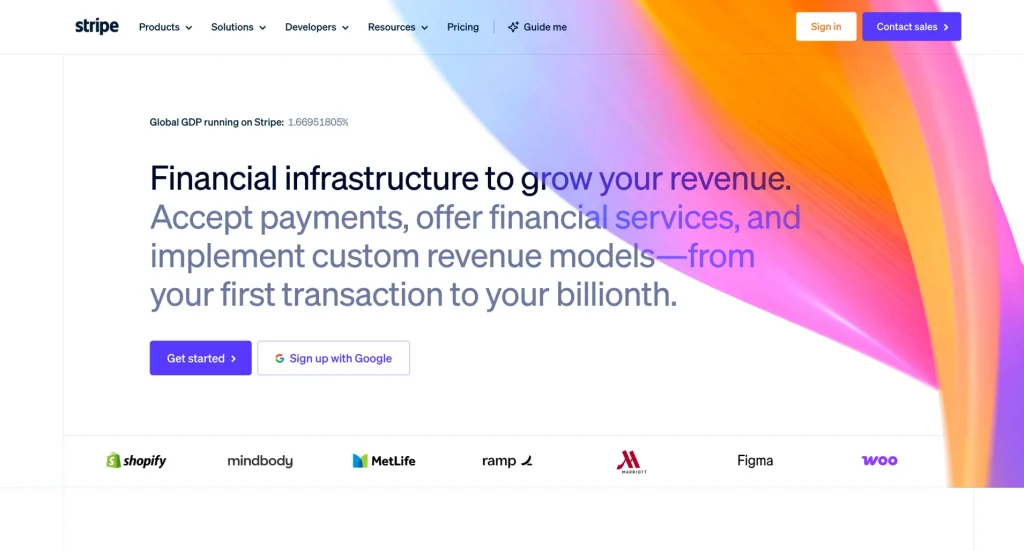
Stripe is the default recommendation for most WordPress stores, and has been for several years. It combines on-site checkout, the deepest feature set, and the strongest fraud prevention of any mainstream gateway.
Why it wins: Stripe’s checkout (Payment Element) is modern and fully on-site — customers never leave your store. Stripe Link lets returning shoppers check out in one click using details they saved on any Stripe-powered site. Its fraud engine, Radar, uses machine learning trained across Stripe’s entire network, and early fraud warnings help you refund before a chargeback hits.
Fees: 2.9% + $0.30 per transaction in the US, with no monthly or setup fees. Domestic rates are notably lower in many regions — 1.5% + £0.20 in the UK and 1.5% + €0.25 across most of the EU, because regulators cap interchange there. International cards add 1.5%, currency conversion adds ~1%, and disputes cost $15 each (refunded if you win). On large international volume you can negotiate custom rates.
Countries & currencies: Available in 40+ countries, supports 135+ currencies.
Payment methods: Cards, Apple Pay, Google Pay, Cash App Pay (US), ACH, SEPA, iDEAL, BNPL, and more.
Security: PCI DSS Level 1, 3D Secure, tokenization, Radar fraud detection.
Best for: Digital product sellers, subscription businesses, and any store wanting a premium on-site checkout. Connect it free via FluentCart (full stores), Paymattic (payments/donations), or Fluent Forms (simple forms) — there’s no gateway license fee, you only pay Stripe’s transaction rate. It also works with WooCommerce and Easy Digital Downloads.
Watch out for: Fee stacking on cross-border sales. If 40%+ of your revenue is international, model your blended rate carefully — it can climb toward 5%+.
2. PayPal — Best for buyer trust and global reach

PayPal’s strength isn’t price; it’s recognition. With 430+ million active accounts, adding a PayPal button can lift checkout completion simply because customers don’t need to dig out their card. For B2C stores where conversion beats fee optimization, that lift often pays for the higher rate.
Why choose it: Available in 200+ countries — the broadest reach on this list. Strong buyer and seller protection reduces disputes. PayPal Pay Later raises average order value. PayPal Commerce (the premium integration) runs on-site rather than redirecting, unlike the old PayPal Standard.
Fees: Standard US card transactions are now 3.49% + $0.49 — notably higher than the 2.9% + $0.30 PayPal charged in earlier years, and a meaningful gap versus Stripe. International transactions add a ~1.5% cross-border fee, and currency conversion runs 3–4% above the base rate (steeper than Stripe’s ~1%).
Countries & currencies: 200+ countries, 25+ currencies.
Security: PCI DSS Level 1, advanced fraud detection, Seller Protection.
Best for: Stores selling internationally to consumers who already trust and use PayPal. Most plugins (WooCommerce, EDD) include a free PayPal integration, so it’s easy to offer as a secondary option alongside Stripe.
Watch out for: The higher fees and currency-conversion margins. Also, PayPal blocks exporting stored card data if you ever migrate gateways — customers would have to re-enter details, which can cause real churn.
3. Square — Best for selling online and in person

If you run a physical location as well as a WordPress store, Square gives you the cleanest bridge between the two. One system tracks inventory, sales, and customers across your website and your point-of-sale terminal.
Why choose it: Unified online and offline sales, automatic inventory sync, fast deposits (often next business day), no monthly fees on the pay-as-you-go plan, and built-in basic CRM and email marketing.
Fees: 2.6% + $0.10 for in-person/contactless, 2.9% + $0.30 for online transactions. No monthly or setup fees on the standard plan.
Countries & currencies: Available in a smaller set of countries (US, UK, Australia, Canada, Japan, and a few others), processing in 8+ currencies — the most geographically limited option here.
Security: PCI DSS compliant, EMV chip support, fraud detection, dispute support.
Best for: Retailers, cafés, and service businesses expanding from a storefront to WordPress. Integrates with WooCommerce, EDD, and WPForms.
Watch out for: Limited country availability. If your customers are outside Square’s supported regions, it’s a non-starter.
4. Authorize.Net — Best for established businesses
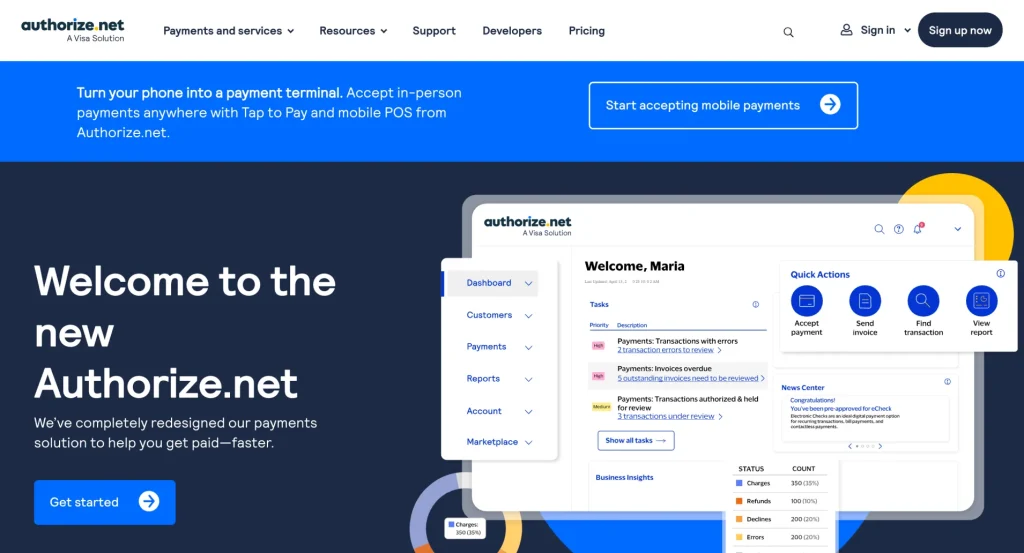
Authorize.Net is one of the oldest gateways (25+ years) and remains a dependable choice for businesses that value stability and already have a merchant account.
Why choose it: Mature fraud tools (Advanced Fraud Detection Suite), strong recurring billing via Automated Recurring Billing (ARB), secure card tokenization through Customer Information Manager, and a virtual terminal for phone orders.
Fees: All-in-one plan runs around $25/month plus 2.9% + $0.30 per transaction, with possible setup fees. If you bring your own merchant account, you pay the ~$25/month gateway fee plus your merchant account’s rates.
Countries & currencies: 35+ countries, 12+ currencies.
Security: PCI DSS compliant, AVS and CVV verification, customizable risk controls.
Best for: Established and B2B businesses with steady volume, subscription/membership sites, and merchants who already hold a merchant account.
Watch out for: The monthly fee makes it pricier than Stripe or Square for low-volume stores. It earns its keep at higher transaction volumes.
5. Braintree — Best for developers and marketplaces
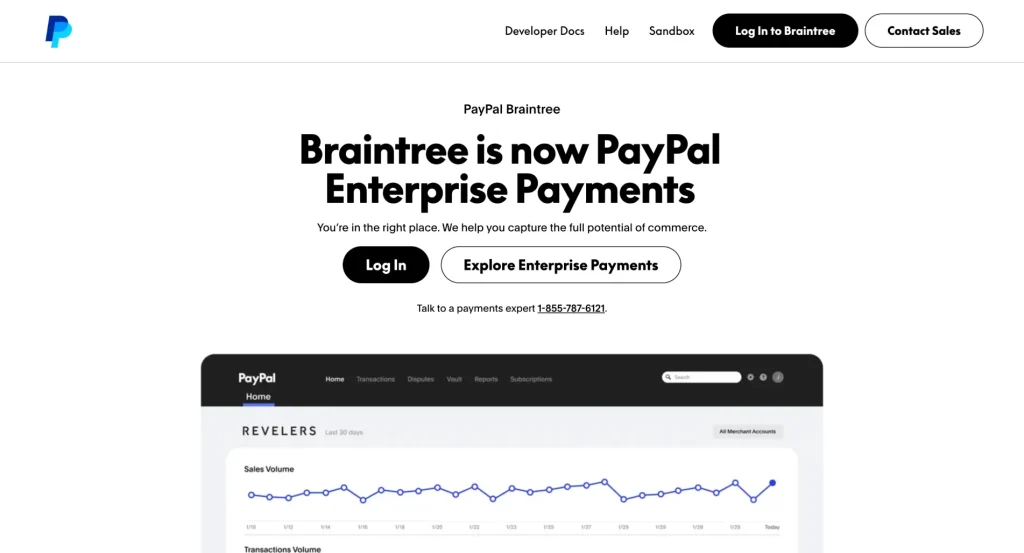
Owned by PayPal, Braintree is the developer-focused option, with one API that accepts cards, PayPal, and Venmo. It’s a common pick for marketplaces and platforms that need to split payments.
Why choose it: 130+ currencies, developer-friendly APIs and drop-in UI, native Venmo and PayPal acceptance, advanced fraud protection, and split-payment support for marketplaces.
Fees: 2.9% + $0.30 for standard US cards. Note that PayPal transactions through Braintree cost 3.49% + $0.49 and Venmo 3.5% + $0.49 — higher than plain card payments. International cards add ~2%, currency conversion ~1%, chargebacks $15. No monthly fees on standard accounts; custom pricing above ~$100K/month.
Countries & currencies: 45+ countries, 130+ currencies.
Security: PCI DSS Level 1, tokenization, 3D Secure, machine-learning fraud tools.
Best for: Developers wanting API control, marketplaces splitting payouts, and stores wanting PayPal/Venmo without redirects.
Watch out for: No ACH for US merchants, and the fee structure gets complicated once you mix card, PayPal, and Venmo volume.
6. Mollie — Best for European sellers

If most of your customers are in Europe, Mollie is worth a serious look. It’s built around European payment habits and supports the local methods that actually convert there.
Why choose it: Strong support for iDEAL (Netherlands), Bancontact (Belgium), SEPA, SOFORT, and other regional methods, plus a clean dashboard and transparent per-method pricing. Setup is fast and the WooCommerce integration is well maintained.
Fees: Per-method rather than flat — starting around 1.8% + €0.25 for European cards, with iDEAL and similar local methods often cheaper. No monthly fees.
Best for: EU-based stores, or any store with a heavily European customer base, especially those selling into the Netherlands, Belgium, and Germany.
Watch out for: Limited reach outside Europe — it’s not the choice for a primarily US or Asian customer base.
7. Razorpay — Best for Indian businesses

For stores based in India serving Indian customers, Razorpay is purpose-built for the market and handles local methods that Stripe and PayPal don’t cover as cleanly.
Why choose it: Native UPI, netbanking, wallets, and EMI support, plus competitive domestic pricing and a strong WooCommerce plugin. It understands Indian compliance and settlement out of the box.
Fees: Around 2% for domestic transactions, with international cards priced higher.
Best for: Indian merchants selling primarily to Indian customers via UPI and local rails.
Watch out for: It’s a regional specialist — for global or non-India audiences, pair it with or replace it with Stripe.
Frequently asked questions
What is the best payment gateway for WordPress?
For most WordPress stores, Stripe is the best overall payment gateway in 2026. It offers on-site checkout, 135+ currency support across 40+ countries, the strongest fraud tools, and excellent recurring billing — all with no monthly fee (2.9% + $0.30 per US transaction). PayPal is the best complement for buyer trust, and Square is best if you also sell in a physical location.
What is the cheapest WordPress payment gateway?
On headline US rates, Square (2.6% + $0.10 in person) and Stripe (2.9% + $0.30) are the most competitive, and both have no monthly fee. In the UK and EU, Stripe is cheaper still at roughly 1.5% + local fixed fee because interchange is capped there. But the cheapest gateway for you depends on your customer mix — international cards and currency conversion add cost on every provider, so model your real blended rate rather than comparing headline numbers.
Can I use more than one payment gateway on WordPress?
Yes. You can enable several gateways at once and let customers pick their preferred method at checkout, which usually lifts conversion. A common, effective setup is Stripe (for cards and wallets) plus PayPal (for shoppers who trust the PayPal name). Keep it to roughly 3–5 options so checkout doesn’t feel cluttered. In most plugins you set a default gateway and let the customer choose the rest.
Do I need an SSL certificate to accept payments on WordPress?
Yes — SSL (HTTPS) is mandatory. It encrypts payment data in transit and is required for PCI DSS compliance; gateways automatically reject non-HTTPS checkouts. Most hosts include free SSL via Let’s Encrypt, and a plugin like Really Simple SSL enforces HTTPS site-wide.
Is Stripe or PayPal better for WordPress?
For lower fees, on-site checkout, and subscriptions, Stripe is generally better — its US rate (2.9% + $0.30) undercuts PayPal’s current 3.49% + $0.49, and its currency conversion (~1%) is far cheaper than PayPal’s 3–4%. PayPal wins on customer trust and country reach (200+ countries). Many stores run both: Stripe as the primary card processor, PayPal as a trusted secondary option.
Which payment gateway is best for subscriptions on WordPress?
Stripe has the most flexible, integrated subscription tooling (Stripe Billing) and lets you migrate stored card data if you switch providers. Authorize.Net is also strong for recurring billing via its ARB feature, especially for established businesses. Avoid relying solely on PayPal for subscriptions — its recurring features are more fragmented and it blocks card-data export on migration.
Do these gateways work with WooCommerce, FluentCart, and other plugins?
Yes. Stripe, PayPal, Square, Authorize.Net, and Braintree all integrate with the major WordPress plugins. Your plugin choice should follow what you sell: FluentCart for a full eCommerce store (it supports a wide range of gateways natively), Paymattic for payments and donation sites (almost every top gateway integrated), and Fluent Forms for simple payment or order forms. Stripe connects free across all three — you only pay the standard transaction rate. Stripe, PayPal, and the others also work with WooCommerce and Easy Digital Downloads. Always confirm the integration is actively maintained for your specific plugin before committing.
Final recommendation
Start with Stripe as your primary gateway — it’s the best all-round fit for the vast majority of WordPress stores on price, features, security, and checkout quality. Add PayPal as a secondary option to capture shoppers who trust that brand. If you sell in person too, build around Square; if you’re an established business with an existing merchant account, Authorize.Net earns its monthly fee; and if your audience is concentrated in Europe or India, Mollie or Razorpay will out-convert the global players in their home turf.
Whatever you choose, calculate your real effective rate using your actual mix of domestic vs. international cards and currencies — that number, not the headline percentage, is what decides your margin.
And remember the gateway is only half the setup: pair it with the right plugin. FluentCart for a full store, Paymattic for payments and donations, Fluent Forms for simple payment forms — and since Stripe connects free across all three, the fastest, lowest-cost way to start accepting payments on WordPress is Stripe plus the plugin that matches what you sell.

WordPress, automation, eCommerce and growth marketing specialist, a WordPress Core Contributor and Media Corps member blending storytelling with technology to craft strategies in SEO, email marketing, and beyond.
-

10 Best jQuery Table Plugins for Best Data Visualization in 2026
Discover the 10 best jQuery table plugins for 2026. Compare -

FluentSMTP Review: Whats Inside this 700K+ WordPress SMTP Plugin?
Check our FluentSMTP review blog to Discover whats inside this -

Taking a Closer Look at Common WordPress Errors and How to Fix Them
A troubleshooting guide to the common WordPress errors, why they


Comments
-
[…] Show/hide payment gates to customers at the checkout page. […]
-
[…] just isn’t enough features and functions that WordPress offers. For any function you need, from payment gateways to UX there’s a WordPress plug-in. That’s something that doesn’t happen with […]

Leave a Reply
You must be logged in to post a comment.