

10 Best TablePress Alternatives in 2026 (For Every Use Case)
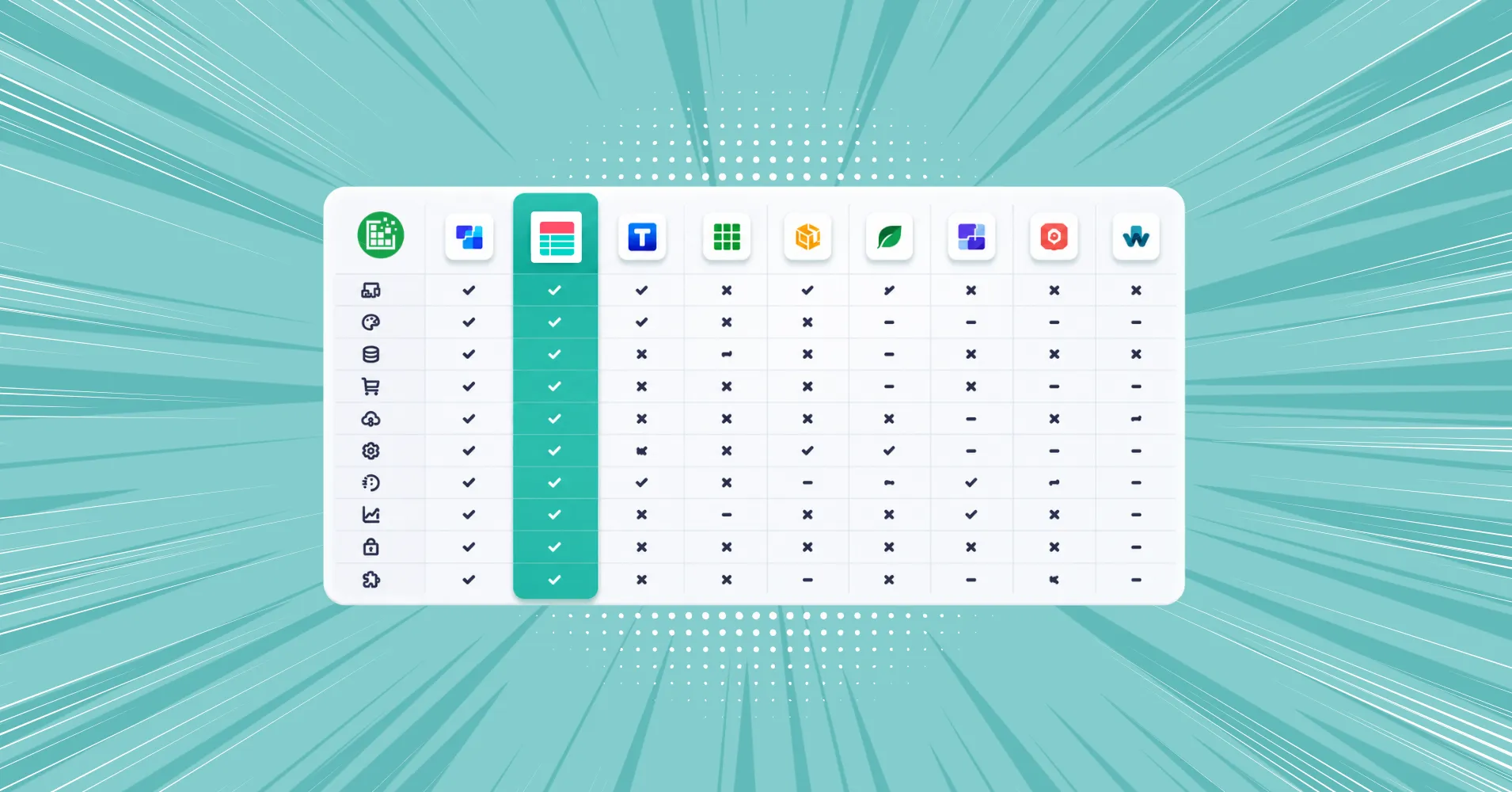
TablePress does exactly what it promises: creates tables. No steep learning curve, a clean spreadsheet-style editor, and a free version that genuinely works for basic static tables. That is why it has a big fanbase.
The free version is genuinely capable of static, simple tables. But the moment a site needs responsive behavior out of the box, dynamic data connections, WooCommerce product displays, conditional formatting, or a table that performs at thousands of rows, TablePress requires either its premium Max plan or a workaround. At that point, it is worth looking at what else the market offers.
The ten TablePress alternatives on this list cover every direction those gaps point. Each one is evaluated realistically, with real pricing, real limitations, and the specific use case it genuinely handles well.
Key Takeaways
- Ninja Tables is the most complete all-around alternative: free version, drag-and-drop builder, WooCommerce and Google Sheets integration, 50+ templates, and a big data rendering engine added in 2026
- wpDataTables leads for database-driven tables with built-in charts and compatibility
- WP Table Builder and League Table are best for visual presentation and ranking-style tables
- Posts Table Pro is the only plugin built specifically for displaying WordPress posts and custom post types as tables
- Tableberg is the Gutenberg-native choice for block-based workflows
- WP Data Access brings direct database management with a visual query builder for technical users
What TablePress Includes And Where It Stops
TablePress’ free version handles the basics well: unlimited tables, sorting, searching, pagination, and import from CSV, Excel, HTML, and JSON. Tables embed via block, widget, or shortcode with no row or size limits. For genuinely simple, static tables, it is a free supporting tool for you.
The problems start when the requirements grow beyond that baseline into a more dynamic and advanced genre.
Responsive tables cost money in TablePress. Mobile responsiveness requires the Pro plan at $89/year. On the free version, tables do not reflow or adapt to smaller screens without custom CSS. In 2026, when the majority of web traffic is mobile, shipping a non-responsive table as the default free behavior is a real limitation.
Visual styling also requires Pro. The visual style customizer, which lets you change table colors and appearance without writing CSS, is a Pro feature. Free users work with the default styling or write their own CSS.
Server-side processing for large datasets is Max only, at $189/year. Advanced Loading and automated periodic import from external sources are also Max-only features.
No plan includes live WooCommerce integration or drag-and-drop column type building. These capabilities do not exist in TablePress at any price point.
The contrast with Ninja Tables is direct. Responsive tables, visual styling controls, 50+ pre-built templates, and 100+ table styles are all available in Ninja Tables for free. What TablePress charges $89/year for, Ninja Tables includes before you pay anything. That is the practical reason most people looking for a TablePress alternative land on Ninja Tables first.
The 10 Best TablePress Alternatives
1. Ninja Tables
Ninja Tables is the most feature-complete TablePress alternative currently available. It takes a fundamentally different approach to table building than TablePress. Where TablePress works like a spreadsheet, Ninja Tables functions as a visual table builder capable of handling dynamic data sources, advanced functionality, and large datasets. Its structured column system makes complex tables easier to build and manage, while keeping the entire workflow accessible to users without coding experience.
The free version alone covers a wide range of what most sites need: responsive tables that work on mobile without custom CSS, 100+ pre-built styles, 50+ table templates for common layouts, search and filtering, sorting and pagination, and CSV import.
Direct comparison with TablePress
| Features | TablePress | TablePress (Pro/ Max) |  |
|---|---|---|---|
| Unlimited data | ✓ | ✓ | ✓ |
| Big data support | ✗ | ✓ | ✓ |
| Dynamic cell types (image, button, link, rating) | Text/HTML only | Text/HTML only | ✓ |
| Responsive on mobile | ✗ | ✓ | ✓ |
| WooCommerce product table | ✗ | ✗ | ✓ |
| Pre-built templates | ✗ | ✗ | ✓ |
| Google Sheets live sync | ✗ | ✓ | ✓ |
| Column filter dropdowns | ✗ | ✓ | ✓ |
| Visual styling (no CSS) | ✗ | ✗ | ✓ |
(Created with Ninja Tables)
The pattern across this table plugin is consistent: features that sit behind TablePress’s paid tiers are part of Ninja Tables’ free version. Features that no TablePress plan offers at all, like live chart data sync, WooCommerce product tables, and a dynamic visual cell-type builder, are standard in Ninja Tables.
What else it covers
Beyond the direct comparison, a few capabilities stand out for specific use cases:
- Conditional formatting: highlight rows or cells based on values, useful for inventory tables, pricing comparisons, or status tracking
- Fluent Forms integration: display form submission data as a searchable, filterable table without custom development
- Multiple table modes: a simple manual entry mode for quick tables, and a drag-and-drop mode for more customized and complex layouts
- Export and role management: Allow users to export table data in CSV/JSON format while controlling table access and management permissions through WordPress user roles.
- Free table templates: A growing library of ready-made table templates that can be imported in seconds using the included CSV or JSON files, then easily edit the content, styling, and layout to fit your branding.
- Ninja Charts integration: Create interactive charts and graphs from table data using multiple chart libraries.
For sites working with large datasets, Ninja Tables also added a DataTables-based rendering engine that moves sorting, filtering, and pagination to the server. With it enabled, the browser only loads the rows for the current page rather than the entire dataset, which keeps large tables responsive. This sits alongside the standard rendering engine as an option for tables where row count is the main concern.
What to consider
The DataTables rendering engine, advanced conditional formatting, and some integrations are Pro features. The free version covers responsive design, styling, templates, search, and filtering, which is already more than TablePress offers at any tier for those specific capabilities.
Best for: Teams that want one plugin covering everything from simple styled tables to WooCommerce product displays to large dataset management, without stacking multiple plugins to get there.
Pricing: Free on WordPress.org. Pro from $79/year (single site). See the free vs Pro breakdown for exact tier details.
2. wpDataTables
wpDataTables connects WordPress to external data rather than storing it inside the plugin. It supports MySQL databases, CSV, Excel, Google Sheets, JSON, and PHP arrays as data sources, and renders them as interactive tables alongside charts from multiple charting libraries, including Google Charts, Highcharts, and Chart.js.

What it handles well
- MySQL server-side processing: tables connected to a database query handle very large row counts with consistent performance
- Chart generation: build charts from the same data source as the table, using Google Charts, Highcharts, and Chart.js
- Conditional cell formatting: color-code individual cells based on value thresholds, useful for reporting dashboards
- Inline editing: edit table data directly from the front-end table without going into the WordPress admin
What to consider
Server-side processing applies to MySQL-connected tables only. CSV and Excel-sourced tables process client-side, which means the performance advantage does not apply to file-based data. The free Lite version supports simple manual tables and basic charts but does not include database-driven tables, dynamic data connections, or advanced filtering.
Best for: Organizations with direct MySQL database access, reporting dashboards combining tables and charts, and teams managing data from multiple live sources.
3. WP Table Builder
WP Table Builder uses a visual drag-and-drop editor where you place content into cells element by element: text blocks, images, buttons, star ratings, and custom HTML. Whatever you see in the editor is exactly what appears on the page.
What it handles well
- Visual cell-level control: place and style each cell element without touching a stylesheet
- Presentation tables: pricing pages, feature comparison grids, and product review tables look polished with minimal effort
- Cell merging: combine cells horizontally or vertically, useful for structured layouts
- CSV import and export: bring data in from spreadsheets and export the finished table
What to consider
No live data connections, no server-side processing, and limited filtering functionality. Built for tables where manual design control matters more than data management.
Best for: Pricing tables, feature comparison layouts, and product review tables where visual design is the priority.
4. Tableberg
Tableberg builds tables as native Gutenberg blocks rather than shortcode-embedded objects. Tables live inside the block editor exactly like any other block: draggable, nestable, and compatible with full-site editing workflows.

What it handles well
- Native Gutenberg integration: no shortcodes, no iframe embedding, tables behave as blocks
- Block editor compatibility: works naturally with Full Site Editing, page templates, and block themes
- Multiple column types: text, image, icon, button, and custom HTML cells
- Template library (Pro): ready-made table layouts for common use cases
What to consider
Newer plugin with a smaller install base than the alternatives above. The feature set is still maturing. Less suited for data-heavy or dynamic use cases.
Best for: Sites using the block editor as the primary workflow, developers building Gutenberg-native themes, and anyone who wants tables that integrate naturally with Full Site Editing.
5. WP Data Access
WP Data Access takes the database-first approach further than wpDataTables. It is built around a Table Builder and Form Builder that connect directly to WordPress’s own database or to remote databases, including MySQL, MariaDB, SQL Server, PostgreSQL, Oracle, and MS Access file-based connections.
What it handles well
- Direct database management: a Data Explorer lets you browse, edit, and query database tables from the WordPress dashboard without phpMyAdmin
- Remote database connections: connect to external SQL Server, PostgreSQL, Oracle, or MariaDB databases through a premium proxy, useful for organizations with data living outside WordPress entirely
- Visual SQL Query Builder: a premium feature that lets you build database queries graphically; the free version includes a standard SQL Query Builder
- Remote data file sync: sync with CSV, JSON, and XML files dynamically, including Google Sheets as a remote data source
- App Builder: a no-code rapid application development tool for building interactive data-driven front-end tables, forms, charts, and dashboards inside WordPress
What to consider
The interface assumes comfort with database concepts even with the visual query builder. It is closer to a lightweight database administration and app-building tool than a typical table styling plugin. The Visual Query Builder, remote database connections, and App Builder are premium features. A 14-day free trial covering all premium features is available directly from the WordPress dashboard.
Best for: Developers and technically confident site owners managing custom databases inside WordPress, agencies integrating data from external SQL databases, and teams who need both table display and data entry forms from the same dataset.
6. Posts Table Pro by Barn2
Posts Table Pro does something none of the other plugins on this list do: it auto-generates tables from existing WordPress content. Connect it to a post type, configure the columns, and it builds a searchable, filterable table from posts, pages, custom post types, custom fields, or media files without manual data entry.

The plugin recently shipped a new version, with a rebuilt engine, faster rendering for larger tables, multi-column sorting, multi-select filters, active filter display with result counts, and a modernized table design.
What it handles well
- Auto-generated tables: pulls directly from WordPress database; tables update automatically when content is added or changed
- Custom post type support: display WooCommerce products, events, team members, documents, or any CPT as a filterable table
- Media and document libraries: create searchable PDF libraries, audio collections, or video archives from WordPress media
- Taxonomy filtering: filter tables by category, tag, or any custom taxonomy
- Custom field columns: surface ACF fields, custom metadata, or any post meta as table columns
What to consider
The free Posts Table with Search & Sort plugin provides basic table functionality, while Posts Table Pro adds features such as AJAX loading for better performance. It is designed specifically for displaying existing WordPress content in a table format and excels at automatically generating tables from posts, pages, and custom post types. For manually managed tables or external data sources, it is more limited than some of the alternatives covered here.
Best for: Document libraries, staff directories, course catalogs, product archives, event listings, and any use case where the data already lives in WordPress as posts or custom post types.
7. Data Tables Generator by Supsystic
Data Tables Generator by Supsystic is actively maintained, with version 1.11.2 released in May 2026. Recent updates added AI-assisted table creation, collapsible row support, column search improvements, and PHP 8+ compatibility fixes. It has been in the WordPress table market for several years and remains in active development.
What it handles well
- Spreadsheet-style editor: cell-based data entry familiar to anyone who has used Excel or Google Sheets inside WordPress
- Google Sheets import: connect a sheet and pull data into the table on demand
- DataTables frontend: built-in sorting, filtering, and pagination using the DataTables library
- AI table creation: added in April 2026, allows generating table structures using AI prompts
- Chart output: basic chart visualization alongside table display
- WooCommerce integration: display product data in table format
What to consider
The interface has not seen the same level of visual refinement as some newer alternatives. Advanced feature depth on certain options is thinner compared to wpDataTables or Ninja Tables. Core functionality is reliable, and the plugin is supported.
Best for: Users already on Supsystic who have no specific reason to migrate, or teams who want a DataTables-based frontend with Google Sheets import and AI-assisted table creation at a low entry point.
8. League Table
League Table is a purpose-built table plugin with a narrower focus than most on this list: sortable, responsive tables built around an embedded spreadsheet editor. It has been sold on Envato Market since 2014 and is now also available as a free Lite version on WordPress.org.
What it handles well
- Embedded spreadsheet editor: built on Handsontable, so the editing experience feels like Excel or Google Sheets directly inside WordPress
- Copy-paste from spreadsheets: bring data in directly from Excel, Google Sheets, OpenOffice, or LibreOffice without a separate import step
- 105+ table customization options: covers typography, colors, cell-level styling, and layout controls in detail
- Multi-column sorting: sort by multiple criteria at once (Pro), useful for rankings, standings, and leaderboards
- Arithmetic formulas: sum, average, minimum, and maximum calculations directly in table cells
What to consider
Tables are capped at 10,000 rows and 40 columns (400,000 cells total) at both free and Pro tiers, a limit set deliberately for performance. No live data connections, no WooCommerce integration, and no dynamic syncing. The Lite version is functional, but the most useful features: multi-column sorting, CSV import and export, and table backups, are Pro-only. The Pro version is a one-time purchase on CodeCanyon (Envato Market), not an annual subscription.
Best for: Sports standings, rankings, leaderboards, and any table where the data is entered or pasted in periodically, and multi-column sorting matters. The spreadsheet-style editor makes it especially approachable for non-technical users moving data from existing spreadsheets.
9. Visualizer by ThemeIsle
Visualizer is primarily a chart plugin that happens to include table functionality. It is most useful when data needs to appear as both a visual chart and a structured table on the same page: for dashboards, reports, or analytics displays where the relationship between the two matters.

What it handles well
- Chart and table from the same source: a single dataset renders as a chart and a table side by side
- Multiple chart types: line, bar, pie, geo, area, scatter, and more from Google Charts and other libraries
- Google Sheets and CSV import: pull data from external sources and update the visualization automatically
- Frontend editing: allows designated users to edit table data from the front end
What to consider
The table functionality is secondary to the chart functionality. If charts are not part of the requirement, there are better-suited alternatives. The 90,000+ installs reflect the chart use case more than the table use case.
Best for: Dashboards and reporting pages where data needs to be presented as both a chart and a table, and where the chart is as important as the table itself.
10. FooTable
FooTable is a jQuery-based plugin that solves one specific problem: making HTML tables readable on small screens without horizontal scrolling. It hides lower-priority columns at defined breakpoints and lets users expand individual rows to reveal the hidden data inline. The WordPress plugin wraps this jQuery functionality for easy integration without writing code.
What it handles well
- Responsive row expansion: columns collapse at defined breakpoints; tapping a row reveals the hidden columns inline
- Custom breakpoints: define exactly which columns hide at which screen widths
- Basic sorting, filtering, and pagination: built into the plugin at no cost
- TablePress compatibility: attaches directly to TablePress-created tables for responsive behavior
- Lightweight: minimal footprint; adds responsive behavior to existing tables without a full rebuild
What to consider
FooTable is entirely free. There is no Pro WordPress plugin tier: the commercial licenses on fooplugins.com are per-developer licenses for teams embedding FooTable in commercial products, not a consumer upgrade. Feature development has slowed compared to newer alternatives. The plugin is a strong fit when the only requirement is responsive row-expansion behavior added to existing tables, and a poor fit for teams who need dynamic data, styling controls, or a full table-building interface.
Best for: Adding responsive behavior to existing HTML or TablePress tables without rebuilding them in a new plugin.
Comparison at a Glance
| Plugin | Free Version | Responsiveness | Dynamic data | Big data |
|---|---|---|---|---|
| Ninja Tables | ✓ | ✓ |
| ✓ (DB-Driven) |
| wpDataTables | ✓ | ✓ |
| ✓ (MySQL) |
| WP Table Builder | ✓ | ✓ | ✗ | ✗ |
| Tableberg | ✓ | ✓ |
| ✗ |
| WP Data Access | ✓ | ✓ |
| ✓ |
| Posts Table Pro | ✗ | ✓ |
| ✗ |
| Data Tables Generator | ✓ | ✓ |
| Limited |
| League Table | ✓ | ✓ | ✗ | ✗ (10K row cap) |
| Visualizer | ✓ | ✓ |
| ✗ |
| FooTable | ✓ | ✓ | ✗ | ✗ |
How to Pick The Right One
The choice comes down to what the table needs to do, where the data comes from, and how technical the team managing it is.
For most WordPress sites
that need an upgrade from TablePress, Ninja Tables covers the widest range of use cases at the most accessible price point. The free version handles responsive tables, styling, search, and basic filtering. Pro adds WooCommerce integration, Google Sheets sync, conditional formatting, and the DataTables rendering engine for high-volume data.
For database-driven data with charts
Ninja Tables combined with Ninja Charts and wpDataTables is the strongest fit. No other plugin in this list combines the existing table, or imported CSV files in the plugin MySQL server-side processing, with multi-library chart output in an easily accessible tool.
For sites where the data already lives in WordPress
As posts, pages, or custom post types, Posts Table Pro eliminates the data entry problem entirely. The table builds itself and updates automatically.
For sports standings, rankings, or leaderboards
League Table’s spreadsheet-style editor and multi-column sorting are built specifically for this. Also, Ninja Tables has multiple free templates with fully flexible customization and styling options for the sports genre to support this.
Soccer Player Performance Leaderboard
| Rank | Player | Club | Matches Played | Goals | Assists | Performance Ratings |
|---|---|---|---|---|---|---|
| 1 |  | 26 | 22 | 6 | 9.3 | |
| 2 |  | 25 | 20 | 7 | 9.1 | |
| 3 |  | 27 | 19 | 8 | 9.0 | |
| 4 | 
Mohamed Salah |  | 26 | 17 | 10 | 8.8 |
| 5 | 
Vinícius Jr. |  | 24 | 15 | 9 | 8.7 |
| 6 | 
Bukayo Saka |  | 26 | 14 | 11 | 8.6 |
| 7 | 
Lautaro Martínez |  | 25 | 16 | 5 | 8.5 |



For technical teams managing custom databases
WP Data Access offers direct database access with a visual query builder, going further than table display into actual data management.
For Gutenberg-native workflows
Tableberg creates tables as native blocks instead of relying on shortcodes, making it a natural fit for Full Site Editing. Ninja Tables also offers dedicated Gutenberg blocks, allowing users to create, edit, and manage tables directly within the block editor without leaving the page.
For large datasets containing thousands or even millions of rows
The key consideration is how the plugin processes and loads data. Both Ninja Tables and wpDataTables offer server-side processing capabilities that help maintain performance when working with thousands of rows. Ninja Tables combines this with DataTables-powered rendering and AJAX loading options, making it a practical choice for displaying large CSV imports, database records, and frequently updated datasets without overwhelming the browser.
For a deeper look at when a WordPress table plugin is the right tool versus when a different structure fits better, the big data tables in WordPress guide covers the architectural decisions clearly.
Wrapping Up
TablePress is not the wrong choice for simple, static tables. It earned its install base by doing that one thing reliably and for free over nearly two decades. The ten alternatives above exist because most WordPress sites eventually need more than that.
Ninja Tables covers the most ground at the most accessible entry point. Start with the free version, test it against your actual tables, and upgrade when the features you need are behind the Pro wall. Most plugins on this list offer a free version or free trial for the same reason. The best choice ultimately depends on your data, workflow, and growth plans. Evaluate the plugins against your real-world requirements, and you’ll quickly find which one fits your site the best.
FAQs
What is the closest free alternative to TablePress? Ninja Tables free version is the most direct comparison. It includes responsive behavior by default, a drag-and-drop column builder, search, filtering, CSV import, and shortcode embedding. The key difference from TablePress free is that Ninja Tables is responsive out of the box without requiring custom CSS.
Can I import my existing TablePress tables into a new plugin? TablePress exports tables as CSV files. Most alternatives, including Ninja Tables, wpDataTables, and Data Tables Generator, accept CSV import. The data transfers cleanly; custom styling and shortcode placements need to be reconfigured in the new plugin.
Which alternative handles the most rows without performance issues? Ninja Tables, with its DataTables-based rendering engine (Free feature) and wpDataTables for MySQL-connected sources, both use server-side processing that keeps load time flat regardless of total row count. The database handles queries; the browser receives only the current page of results.
Do any of these alternatives integrate with WooCommerce? Ninja Tables integrates directly with WooCommerce, building product tables from the store catalog with Add to Cart functionality included. Posts Table Pro can also display WooCommerce products as filterable tables. For a full setup guide, the Ninja Tables WooCommerce integration walkthrough covers the configuration.

Hi there! I’m a creative content writer at Ninja Tables, WPManageNinja. I love writing on diverse topics and when I’m not writing, you’ll find me chilling with a book.
-

FluentSMTP Review: Whats Inside this 700K+ WordPress SMTP Plugin?
Check our FluentSMTP review blog to Discover whats inside this -

7 Best Ecommerce Plugins for WordPress in 2026 (Tested And Compared)
Compare the 7 best ecommerce plugins for WordPress in 2026 -

Popular WordPress Affiliate Plugins: Manage Affiliates Inside Your Dashboard
Compare WordPress affiliate management plugins for tracking referrals, commissions, affiliates,



Leave a Reply
You must be logged in to post a comment.