

BFCM 2026 Preparation: The Complete Black Friday Cyber Monday Playbook
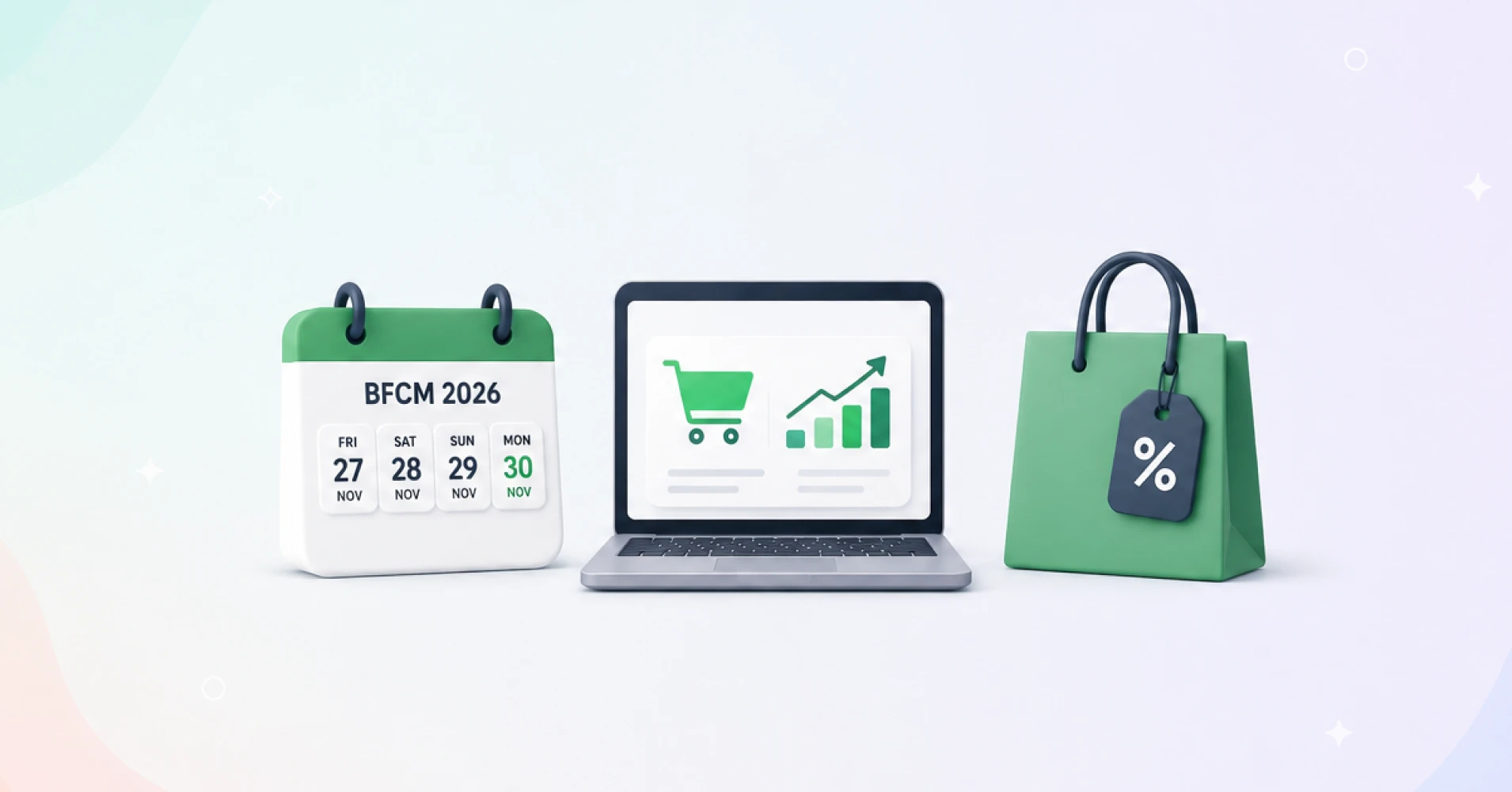
BFCM 2026 runs from Friday, November 27 (Black Friday) through Monday, November 30 (Cyber Monday), with the wider Cyber Week stretching November 27 to December 3.
If you sell anything online, this 4-day window is the single biggest revenue opportunity of your year and the brands that win it are the ones that start preparing in September, not the ones that scramble in November.
This is your complete BFCM 2026 preparation guide: what BFCM means, the dates that matter, an 8-week countdown checklist, the discount strategy that actually protected margins in 2025, and the AI-powered marketing ideas that are reshaping how shoppers find deals. Everything here is built to be skimmed, saved, and acted on.
Key takeaways
- BFCM 2026 dates: Black Friday is Friday, November 27, Cyber Monday is Monday, November 30, and Cyber Week runs November 27 – December 3, 2026.
- Start 8 weeks out. Brands that begin BFCM preparation in late September consistently outperform those who scramble in November.
- Discipline beats depth. In 2025, no major deal day averaged more than a 30% discount. Use a descending model — strongest offer to VIP early-access buyers first, then hold or step down.
- Mobile is the checkout channel. Over 57% of Cyber Monday 2025 sales happened on phones — a slow mobile experience is the fastest way to lose a BFCM sale.
- AI is now a discovery channel. AI-driven retail traffic surged 670% on Cyber Monday 2025; your deals need to be discoverable by ChatGPT, Perplexity, and Google AI Overviews, not just Google’s blue links.
- The sale doesn’t end at checkout. Your best retention window of the year opens the moment a BFCM order is placed — plan the post-sale flow before the rush.
Quick answer: What is BFCM and when is BFCM 2026?
BFCM stands for Black Friday Cyber Monday — the combined shopping period that begins the day after US Thanksgiving and runs through the following Monday. It is the busiest, highest-intent retail window of the year for both ecommerce and brick-and-mortar stores.
| Event | BFCM 2026 Date |
|---|---|
| Thanksgiving (US) | Thursday, November 26, 2026 |
| Black Friday | Friday, November 27, 2026 |
| Small Business Saturday | Saturday, November 28, 2026 |
| Cyber Monday | Monday, November 30, 2026 |
| Cyber Week | November 27 – December 3, 2026 |
| Recommended Prep Start | Early-to-late September 2026 |
What is BFCM?
BFCM is an acronym for Black Friday Cyber Monday, the four-day shopping event that kicks off the holiday season. Black Friday falls on the Friday after US Thanksgiving and is historically associated with in-store doorbusters.
Cyber Monday, created by the National Retail Federation in 2005, is the Monday after and is associated with online deals. Together they bookend the most concentrated burst of consumer spending on the calendar.
The “Black” in Black Friday refers to retailers moving from red ink (losses) to black ink (profit) — the day many businesses historically turned profitable for the year. The term first stuck in 1960s Philadelphia before being reframed as a positive shopping event in the 1980s.
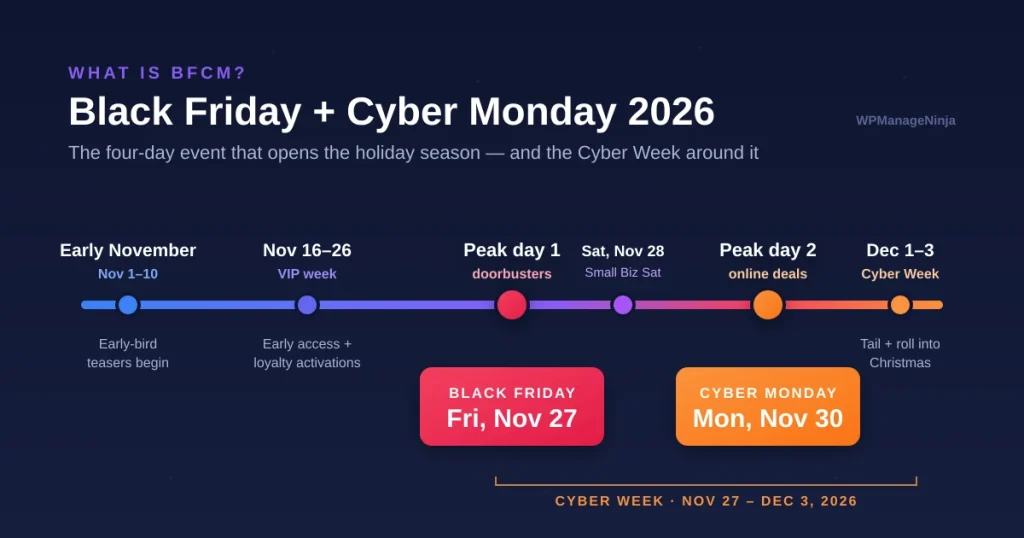
What matters in 2026 is that BFCM is no longer a single weekend. It now behaves as a season: early-bird deals begin in early November, influenced revenue starts climbing roughly two weeks before Black Friday, and promotions extend through Cyber Week into December. The shopping events have widened, the start dates have moved earlier, and consumer behavior has shifted to match.
When is BFCM 2026?
Black Friday 2026 is Friday, November 27, and Cyber Monday 2026 is Monday, November 30. Cyber Week — the extended discount window most brands now run — covers November 27 through December 3, 2026.
These dates are fixed because Thanksgiving always falls on the fourth Thursday of November (November 26 in 2026), and Black Friday is always the day after. Treat these as anchors, not endpoints. The smartest BFCM 2026 strategy spreads your campaign across multiple weeks rather than betting everything on a single 24-hour window.
A realistic 2026 calendar looks like this:
- Early November (Nov 1–10): Early-bird and “Black November” teasers begin.
- November 11: Singles’ Day — a global pre-Black Friday milestone.
- November 16–26: VIP early access, member weeks, and loyalty activations. In 2025, influenced revenue began climbing around November 16 — nearly two weeks before Black Friday.
- November 27: Black Friday.
- November 28: Small Business Saturday.
- November 30: Cyber Monday.
- December 1–3: Cyber Week tail; transition into Christmas campaigns.
BFCM 2025 by the numbers (and what it means for 2026)
Understanding last year’s data helps you set realistic BFCM 2026 goals. Here are the verified highlights from the 2025 shopping events:
| 2025 BFCM Metric | Figure | Source |
|---|---|---|
| Shopify merchant BFCM weekend sales | $14.6 billion (+27% YoY) | Shopify |
| Customers who bought from Shopify brands | 81+ million worldwide | Shopify |
| Black Friday US online spend | $11.8 billion (+9.1% YoY) | Adobe Analytics |
| Cyber Monday US online spend | ~$14.2 billion | Adobe Analytics |
| Share of online sales via mobile (Cyber Monday) | 57.5% | Adobe Analytics |
| BNPL spend, Cyber Monday | ~$1.03 billion (7.2% of online sales) | Adobe Analytics |
| AI-driven retail traffic increase (Cyber Monday) | +670% YoY | Adobe Analytics |
| Average order value, Shopify BFCM weekend | ~$114 | Shopify |
The three takeaways that should shape your BFCM 2026 preparation:
First, mobile is now the checkout channel, not just the discovery channel. With more than half of Cyber Monday sales happening on phones, a slow or clumsy mobile experience is the fastest way to lose a sale during the BFCM rush.
Second, AI changed how shoppers find deals. AI-driven traffic to retail sites exploded in 2025. Shoppers are asking ChatGPT, Perplexity, and Google AI Overviews “what are the best Black Friday deals on X” — which means your store and your content now need to be discoverable by answer engines, not just Google’s blue links.
Third, discount discipline won. No major deal day topped a 30% average discount in 2025. Brands that led with VIP early access and smart, product-level pricing outperformed those that slashed blanket discounts. Deeper is not better.
Your BFCM 2026 goals
Before tactics, set targets. BFCM is not only about discounts and a shopping frenzy — every store should walk in with a clear purpose. Write down four numbers and measure against them after Cyber Monday:
- Revenue target — your headline number for the BFCM 2026 weekend.
- AOV target — average order value you want to protect or grow (bundles and free-shipping thresholds move this).
- New customer acquisition target — BFCM is the rare window where acquisition cost drops, so a chunk of your goal should be net-new buyers.
- Margin floor — the discount depth you will not cross, so volume never quietly turns into a loss.
Beyond the numbers, most BFCM campaigns chase four classic goals: acquiring new customers, clearing slow-moving stock, boosting profit, and driving a traffic-and-visibility uptick that carries into Christmas. Decide which one leads for you — that single decision shapes every promotion you build.
The 8-week BFCM 2026 preparation checklist
The data is consistent: brands that begin BFCM preparation 8 weeks out — in late September 2026 — outperform those who start in November, every single time. Here is the week-by-week countdown checklist.
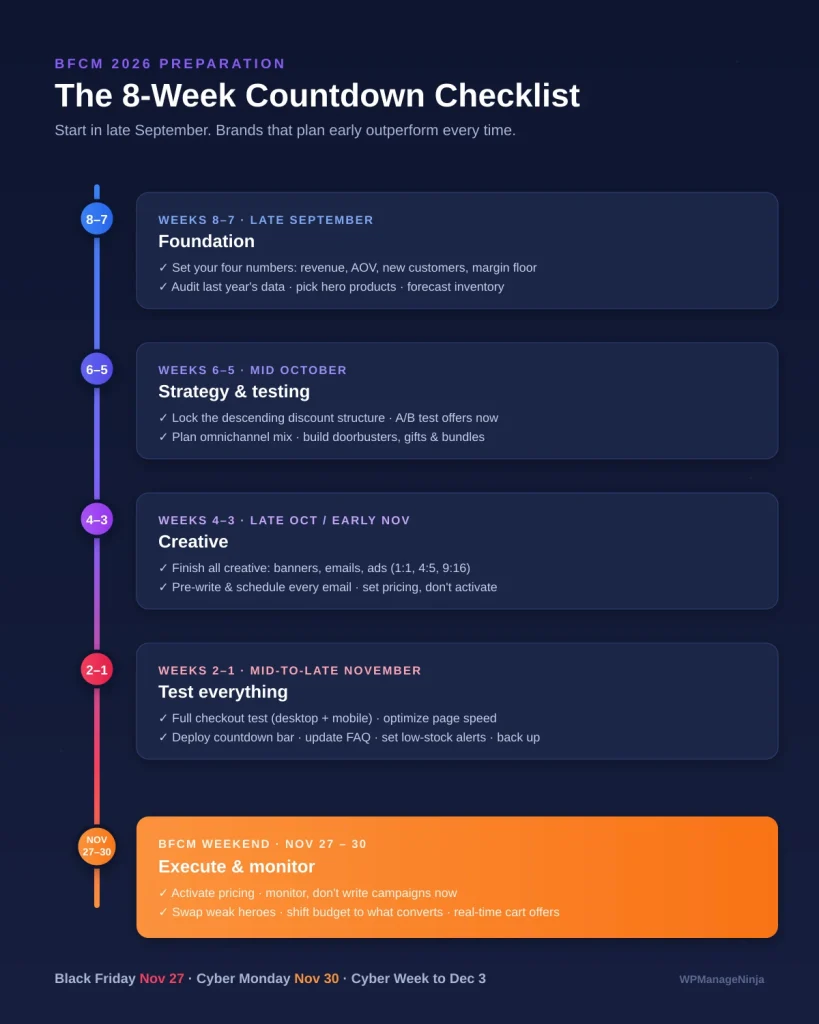
Weeks 8–7 (Late September): Foundation
- Set your four numbers (revenue, AOV, new customers, margin floor).
- Audit last year’s BFCM data: best-selling products, top channels, the discount depth that actually converted, and what broke.
- Choose your hero products and protect high-margin items from deep cuts.
- Forecast inventory. Underestimating means lost revenue; overestimating means dead stock and storage costs.
Weeks 6–5 (Mid October): Strategy and Testing
- Lock your discount structure (see the descending model below).
- A/B test offers, hooks, and subject lines now — not during peak season.
- Plan your omnichannel mix: email, SMS, WhatsApp, push, social, ads.
- Build product sets: doorbusters, giftable items, high-margin bundles.
Weeks 4–3 (Late October / Early November): Creative
- Finish all creative before launch — hero images, homepage and collection banners, email headers, social graphics, ad creative in 1:1, 4:5, and 9:16.
- Pre-write and pre-schedule every email: VIP early-access, Black Friday launch, mid-campaign social proof, Cyber Monday urgency.
- Configure all sale pricing now, but do not activate it — set it to flip on with one click.
Weeks 2–1 (Mid-to-Late November): Test Everything
- Run a full end-to-end test of checkout on desktop and mobile.
- Optimize page speed and site traffic capacity for a surge — slow pages lose impatient thumbs.
- Deploy your announcement bar with a countdown timer and free-shipping progress bar.
- Update your FAQ page with BFCM-specific questions (shipping deadlines, sale-item returns, discount-code help). BFCM generates 3–5× normal support volume.
- Set low-stock alerts and prepare “only X left” scarcity messaging plus “sold out” alternatives.
- Back up everything — site code, product images, configurations.
BFCM Weekend (Nov 27–30): Execute and Monitor
- Activate pricing. Monitor results — do not write campaigns now.
- Swap underperforming hero products for backups.
- Shift budget toward whichever channel is converting (ad costs spike 2–3× this weekend, so spend where it works).
- Send abandoned-cart and walk-away offers in real time.
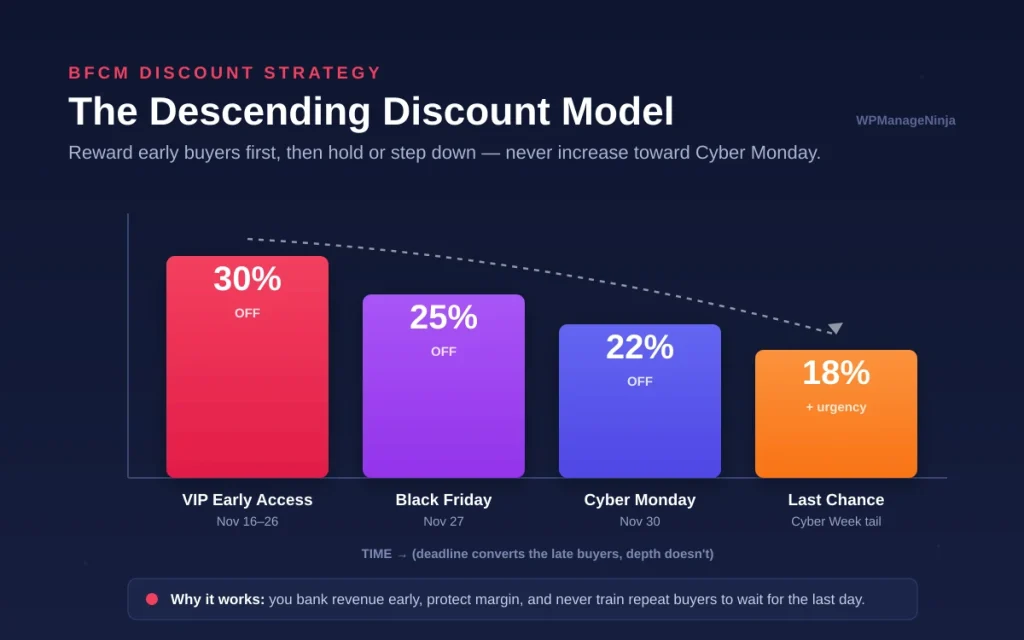
The winning 2026 discount model rewards early buyers and uses the deadline to convert late ones, never the reverse. Start with your strongest discount for VIP early access, then hold or step down as BFCM progresses. If you start at 15% and jump to 25% on Cyber Monday, you teach every repeat customer to wait until the last day next year.
Common structures that protect margin while still converting:
- Sitewide percentage (e.g., 25% off) — simplest to communicate, high conversion.
- Tiered by cart value (e.g., 20% off $75+, 30% off $150+) — drives AOV up.
- VIP early access — your best offer goes to your list first. This is wallet capture, not a gimmick: you bank revenue before the noise of Black Friday.
- Bundle deals — group a bestseller with complementary products at a special bundle price to lift AOV.
- Trigger / walk-away offers — when a shopper is about to leave, serve a personalized, time-limited deal (“Your 18% off expires in 22 minutes”) that answers the only question that matters during BFCM: why buy right now instead of checking three more stores?
Segment your discounts by customer type, too. New visitors, one-time buyers, repeat buyers, cart-abandoners, and referrers should not all see the same offer. Your repeat buyers and referrers are your most loyal, reward them best.
Marketing ideas for BFCM 2026
Marketing is not optional, even for big brands — and in a saturated BFCM market, your promotion is what separates a record weekend from a quiet one. Here are the marketing ideas driving results for BFCM 2026:
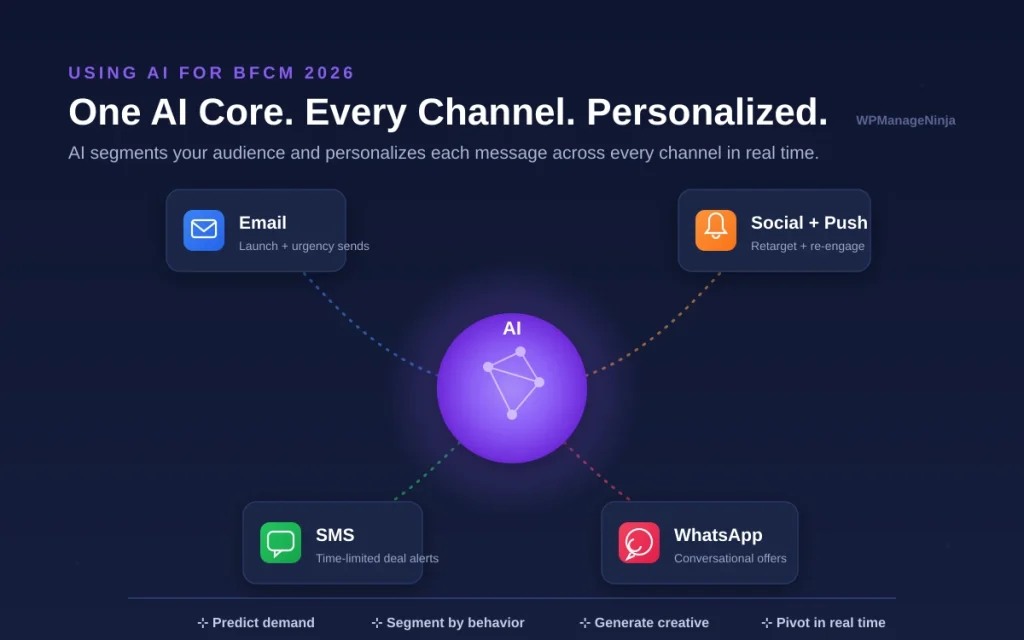
Omnichannel messaging. Stop juggling tools. Run email, SMS, WhatsApp, and push from one cohesive system so every message reaches shoppers on their preferred channel. Email remains the BFCM workhorse — Black Friday is historically the single highest-volume email day of the year — but SMS and WhatsApp now drive meaningful incremental revenue during peak.
Early email warm-up. Start your BFCM email campaign at least a week before Black Friday to build anticipation. Pre-schedule the full sequence so the weekend is for monitoring, not writing.
Countdown urgency. Announcement bars, countdown timers, and “only X left” scarcity indicators keep urgency visible throughout every browsing session without being intrusive.
Social commerce and influencers. Social-driven Cyber Monday revenue jumped over 56% year-over-year in 2025, with live shopping and TikTok Shop posting outsized growth. Curate influencer and affiliate partnerships well before peak — content creators now guide a large share of deal discovery.
Retargeting and re-engagement. Many shoppers add to cart and leave. Serve final-offer messages to cart-abandoners and re-engage browsers who didn’t convert — this is some of the cheapest, highest-ROI revenue of the weekend.
Personalization. Divide your audience by past behavior and personalize content accordingly. A shopper who opened but didn’t buy should get a different, stronger message than one who already purchased.
Free-shipping thresholds. Lower your free-shipping threshold for BFCM and show a progress bar (“Add $12.50 more for FREE shipping”). It’s one of the most reliable AOV boosters during a sale.
Sustainability signals. A large majority of global shoppers now weigh sustainability when buying online. If you have eco-friendly packaging or shipping, say so on product pages — make it a feature, not a footnote.
Using AI for your BFCM campaigns
AI moved from a nice-to-have to a core BFCM channel in 2025, and 2026 will lean on it harder. Two shifts matter for marketers:
1. AI as a campaign accelerator. AI-driven tools now predict customer behavior, recommend timely promotions, dynamically segment audiences, and generate campaign creative — keeping your marketing agile through the BFCM rush with far less manual effort. Use AI to draft and personalize messages, build targeted segments from past behavior, forecast demand, and analyze performance in real time so you can pivot budget mid-campaign.
2. AI as a discovery channel. Shoppers increasingly ask AI assistants — ChatGPT, Perplexity, Google AI Overviews, and shopping agents like Amazon’s Rufus — to find the best deals. AI-powered shopping traffic surged in 2025. To capture that demand, your content and product pages need to be structured so answer engines can extract and cite them. Clear question-based headings, direct answers, data tables, FAQ schema, and fresh content (updated within the last six months) are what get a brand pulled into an AI-generated answer instead of skipped.
The brands that treat BFCM as a data goldmine — capturing customer identity, learning from every click and cart, and feeding that back into AI-driven personalization — turn one weekend into a year of smarter marketing.
How to prepare your WordPress store for BFCM
If you run an ecommerce store on WordPress, a few structural choices make a measurable difference during the BFCM rush. Here is how to prepare your store and the WPManageNinja toolkit for each job.
Start your BFCM campaign early and capture leads
A VIP early-access list is your single most valuable BFCM asset, and the data shows influenced revenue starts climbing nearly two weeks before Black Friday. Launch your sign-up campaign in early November and capture demand with high-converting forms built in Fluent Forms — early-bird waitlists, “notify me” opt-ins, and quiz or survey forms that segment shoppers as they sign up.
Run email marketing to old and new prospects
Use FluentCRM to run the segmented email sequences the descending-discount model depends on — VIP early access, Black Friday launch, mid-campaign social proof, Cyber Monday urgency, and post-sale follow-up. Re-engage past customers and nurture new prospects from the same dashboard, with automations that fire on real behavior.
Build a community for your BFCM buyers
Shoppers who want every deal update are your warmest audience. Spin up a private space with FluentCommunity where interested buyers get early-access announcements, exclusive drops, and updates in one place — turning a one-weekend transaction into an ongoing, owned channel you don’t rent from social platforms.
Showcase your social proof
Trust converts during a crowded BFCM, when shoppers are comparing three stores at once. If you haven’t already, pull your reviews and testimonials from Google, Facebook, Instagram, TikTok, and more onto your site with WP Social Ninja, and display fresh social feeds and trust badges on your deal and product pages.
Display products in a fast, filterable table
During peak traffic, panicked shoppers miss products that are right in front of them. A searchable, filterable product table keeps everything organized and lets customers instantly see what’s on sale and what’s in stock. Ninja Tables lets you build customizable WordPress product tables — with images, prices, stock status, and add-to-cart buttons — without code.
Build a dedicated BFCM deal page
A single, permanent deal page is a proven best practice: it’s the URL you point every email, ad, and social post to, and it’s what answer engines and Google index for “your brand Black Friday deals.” Lay out every offer with Ninja Tables for the product grid and a clear pricing table for tiered or bundled discounts that routes straight to checkout and reduces hesitation.
Take payments and manage orders smoothly
Make sure your checkout and any donation, booking, or order forms can handle the surge. Paymattic handles payments and subscriptions, and if you sell digital products or your own plugins/themes, FluentCart keeps carts, discounts, and order management running cleanly through peak.
Handle the support spike
BFCM generates 3–5x normal support volume. Set up FluentSupport with BFCM-specific saved replies (shipping deadlines, sale-item returns, discount-code help) so your team and any chatbot answers fast when it matters most.
Keep the site fast and stable
Optimize page speed, audit and remove apps you won’t need during BFCM, and confirm your countdown bar, free-shipping bar, popups, and email integrations are all wired correctly before the surge. Make sure your transactional emails actually land by routing them through FluentSMTP, an undelivered order confirmation during BFCM is a support ticket and a lost-trust moment.
Start collaborations with same-niche brands
Partner with complementary, non-competing brands in your niche for cross-promotions, bundle deals, or shared giveaways. Each partner exposes you to a warm, pre-qualified audience at zero ad cost — and co-marketed deals stand out in a saturated BFCM market. Manage any affiliate or partner payouts with FluentAffiliate.
Build authority before the rush
The brands that get found by Google and by AI answer engines are the ones that are published early. Start blogging your BFCM guides, gift lists, and buying advice now, post consistently on social media, and earn third-party mentions in roundups and communities. This is what gets your deals cited in AI search and ranked in the organic top 10 before Black Friday, not during it.
Post-sale: turning BFCM buyers into repeat customers
The sale doesn’t end at checkout — that’s where the real relationship begins. The 48 hours after Cyber Monday are your most important analytical window, and the weeks after are your best retention opportunity of the year.
- Communicate fast and clearly: confirmation emails, real-time tracking, proactive delay updates.
- Add small moments of delight: a thank-you message, an exclusive follow-up offer, a loyalty invitation in the package.
- Make returns easy: a flexible, simple returns process builds confidence and can even lift conversion before checkout. Customers remember how you handle problems more than how you handle promotions.
- Mine the data: every click, add-to-cart, and return reveals who your customers are. Feed it into your 2026 marketing strategy and your Christmas campaign, which you can build directly from BFCM learnings.
- Re-engage and segment: split buyers from browsers and tailor your December follow-up so first-time BFCM buyers become repeat customers.
BFCM 2026 FAQ
What does BFCM stand for?
BFCM stands for Black Friday Cyber Monday — the combined shopping period from the day after US Thanksgiving through the following Monday. It marks the start of the holiday shopping season.
When is BFCM 2026?
Black Friday 2026 is Friday, November 27, and Cyber Monday 2026 is Monday, November 30. Cyber Week runs November 27 to December 3, 2026.
When should I start preparing for BFCM 2026?
Start 8 weeks out, in late September 2026. Brands that begin planning in September consistently outperform those who scramble in November. If you’re short on time, a focused 4-week plan executed on schedule beats an 8-week plan crammed into two.
What discount should I offer for BFCM 2026?
Discipline beats depth. In 2025, no major deal day averaged more than a 30% discount. Use a descending model — your strongest offer goes to VIP early-access buyers first, then holds or steps down — rather than increasing discounts toward Cyber Monday.
Is Cyber Week worth it?
Yes. Many shoppers now spread purchases across the full window, and Cyber Monday has one of the highest conversion rates of the year as deals end. Extending pricing through Cyber Week (Nov 27–Dec 3) captures shoppers who research first and buy later.
How do I get my BFCM deals to show up in AI search?
Structure content for answer engines: lead with a direct answer, use question-based headings, include data tables, add FAQ and Article schema, and keep content updated within the last six months. AI-driven shopping traffic surged in 2025, so being citable by ChatGPT, Perplexity, and Google AI Overviews is now part of BFCM preparation.
What is the biggest BFCM mistake to avoid?
Two: starting too late, and discounting too deeply. The first leaves revenue on the table; the second trains customers to wait and erodes margin. Plan early, discount with discipline.
Wrapping up
BFCM 2026 lands on November 27–30, and the brands that win it will be the ones that started in September, protected their margins with a descending discount model, ran a cohesive omnichannel campaign, and made their deals discoverable by both Google and AI answer engines. Use the 8-week checklist above as your operational playbook, lock your four numbers, and prepare your store before the rush — not during it.
Once BFCM wraps, roll the same playbook straight into Christmas. The checklist barely changes.
What’s the one thing you’re changing about your BFCM preparation this year? Let us know.

WordPress, automation, eCommerce and growth marketing specialist, a WordPress Core Contributor and Media Corps member blending storytelling with technology to craft strategies in SEO, email marketing, and beyond.
-
10 Best jQuery Table Plugins for Best Data Visualization in 2026
Discover the 10 best jQuery table plugins for 2026. Compare -
Black Friday Marketing Strategies for 2026: Core and Advance Move
Black Friday is the most celebrated shopping season worldwide. Discover -
How Much Can You Earn With Amazon Affiliate Marketing? Rates & Niches
How much can you earn with Amazon affiliate marketing? Dive


Leave a Reply
You must be logged in to post a comment.