

How to Create a Mortgage Calculator in WordPress Using Fluent Forms
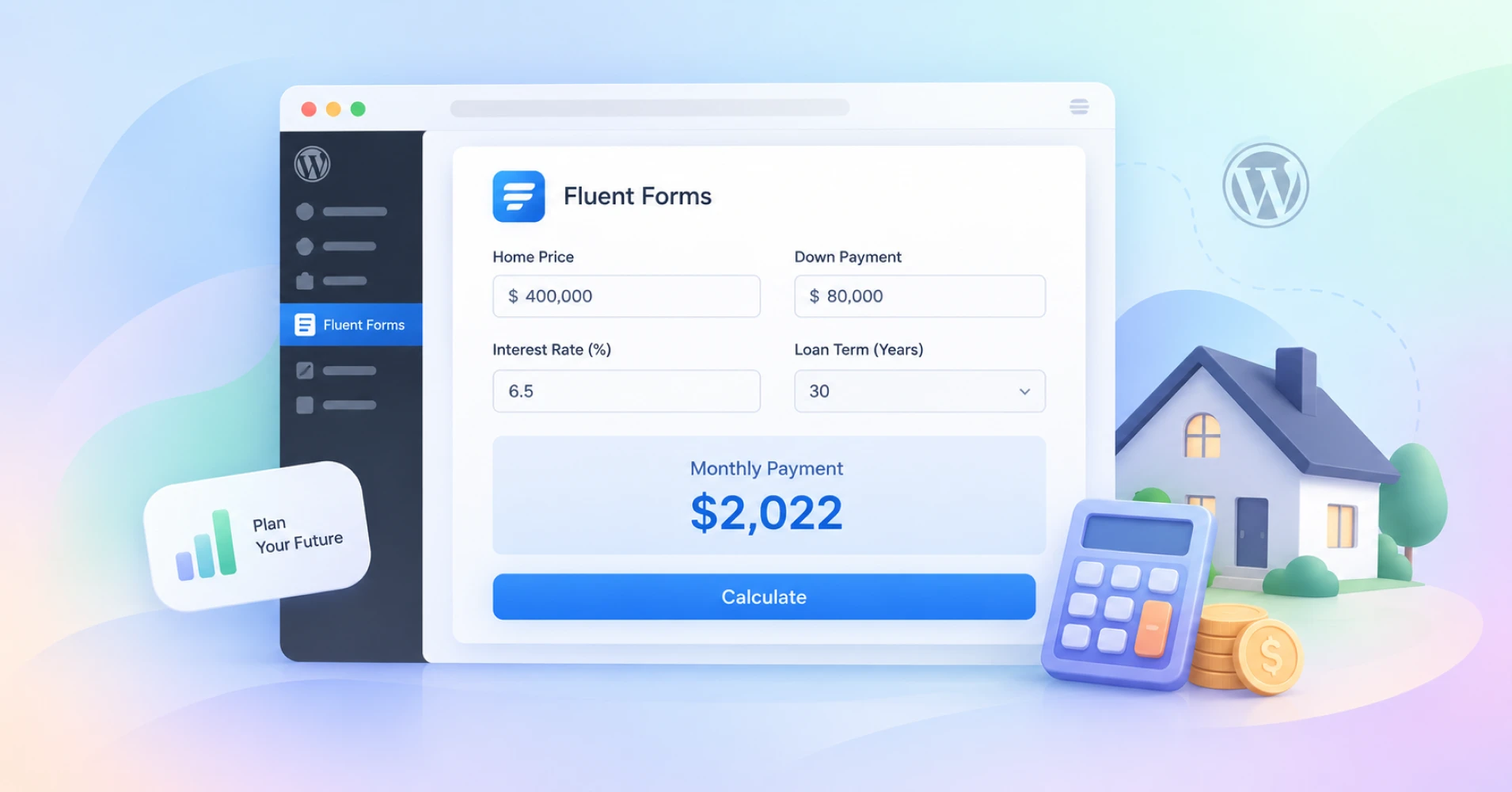
Buying a home usually starts with one question: what will the monthly payment look like? People want a quick estimate before they talk to a lender, compare homes, or decide what they can afford.
A mortgage calculator gives them that answer fast, and Fluent Forms makes it easy to build one in WordPress without code.
- Fluent Forms lets you build a mortgage calculator without writing any code
- Users can enter a deposit as a fixed amount or a percentage
- Conditional logic keeps the form clean by showing only the relevant deposit field
- Breaking the math into smaller steps makes the calculator easier to build
- You can hide intermediate calculations and show only the final monthly payment
What You Need Before You Start
To build a mortgage calculator, you will need Fluent Forms Pro because the calculation feature is part of the premium version.
Once Fluent Forms Pro is installed and activated, you can create the full calculator right inside WordPress. The easiest way to build it is to work in small steps.
Instead of one large formula, I’ll show you how to calculate each part separately. That makes the setup easy to follow now and easier to update later.
Save 20%
1 Domain License
Super Saver
Save 20%
5 Domain License
Save 20%
Unlimited Domain License
*Grab a special discount on your first year with us!
Save 20%
1 Domain License
Super Saver
Save 20%
5 Domain License
How the Mortgage Calculator Works
Before you build the form, it helps to understand the math behind it. The standard amortization formula calculates the monthly mortgage payment:
M = L × [r(1+r)^n] / [(1+r)^n – 1]
Here’s what each part means:
- M = Monthly payment
- L = Loan amount, which is the home price minus the down payment
- r = Monthly interest rate, which is the annual rate divided by 12
- n = Total number of payments, which is the loan term in years multiplied by 12
The flow is pretty straightforward once you break it down. Home price gives the total property value. The deposit can be entered as either a fixed amount or a percentage. From there, the loan amount is just the home price minus the deposit.
Then, the annual interest rate is converted into a monthly rate, the loan term is converted into months (total payments), and the final monthly payment amount is calculated using the standard mortgage formula. Let’s see how Fluent Forms handles it.
Step-by-Step: Setting Up Your Mortgage Calculator Form
Go to Fluent Forms in your WordPress dashboard and click New Form. Select New Blank Form and name it “Mortgage Calculator.”
1. Add primary fields
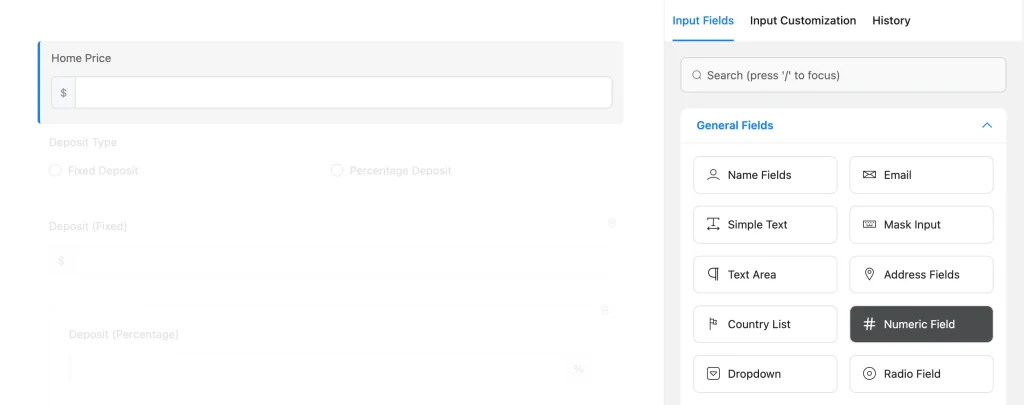
Add these numeric fields from the Input Fields section on the right and assign labels:
Home Price: This captures the total property value. In the field settings, set the label to “Home Price” and enable the currency prefix ($) under Advanced Options for clarity.
Interest Rate: The annual percentage rate. Label this field “Annual Interest Rate,” so users know to enter the yearly rate, not monthly.
Loan Term: How long the mortgage lasts. Label it “Loan Term (Years)” and consider adding placeholder text like “30” to suggest a common value.
Once these core inputs are added, move on to the deposit option.
2. Let users choose how they want to enter the deposit
Now add a Radio field and label it “Deposit Type.” Add two options:
- Fixed Amount
- Percentage
This gives users a simple choice. Some know the exact cash they can put down. Others prefer percentages. Letting them choose makes the calculator more intuitive. Next, add two numeric fields labeled “Fixed Deposit Amount” and “Deposit Percentage.”
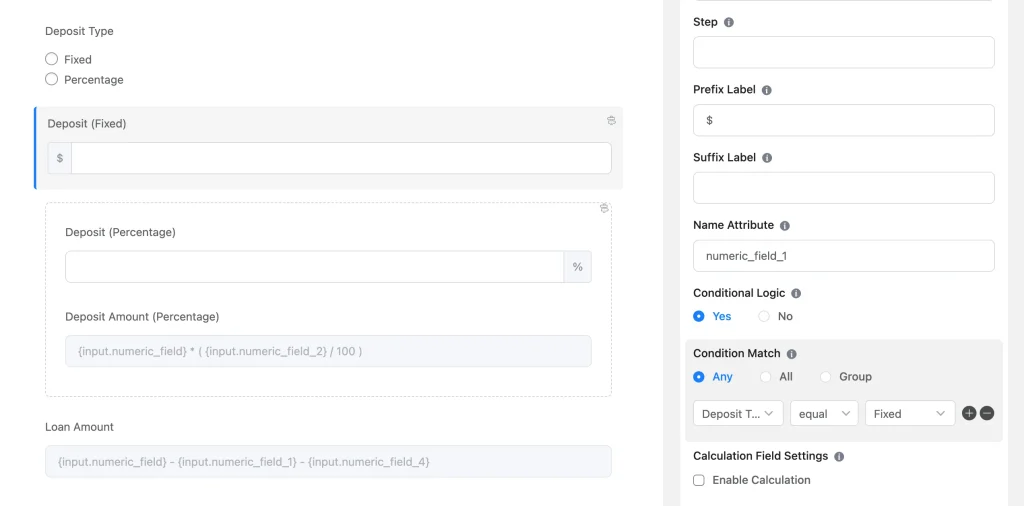
We have to show the relevant deposit field conditionally. To set it up, scroll down to the Advanced Options for these numeric fields. Select “Yes” under Conditional logic. Under the condition match, match the field label with the relevant value using a dropdown menu. For example,
- For the Fixed Deposit Amount, choose Deposit Type equals Fixed Amount
- For the Deposit Percentage, choose Deposit Type equals Percentage
This keeps the form tidy. Users only see the field they need, which makes the calculator feel cleaner and easier to use.
3. Calculate the deposit value for the percentage deposit
If the user chooses Fixed, you can use that amount directly in the calculation. If they choose Percentage, you need to convert it into a currency value first.
Add a numeric field and turn it into a calculated field by enabling “Calculation” from the field’s Advanced Options. This field will derive the actual deposit amount, which will be used to calculate the loan amount.
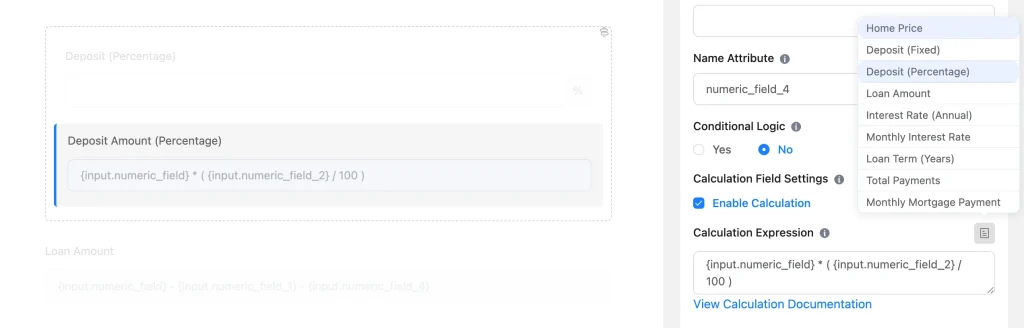
Use this conversion formula in the calculation expression:
If the home price is $400,000 and the user enters 10 percent, the deposit value becomes $40,000.
4. Calculate the loan amount
This gives you the amount the buyer actually needs to borrow. Subtract both deposit values from the home price:
{home_price} – {fixed_deposit} – {percentage_deposit_amount}.

Only one of those deposit values will be active, so the other one will stay 0. That keeps the loan amount calculation simple and reliable.
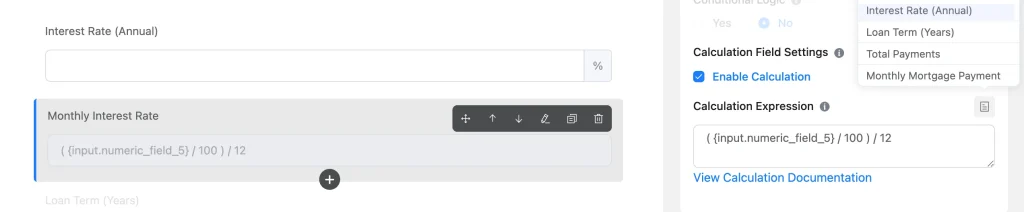
5. Convert the interest rate to a monthly rate
Mortgage formulas use monthly interest, not annual interest, so add another calculated field for the monthly rate. Use this formula:
({interest_rate} / 100) / 12.
This turns a yearly percentage like 6 into a monthly decimal like 0.005.
6. Calculate the total number of payments
Add another calculated field for the total number of monthly payments:
{loan_term} * 12.
This converts a 30-year mortgage into a total of 360 payments.

7. Calculate the monthly mortgage payment
Now add the final calculated field for the monthly payment. Use the standard amortization formula:
{loan_amount} * ({monthly_rate} * pow(1 + {monthly_rate}, {total_payments})) / (pow(1 + {monthly_rate}, {total_payments}) – 1)
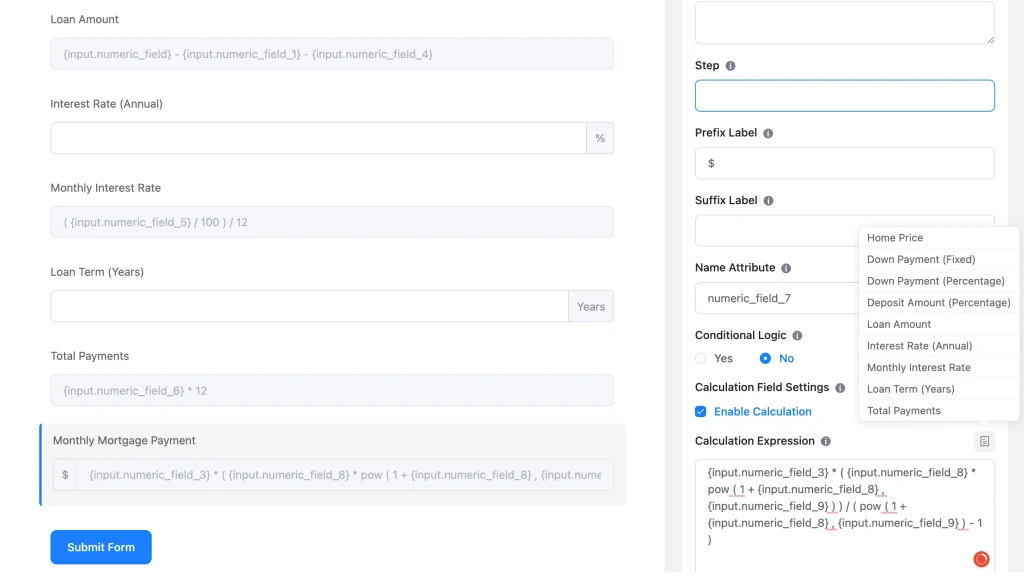
The logic is simple:
- Loan Amount is the borrowed amount
- The monthly rate is the monthly interest
- Total Payments is the loan length in months
- pow() handles the exponent part of the formula
The monthly mortgage payment amount updates automatically as users enter their details.
8. Tidy up your calculator
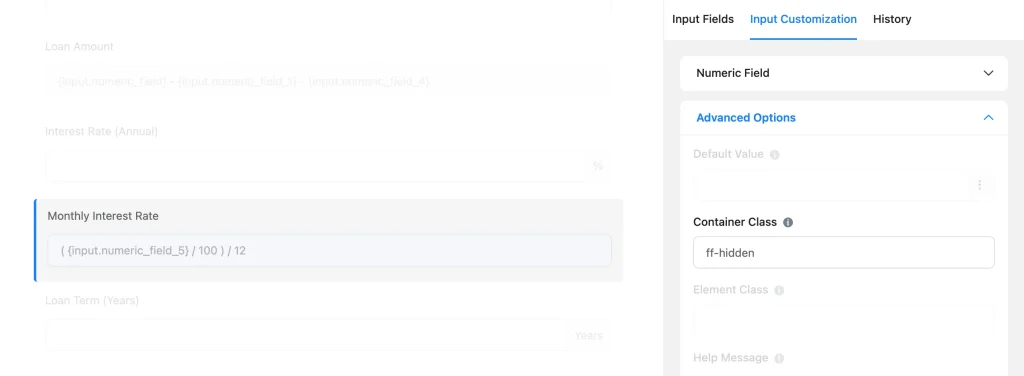
You don’t need to show every intermediate calculation to the user. If you want a cleaner layout, hide fields like:
- Deposit Value
- Loan Amount (optional)
- Monthly Rate
- Total Payments
- Submit Button
Use ff-hidden in the Container Class (from Field Settings > Advanced Options) for those fields. They will still work behind the scenes, but users will only see the important inputs and the final payment result.
This setup is better for both users and you. For users, it feels simple because they only see the field they need. For you, it is easier to maintain because each formula has one clear job. If you ever want to add taxes, insurance, or extra payment options later, you can extend the calculator without rebuilding everything.
You can control how many digits you want to show after the decimal using the round formula. For example,
round ( {monthly_mortgage_payment} , 2) = 1,618.79 and round(3.235723663, 0) = 3.
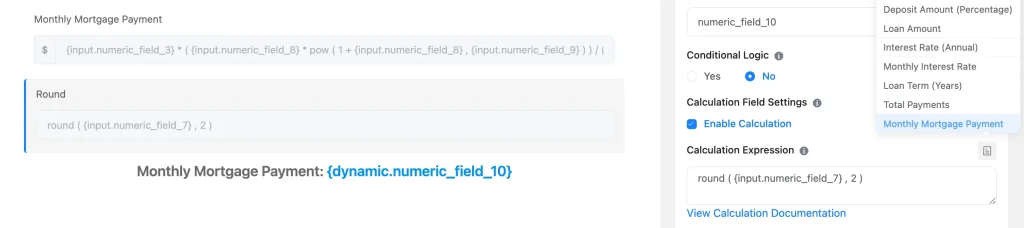
You can also hide a numeric field and display the result via an HTML field for styling flexibility. HTML fields support dynamic value insertion. For example, {dynamic.numeric_field_10}, where numeric_field_10 is the name attribute of the calculation field (you’ll find this in the advanced options of a field).
Displaying this way lets you customize the text & background color, typography, and overall presentation of your result (without writing HTML code).
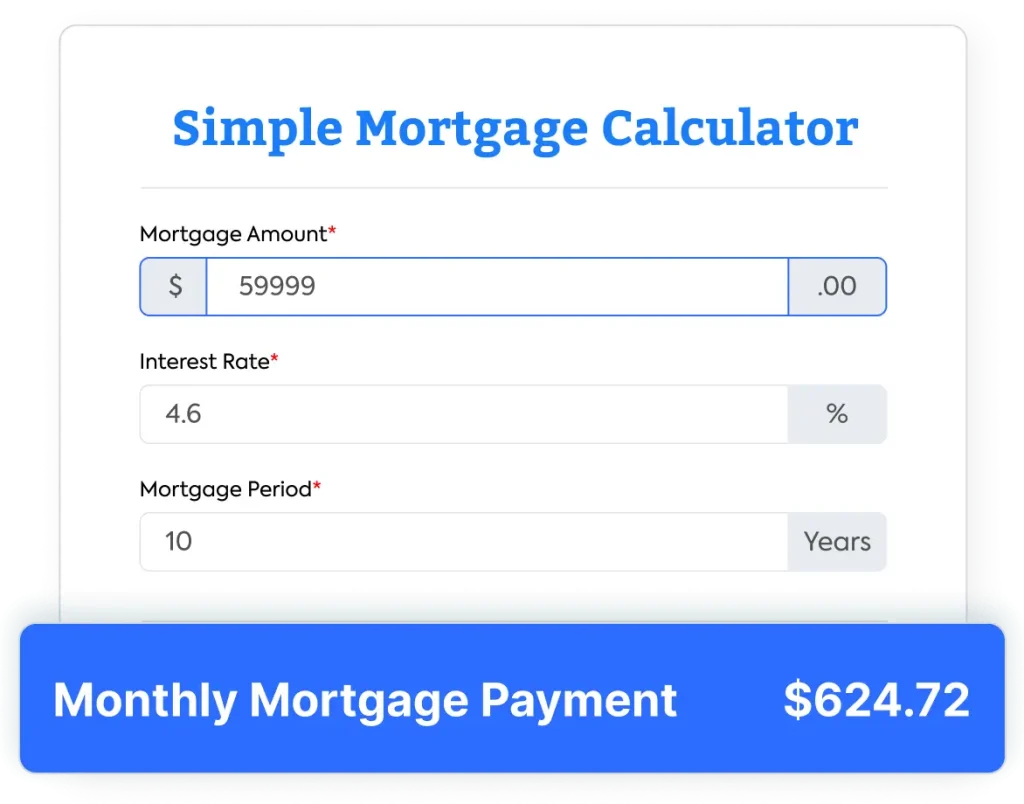
Your mortgage calculator is now ready. Save it and test before making it live.
Test the Calculator before Publishing
Before making the form live, test it with real numbers. For example:
- Home Price: $300,000
- Deposit: 10 percent
- Interest Rate: 6 percent
- Loan Term: 30 years
The calculator should return an expected Monthly Payment of $1,618.79. If the number in your form matches this result, your calculator is working properly.
Mortgage Calculator
| Year | Principal | Interest | Balance |
|---|
| Month | Payment | Principal | Interest | Balance |
|---|
If it doesn’t, first check the deposit calculation, then the monthly rate, and finally the total payments field.
Once your calculator is ready, you can style it in the Preview tab and publish it anywhere on your site using its shortcode.
Engage Users with Your Mortgage Calculator
A mortgage calculator is one of the most useful tools you can add to your real estate, mortgage brokerage, lending, or financial advice WordPress site. It gives visitors a quick way to estimate payments, understand affordability, and feel more confident before they take the next step.
You can also start with a calculator template and customize it according to your requirements.
View Fluent Forms Calculators
Simply start with the basics, test each calculation as you go, and keep the layout simple. Once the core calculator works, you can always expand it with extra fields or refinements later.

Sarika creates helpful content for Fluent Forms & FluentPlayer. Endlessly curious, she loves connecting over diverse interests & unique perspectives. Off the clock, she’s exploring art or relaxing with a binge-worthy show.
-

10 Best jQuery Table Plugins for Best Data Visualization in 2026
Discover the 10 best jQuery table plugins for 2026. Compare -

FluentSMTP Review: Whats Inside this 700K+ WordPress SMTP Plugin?
Check our FluentSMTP review blog to Discover whats inside this -

Black Friday Marketing Strategies for 2026: Core and Advance Move
Black Friday is the most celebrated shopping season worldwide. Discover



Leave a Reply
You must be logged in to post a comment.