

Product Launch Strategy: Step-by-Step Guide + Templates [2026]
![Product Launch Strategy_ Step-by-Step Guide + Templates [2026]](https://wpmanageninja.com/wp-content/uploads/2026/04/Product-Launch-Strategy_-Step-by-Step-Guide-Templates-2026.webp)
Nearly 30,000 new consumer products enter the market every year, and most of them fail. Research consistently shows that lack of preparation is the most common root cause across product launches.
The difference between the ones that survive and the ones that don’t usually comes down to strategy, not the product itself. A well-built product with a weak launch is a missed opportunity. A clear, structured, and well-timed launch creates market share, builds trust, and sets long-term growth.
In this blog, we break down what a product launch is, why strategy matters more than launch day, the essential stages, how to build a go-to-market plan, and how WPManageNinja tools make execution easier.
- A product launch is a coordinated, cross-functional effort to bring a new product to market and build demand for it.
- The three core stages are pre-launch, launch, and post-launch, and each requires its own set of actions and metrics.
- A product launch strategy is not the same as a product launch plan. Strategy sets direction; the plan turns that direction into tasks.
- Successful launches are built on deep market research, clear positioning, consistent messaging, and aligned teams.
- Common failure points include poor market validation, misaligned teams, bad timing, and weak post-launch follow-through.
- Tools like FluentCart, FluentCRM, and Fluent Forms can support the selling, technical and marketing side of a WordPress-based product launch.
What Is a Product Launch?
A product launch is a company’s planned and coordinated effort to introduce a new product to the market. It covers everything from timing and messaging to the purchase path, from internal team preparation to public-facing campaigns.
The goal is straightforward:
- Create awareness
- Drive demand
- and convert that demand into real adoption
However, a product launch is more than just pressing “publish” or flipping a switch. It is a multi-stage effort involving product, marketing, sales, and customer support working in tandem. When done correctly, it can establish a product’s place in a competitive market, earn early adopters who later become brand advocates, and create momentum that sustains growth well beyond the launch window.
What a product launch is not is a single event. A launch is a campaign, and like any campaign, its success depends on the work that happens long before the first announcement goes out.
Product Launch Strategy vs. Product Launch Plan
These two terms are often used interchangeably, but they refer to different things, and confusing them creates real problems for teams.
Product Launch Strategy
A product launch strategy is the guiding framework. It defines the target audience, the product positioning, the core messaging, the competitive context, and the overarching goals. It answers “why” and “what,” and it sets the direction for the entire launch effort.
Product Launch Plan
A product launch plan is the tactical execution document built from that strategy. It assigns tasks, sets deadlines, allocates budget, names owners, and breaks the strategy into concrete, trackable steps.
April Dunford, author of Obviously Awesome: How to Nail Product Positioning so Customers Get It, Buy It, Love It, argues that “positioning is the foundation of every marketing and sales decision that follows.” Without clear positioning in your strategy, your plan has no compass.
Without both, you end up either running an undirected activity or executing a perfectly organized plan that serves the wrong goal.
| Aspect | Product Launch Strategy | Product Launch Plan |
|---|---|---|
| Focus | Sets the direction | Defines the execution |
| Answers | Why and what | How, who, and when |
| Key Elements | Target audience, positioning, messaging, goals | Tasks, timeline, budget, owners, steps |
| Outcome | A clear roadmap | A practical action plan |
| Role | Guides decisions | Turns decisions into results |
Stages of a Product Launch
Every successful launch follows the same broad architecture, regardless of the industry, product type, or team size.
Stage 01: Pre-Launch Stage
The pre-launch stage is often where the most valuable work happens, and this is where the foundation is built.
- Research happens here.
- Personas are defined.
- Positioning is tested.
- Messaging is developed.
- The go-to-market strategy is finalized.
- Promotional assets, landing pages, email sequences, and press materials are created.
- Internal teams are briefed, trained, and aligned.
Yet it is also where teams most commonly rush or skip steps to hit an arbitrary launch date.
Schneider and Julie Hall, writing in Harvard Business Review, found that “the single biggest problem across hundreds of product launches was lack of preparation.” Companies that underfund or rush the pre-launch phase consistently underperform those that treat it as a strategic phase in its own right.
Stage 2: Launch Stage
The launch stage is execution. Campaigns go live. The product becomes available. Press releases are distributed. Events or webinars run. Social media picks up momentum. The sales team engages leads. Customer support is on standby for immediate issues.
The key here is that the launch stage should feel like a smooth relay, not a fire drill. Every team should know exactly what to do and when, because the pre-launch stage already sorted that out.
Stage 3: Post-Launch Stage
Post-launch is where many companies lose momentum, which is ironic because it is arguably the most important phase for long-term success. This is when you measure results against your KPIs, collect customer feedback, hold post-mortems, fix what broke, and plan your next moves.
Geoffrey Moore, in Crossing the Chasm, “makes a compelling argument that the real challenge for most products is not the initial launch. It is the gap between early adopters and the mainstream market.” A strong post-launch strategy is what helps you bridge that gap systematically rather than hoping the early buzz carries you forward.
| Aspect | Pre-Launch | Launch | Post-Launch |
|---|---|---|---|
| Purpose | Build the strategic foundation | Execute and enter the market | Learn, optimize, and scale |
| Focus | Direction, clarity, and alignment. | Coordination and execution. | Performance and iteration. |
| What Happens | • Customer & market research • Personas defined • Positioning validated • Messaging developed • GTM strategy finalized • Assets and campaigns prepared • Teams aligned and trained | • Campaigns go live • Product becomes available • Press and distribution roll out • Events and webinars run • Sales engages leads • Support handles real-time issues | • Measure against KPIs • Collect customer feedback • Analyze performance • Fix gaps and friction • Run post-mortems • Plan next iterations |
| Key Mindset | Learn fast. Iterate deliberately. | Execute with precision, not chaos. | Learn fast. Iterate deliberately. |
| Why It Matters | Strong preparation prevents weak launches. | Sets initial market perception and demand signals. | Drives long-term growth beyond initial traction. |
| Core Risk | Rushing or skipping critical thinking. | Poor coordination across teams. | Losing momentum after launch. |
3 Types of Product Launches
Not every launch looks the same. The type you choose should match your goals, your confidence in the product, and your audience readiness.
Soft launch
Soft launch introduces your product to a limited, controlled group first, such as beta testers, waitlist members, or a specific geographic market. It is a lower-risk approach that generates real feedback before a broader rollout. It is the right choice when you need real-world validation before committing to full-scale investment.
Hard launch
Hard launch releases the product to the full target audience simultaneously, supported by multi-channel campaigns, press coverage, and coordinated marketing activity. It maximizes immediate exposure but requires high confidence in product readiness, messaging clarity, and team alignment.
Phased launch
Phased launch expands access progressively, by audience segment, geography, or use case. It allows the team to learn and adjust between phases. Spotify’s addition of podcasts to a music streaming platform is a clean example: it expanded the product’s value and entered a new content vertical in a measured, controlled way.
| Launch Type | Audience Scope | Marketing Effort | Best For | Risk Level |
|---|---|---|---|---|
Soft Launch Test. Learn. Improve. | Limited, controlled group such as beta testers, waitlist members, or a specific geographic market. | Low to moderate. Focused and targeted campaigns. | Validating the product with real users before scaling. | Low |
Hard Launch Launch Big. Go All In. | Full target audience released at once. | High. Multi-channel campaigns, press coverage, and coordinated rollout. | Products with high confidence in readiness, messaging, and team alignment. | High |
Phased Launch Scale, Learn, Adapt. | Limited, controlled group such as beta testers, waitlist members, or a specific geographic market. | Low to moderate. Focused and targeted campaigns. | Validating the product with real users before scaling. | Medium |
5 Core Components of Building a Product Launch Strategy
1. Market Research and Audience Definition
Market research is not an optional prep step. It is the foundation of every other strategic decision you will make.
CB Insights’ analysis of startup and product failures consistently identifies “a lack of market need as a top cause of failure, cited in 35% of cases”. This makes pre-launch market validation one of the highest-leverage investments a team can make before going public with any product.
Research should cover:
- Who your target audience is
- What problems they are trying to solve
- How they currently solve those problems
- What gaps existing solutions leave
- Where your product sits in that competitive landscape
Build detailed buyer personas. Understand demographic and behavioral patterns. Identify the pain points that are severe enough to drive a purchasing decision, not just mild enough to cause a complaint.
2. Product Positioning and Core Messaging
Positioning answers a deceptively simple question: why should a customer choose your product over every other available option, including doing nothing?
April Dunford frames positioning as the work of finding the market context in which your product is obviously the best choice. That context shapes your messaging, your sales approach, your content strategy, and even your pricing.
Messaging, in turn, translates that positioning into language that resonates with your audience. It should be consistent across all channels, from your landing page headline to your sales call scripts to your social posts. Inconsistency in messaging creates doubt and friction.
3. Go-to-Market Strategy
Your go-to-market (GTM) strategy is the roadmap for how your product reaches the right customers at the right time through the right channels.
A solid GTM plan defines:
- which market segments you are targeting,
- which channels you will use to reach them (content, email, paid, social, PR, partnerships),
- what content and creative assets those channels require,
- the sequence and timing of campaign activity,
- and how you will measure effectiveness.
The distribution of your effort across channels should be driven by data, not intuition. Different product types, audiences, and price points respond differently to different channels.
4. Launch Goals and KPIs
Clear goals make everything else easier to prioritize. Vague goals make everything harder.
Define what a successful launch looks like in measurable terms. This might mean a specific number of sign-ups in the first 30 days, a revenue target, a conversion rate threshold, or a market penetration goal. Whatever metrics you choose, they need to be specific and time-bound.
Common product launch KPIs include:
- number of sign-ups or activations,
- revenue and units sold,
- website traffic and conversion rate,
- customer acquisition cost,
- social media engagement,
- press coverage volume,
- and Net Promoter Score (NPS).
Research published in Harvard Business Review has documented that “well-executed product launches not only drive initial revenue but also establish the brand positioning that sustains competitive advantage long after the launch window closes.” However, realistic goal-setting for your specific context matters far more than chasing industry averages.
5. Team Alignment and Cross-Functional Communication
The biggest operational risk in any product launch is not a bad product, it is poor internal alignment.
Mural’s 2025 Global GTM Alignment Gap Index, a survey of 350 go-to-market professionals, found that “85% of GTM teams experience frequent misalignment between sales, marketing, and R&D; even while 85% of those same teams express confidence in their processes.” That misalignment translates directly into slower launches, inconsistent customer experiences, and lost revenue.
Every team involved in a launch, including product, marketing, sales, customer support, and operations, needs to understand the strategy, their specific role, the timeline, and how their work connects to the broader goals. Without that shared context, individual contributors execute well in isolation and fail as a team.
Wes Bush, author of Product-Led Growth, argues for a model where the product itself drives acquisition and onboarding, but that model still requires deep alignment between what the product does and how it is positioned, marketed, and supported. The medium changes; the need for alignment does not.
Step-by-Step Product Launch Process
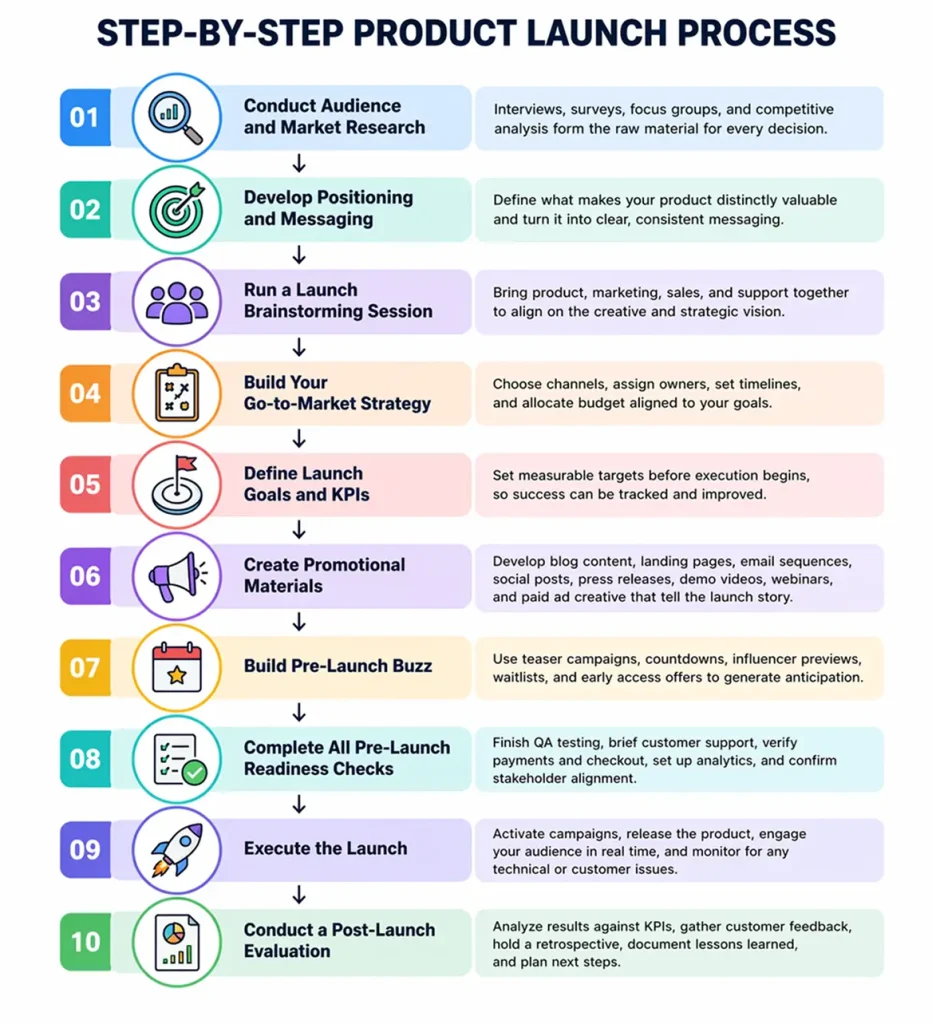
1. Conduct audience and market research: Interviews, surveys, focus groups, and competitive analysis form the raw material for every subsequent decision.
2. Develop positioning and messaging: Define exactly what makes your product distinctly valuable and translate that into clear, consistent language for every channel.
3. Run a launch brainstorming session: Bring stakeholders from product, marketing, sales, and customer support together to build a shared creative and strategic vision.
4. Build your go-to-market strategy: Select channels, assign owners, set timelines, and allocate budget aligned to your objectives.
5. Define launch goals and KPIs: Establish measurable targets before execution begins, not after.
6. Create promotional materials: Blog content, landing pages, email sequences, social posts, press releases, demo videos, webinars, and paid ad creative. Each asset should serve the launch story.
7. Build pre-launch buzz: Teaser campaigns, countdown sequences, influencer previews, waitlist campaigns, and early access offers generate anticipation before the product is available.
8. Complete all pre-launch readiness checks: QA testing, customer support briefing, payment and checkout verification, analytics setup, and stakeholder alignment all need to be done before launch day.
9. Execute the launch: Activate campaigns, release the product, engage your audience in real time, and monitor for immediate technical or customer issues.
10. Conduct a post-launch evaluation: Analyze results against your KPIs, gather customer feedback from all channels, hold a retrospective, document lessons learned, and plan next steps.
Pre-Launch Marketing
Pre-launch marketing is its own discipline. The goal is not just awareness, it is emotional investment. When your target audience already wants your product before it exists, launch day becomes a confirmation rather than a cold introduction.
Most effective pre-launch tactics
Teaser campaigns that hint at the product without fully revealing it. Apple has used this formula for decades, and the pattern works because it triggers what psychologists call the Zeigarnik effect: people remember and fixate on unfinished narratives more strongly than completed ones. The anticipation becomes part of the value.
Waitlist and early access programs
Waitlist and early access programs that turn prospective customers into invested stakeholders. When someone signs up for a waitlist, they are not just a lead, they are psychologically committed to caring about the outcome. That makes conversion significantly easier.
Content-driven pre-launch sequences
Content-driven pre-launch sequences that educate the audience on the problem your product solves before introducing the solution. Educational content that directly addresses your audience’s pain points positions your brand as a trusted authority and makes the eventual product reveal feel like a natural conclusion rather than a sales pitch.
Influencer and partnership previews
Influencer and partnership previews that extend your reach into audiences you have not yet earned. The key is authenticity.
According to Glossier’s community-driven approach, campaigns built around genuine user advocates and micro-influencers consistently outperform celebrity endorsements because the audience trust is higher.
Email-based pre-launch campaigns from WordPress
If you are running email-based pre-launch campaigns from WordPress, Fluent Forms gives you an efficient way to build waitlist and lead capture forms that connect directly into your email marketing workflows.
The combination of a well-structured signup form with a clean onboarding sequence can make your pre-launch email list significantly more engaged than a standard newsletter signup.
Product Launch Checklist
At a high level, your checklist should cover these areas:
| Stage | Checklist |
|---|---|
| Pre-Launch |
|
| Launch |
|
| Post-Launch |
|
Post-Launch Strategy (Sustain the Momentum)
The work does not end on launch day. In many ways, that is when the real work begins. A strong post-launch strategy keeps the product visible, captures the insights that only real-world usage generates, and builds the customer relationships that turn one-time buyers into loyal advocates.
Continuous Feedback Collection
- Surveys after purchase or onboarding
- Support conversations and tickets
- Direct customer outreach
- Feature requests and usability feedback
Iterative Product Improvement
- Prioritize updates based on real usage
- Fix friction points discovered post-launch
- Improve onboarding and first-use experience
- Ship small, continuous enhancements
Ongoing Content Marketing
- Real use case walkthroughs
- Tutorials based on customer workflows
- Feature deep-dives after launch
- Customer stories and implementation examples
Loyalty and Referral Programs
- Incentives for repeat purchases
- Referral rewards for existing customers
- Early adopter benefits
- Retention-focused offers
Community Building
- User communities or groups
- Customer feedback discussions
- Shared use cases and workflows
- Direct engagement with early adopters
Measurement and Channel Optimization
- Review conversion performance
- Compare channel effectiveness
- Adjust messaging based on engagement
- Reallocate effort toward high-performing sources
Lean Iteration Framework
The Lean Product Playbook by Dan Olsen offers a practical framework for this:
- Validate product-market fit hypotheses in the real world
- Measure gaps between expected and actual behavior
- Iterate quickly based on real usage
The goal is not perfection at launch but rapid improvement after it.
Managing Post-Launch Customer Relationships in WordPress
For WordPress store owners managing the post-launch customer relationship, FluentCRM offers native automation capabilities that make this significantly more manageable:
- Segment customers by the product purchased
- Trigger email sequences based on purchase behavior
- Track customer lifetime value
- Build personalized retention campaigns
Post-launch marketing does not have to mean adding more tools to your stack.
6 Common Reasons Product Launches Fail
Understanding failure modes is as valuable as knowing best practices. Most unsuccessful launches share a recognizable set of root causes.
Reason 1: Poor Market Validation
Teams fall in love with their product and skip the research that would tell them whether the market actually wants it. According to CB Insights, the most common reason startups fail is building something the market does not need.
Reason 2: Unclear or Inconsistent Positioning
When the product’s value is not communicated clearly or consistently, the market gets confused. Confusion kills conversions.
Reason 3: Misaligned Teams
- Marketing builds the wrong message
- Sales cannot articulate the value proposition
- Support is not prepared for product-related questions
Each of these individually weakens the launch; all together, they can derail it entirely.
Reason 4: Poor Timing
- Launching into a competing news cycle
- Launching during seasonal lows
- Launching before the product is actually ready
Launch timing matters more than most teams acknowledge. Each of these carries significant cost.
Reason 5: No Pre-Launch Buildup
Launching without creating anticipation means starting cold, which is harder and more expensive than any pre-launch campaign.
Reason 6: Insufficient Post-Launch Follow-Through
Customers expect a new product to work flawlessly from the first interaction. When it doesn’t, and the team is not responsive, early adopters become the loudest critics rather than the loudest advocates.
SaaS and Digital Product Launches: What’s Different
Digital product and SaaS launches follow the same strategic framework as any other product launch, but a few elements require distinct attention.
Product-Led Growth Changes the Launch Focus
Wes Bush outlines product-led growth as a model where the product itself becomes the primary acquisition and retention mechanism. This changes how you think about the launch:
- Free trial experience becomes part of marketing
- Onboarding flow drives activation
- In-app activation moment (“aha moment”) becomes the conversion point
The product experience functions as much as any external campaign.
Metrics That Matter for SaaS and Digital Products
For digital products and SaaS specifically, the metrics that matter most are:
- Activation rate
- Time to value
- Retention
Not just top-of-funnel acquisition. A product can generate massive sign-up numbers on launch day and still fail if users do not reach their first value milestone.
Additional Considerations for B2B Launches
B2B product launches add another layer:
- Align sales team with launch messaging
- Prepare for longer buying cycles
- Invest in case studies
- Create detailed documentation
- Build sales enablement materials
Presenting SaaS Launch Content Clearly
If you are managing a SaaS product’s pre-launch and launch content strategy on WordPress, Ninja Tables offers a clean way to present:
- Comparison tables
- Pricing tiers
- Feature breakdowns
Structured, easy-to-read comparison content also tends to perform well in search results for audience members in the research and evaluation phase of their buying journey.
Product Launch Tools
Execution at scale requires the right tools. The good news is that most of what you need for a complete product launch workflow does not require a separate, expensive software stack.
Product Launch Task Management
FluentBoards helps you plan launch timelines, assign tasks, and track progress in a centralized workspace so your entire product launch stays aligned and on schedule.
Lead Management During Pre-Launch
Fluent Forms supports waitlist signups, early access request forms, and multi-step registration flows with native integrations into your email and CRM systems.
Email Automation & Customer Segmentation
FluentCRM enables pre-launch email sequences, launch day broadcasts, and post-launch retention campaigns all from within WordPress, without monthly SaaS fees.
Social Proof and Review Management
WP Social Ninja lets you surface real social proof on your product page, which is critical for building trust with audiences encountering your product for the first time.
Content and Knowledge Management
BetterDocs provides a structured knowledge base that supports post-launch customer self-service and reduces support ticket volume during the high-demand period after release.
Affiliate Launch Campaigns
If your product launch strategy includes a referral or affiliate component, FluentAffiliate integrates natively with FluentCart and other Fluent ecosystem products to automate commission tracking and partner management.
Tables, Comparison, Feature Breakdowns
For product tables, pricing comparisons, and feature breakdowns on your launch page, Ninja Tables makes it easy to build clear, responsive comparison tables without custom development.
Customer Support Readiness
Fluent Support ensures your team is equipped to handle the volume of questions and issues that typically spike immediately after a major launch.
Download Product Launch Template
Wrapping Up
A strong product launch strategy does not happen by accident, and it does not happen on launch day. It is built methodically, through research, positioning, messaging, alignment, and preparation, often over months before the product is publicly visible.
If you are in the early stages of planning a launch, start with the question your audience is already asking, and build your strategy around the answer. If you are on the other side, reviewing a launch that underperformed, the post-launch evaluation is not a postmortem: it is the starting point for doing it better next time.
For teams building and selling on WordPress, the WPManageNinja ecosystem offers a connected set of tools, from lead capture and email marketing to eCommerce and affiliate management, that can support both the marketing side and the execution side of a product launch without the overhead of managing a dozen disconnected platforms.
Frequently Asked Questions
How long should product launch preparation take?
Most successful launches involve at least 3 months of pre-launch preparation for digital products and significantly longer for hardware or complex enterprise software. The preparation time includes market research, positioning work, asset creation, team alignment, and technical readiness. Rushed pre-launch work is one of the most consistent predictors of underperformance.
What is the difference between a soft launch and a beta launch?
A soft launch is a limited public release, meaning the product is available but the marketing is restrained. A beta launch is typically a testing phase, often invite-only, where feedback is the primary goal and the product is not yet in a commercial release state. They are related concepts but serve different purposes.
What KPIs matter most in the first 30 days post-launch?
The most important early KPIs depend on your product type, but generally include activation rate (users who complete a key action after signing up), time to first value, conversion rate from trial or free tier to paid, and customer support ticket volume. These leading indicators give you earlier signals than lagging indicators like monthly revenue, which take longer to accumulate.
Does product launch strategy apply to feature updates, not just new products?
Yes, though the scope and intensity are different. Feature launches typically target an existing user base and use different channels (in-app messaging, email to existing users) rather than the broader awareness channels used for new product launches. The strategic elements, positioning, messaging, goals, and post-launch evaluation, remain relevant.

A published literary author, and a musician. I thrive on marketing for tech companies while composing music, collecting books of lasting depth, exploring cinema with a discerning eye, and studying the arts and history.
-
10 Best jQuery Table Plugins for Best Data Visualization in 2026
Discover the 10 best jQuery table plugins for 2026. Compare -

Black Friday Marketing Strategies for 2026: Core and Advance Move
Black Friday is the most celebrated shopping season worldwide. Discover -
How Much Can You Earn With Amazon Affiliate Marketing? Rates & Niches
How much can you earn with Amazon affiliate marketing? Dive



Leave a Reply
You must be logged in to post a comment.