

WordPress vs Joomla vs Drupal: Which CMS Should You Choose in 2026?
Choosing between WordPress, Joomla, and Drupal can feel confusing when every platform claims to be flexible, secure, and powerful. This guide breaks the comparison down in plain language so you can choose the right CMS based on your website, team, budget, and growth plans.
Key takeaways
- WordPress is the best CMS for most blogs, business websites, marketing sites, landing pages, and small to midsize online stores.
- Joomla is a strong middle option when you need multilingual publishing, user access control, and more structure without going fully enterprise.
- Drupal is best for complex websites that need custom content architecture, strict workflows, permissions, integrations, and long-term governance.
- All three platforms are open source, but the real cost depends on development, hosting, maintenance, extensions, and technical support.
- Security depends less on the CMS name and more on how well the site is built, updated, hosted, and maintained.
WordPress, Joomla, and Drupal in 2026: What changed?
WordPress, Joomla, and Drupal are not new names. They have been around for years, powering everything from personal blogs to government portals. But comparing them based on old opinions is a mistake.
The CMS world has changed. WordPress has moved deeper into block editing, design flexibility, AI-ready workflows, and a massive plugin ecosystem. Joomla continues to improve its multilingual tools, access control, and publishing features. Drupal remains one of the strongest choices for structured content, enterprise publishing, and complex digital experiences.
So, the better question is not “Which CMS is the most famous?”
The better question is: Which CMS fits your project best right now?
In 2026, WordPress is still the clear market leader. Joomla still matters for teams that want more built-in structure. Drupal is still the serious choice for organizations that need advanced control. Each platform has a place. The trick is knowing where each one shines and where it starts to feel heavy.
WordPress vs Joomla vs Drupal: Quick comparison
Here is the easiest way to understand the difference.
| Feature | WordPress | Joomla | Drupal |
|---|---|---|---|
| Best for | Blogs, business sites, marketing sites, eCommerce, content-driven brands | Multilingual sites, membership portals, community websites, structured business sites | Enterprise sites, government portals, universities, complex publishing systems |
| Ease of use | Easiest | Moderate | Most complex |
| Setup speed | Fast | Moderate | Slower |
| Flexibility | Very high through plugins and themes | High with built-in controls and extensions | Very high with custom architecture |
| SEO | Strong with plugins and good structure | Strong built-in SEO controls | Strong when content architecture is planned well |
| Multilingual support | Usually plugin-based | Strong built-in multilingual features | Strong but requires technical setup |
| Security | Strong when maintained properly | Strong with good access control and maintenance | Very strong for disciplined enterprise teams |
| Cost to launch | Usually lowest | Moderate | Usually highest |
| Best user type | Marketers, creators, small businesses, agencies | Teams that need more structure than WordPress | Technical teams and large organizations |
If you want a quick answer, here it is: WordPress is best for most websites. Joomla is best when you need a balanced mix of control and usability. Drupal is best when your website is not just a website, but a serious content system.
What is WordPress?
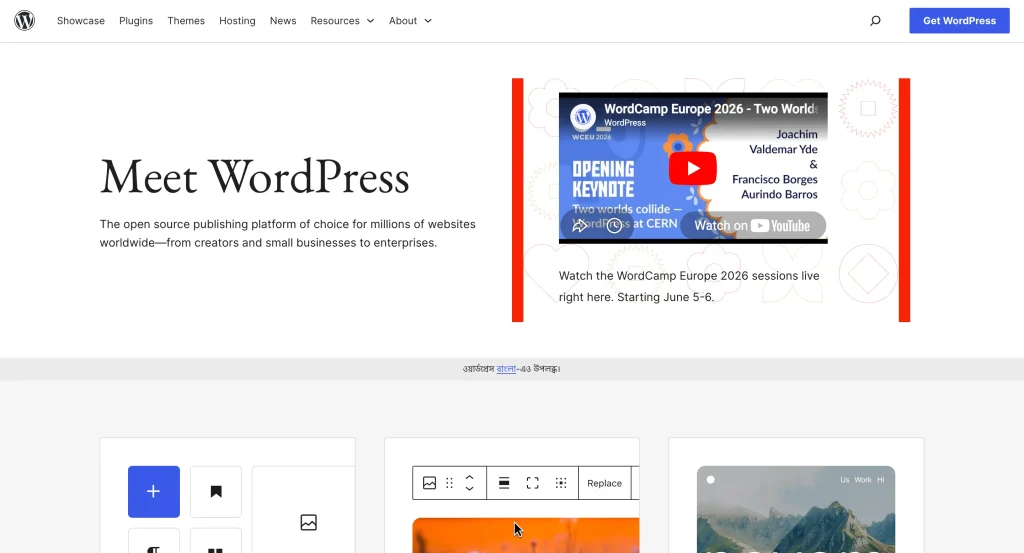
WordPress is the most popular content management system in the world. It started as a blogging platform, but today it powers business websites, eCommerce stores, membership sites, LMS platforms, portfolios, directories, communities, and almost every other type of website you can imagine.
Its biggest strength is simple: WordPress is easy to start and easy to extend.
You can install WordPress, choose a theme, add plugins, publish pages, optimize content, and launch a website without needing a full development team. That is why creators, marketers, small businesses, agencies, and product companies keep choosing it.
WordPress also has a huge ecosystem. Themes, plugins, page builders, hosting providers, developers, tutorials, communities, and support resources are everywhere. If you run into a problem, chances are someone has already solved it.
That network effect is powerful. It lowers the learning curve and reduces hiring difficulty. It makes maintenance easier. And it gives non-technical teams more confidence to manage their own websites.
Best use cases for WordPress
WordPress is a great fit for:
- Blogs and content websites
- Business websites
- SaaS websites
- Landing pages
- eCommerce stores
- Course websites
- Membership websites
- Agency websites
- Local business websites
- Portfolio websites
- News and magazine sites
- Product documentation sites
WordPress is especially strong when your website needs to publish content regularly, capture leads, sell products, run campaigns, or connect with marketing tools.
What is Joomla?
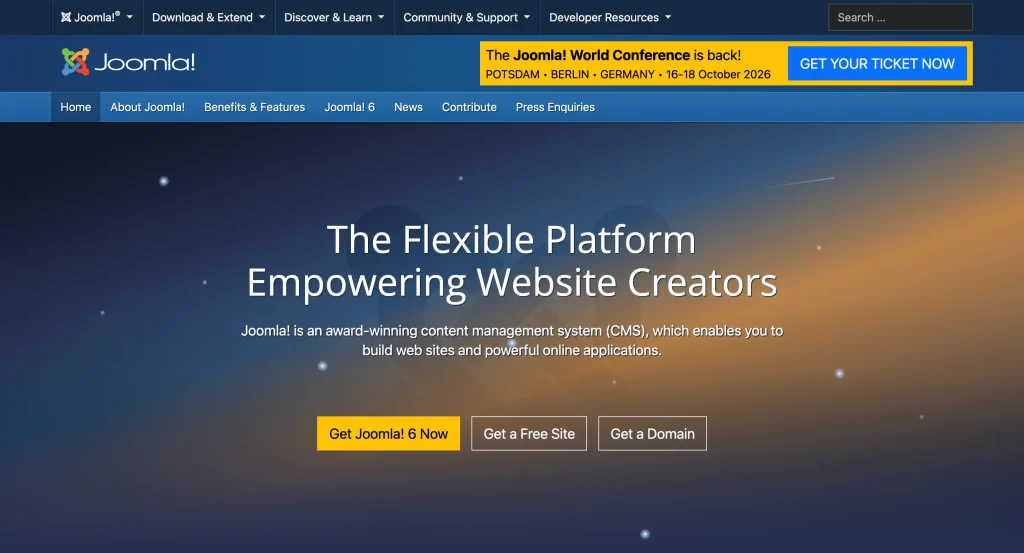
Joomla is another open-source CMS with a long history and a loyal community. It does not have the same market share as WordPress, but it still offers a strong set of features for teams that want more built-in control.
The easiest way to describe Joomla is this: it sits between WordPress and Drupal.
It is not as beginner-friendly as WordPress. But it is not as developer-heavy as Drupal either. Joomla gives you more structure in the core system, especially around multilingual content, user permissions, custom fields, categories, templates, and access control.
That makes Joomla useful for websites where different users need different levels of access. For example, associations, schools, nonprofit websites, membership portals, and multilingual business websites can benefit from Joomla’s built-in features.
You may need more time to learn the admin interface, but once the structure makes sense, Joomla can feel quite practical.
Best use cases for Joomla
Joomla is a good fit for:
- Multilingual websites
- Membership websites
- Community portals
- Association websites
- Education websites
- Internal business portals
- Websites with multiple user groups
- Structured content websites
- Mid-sized organization websites
Joomla works best when you need more control than a basic WordPress setup but do not want the complexity of Drupal.
What is Drupal?
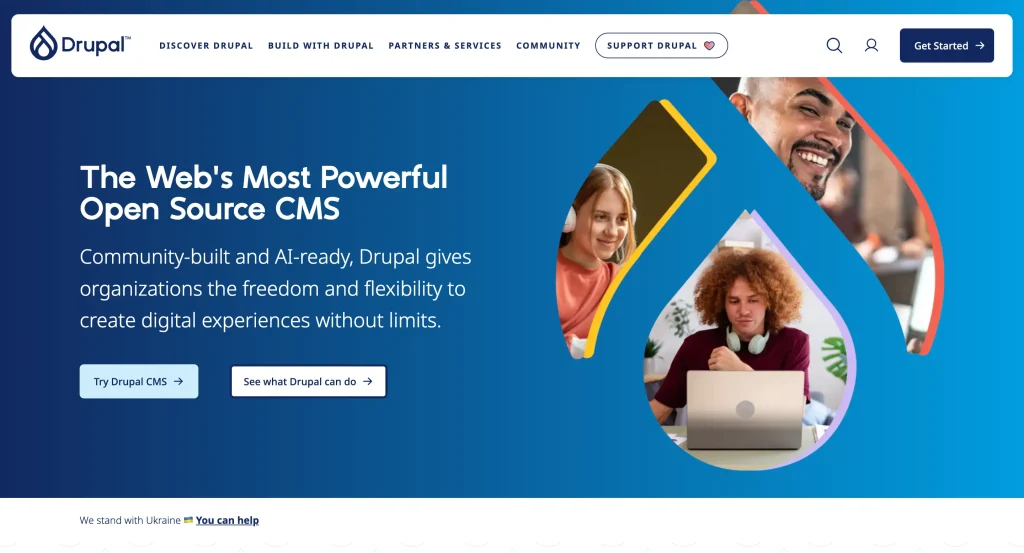
Drupal is a powerful open-source CMS built for complex websites and digital platforms. It is known for structured content, security, scalability, workflows, permissions, and deep customization.
But let’s be honest. Drupal is not the easiest CMS for beginners.
It usually needs experienced developers, proper planning, and a clear content architecture. You do not choose Drupal because you want the fastest setup. You choose Drupal because your website has complex requirements that simpler systems may struggle to manage cleanly.
Drupal is often used by governments, universities, enterprise companies, large nonprofits, publishers, and organizations with serious content workflows.
Its strength is not just publishing pages. Its strength is building a flexible content system where every content type, permission, relationship, workflow, and integration can be planned properly.
Best use cases for Drupal
Drupal is a strong fit for:
- Government websites
- University websites
- Enterprise portals
- Large publishing platforms
- Complex multilingual websites
- Content-heavy organizations
- Websites with strict permissions
- Custom digital experience platforms
- Large-scale content architecture
- Systems that need deep integrations
Drupal is overkill for many small websites. But for the right project, it can be the strongest option.
Which CMS is easiest to use?
WordPress wins here.
For beginners, WordPress is the easiest CMS among the three. The dashboard is more familiar, the publishing flow is simple, and there are thousands of tutorials available for almost every task.
A marketer can usually learn how to publish a blog, update a page, add media, install plugins, and manage basic SEO without needing deep technical knowledge. That makes WordPress especially useful for teams that move fast.
Joomla has a steeper learning curve. It gives you more built-in structure, but that also means more settings and more concepts to understand. Once you get used to it, Joomla is manageable. But beginners may need more onboarding.
Drupal is the hardest for non-technical users. Editors can use Drupal comfortably after the site is built properly, but setting it up and managing its architecture usually requires technical experience.
So, for ease of use:
- WordPress is easiest.
- Joomla is moderate.
- Drupal is most complex.
If your team is mostly marketers, founders, writers, or small business owners, WordPress is usually the safest choice.
Which CMS is best for flexibility?
This is where the answer gets interesting.
WordPress is extremely flexible because of its ecosystem. You can add forms, SEO tools, eCommerce, CRM, email marketing, booking, tables, social feeds, analytics, security, and automation using plugins.
For example, a WordPress business website can become a full marketing machine with the right tools. You can collect leads with forms, send emails, sell products, build funnels, manage affiliates, and run customer communities from the same ecosystem.
This plugin-driven flexibility is one of the biggest reasons WordPress wins so many projects.
Joomla is also flexible, but in a different way. It gives you more structure inside the core CMS. Multilingual content, access control, content categories, and user permissions are stronger out of the box compared to a basic WordPress installation.
Drupal offers the deepest flexibility at the architecture level. You can create custom content types, relationships, workflows, permissions, and integrations with serious precision. But that flexibility comes with complexity. You need the right team to use it properly.
So, if we compare flexibility:
- WordPress is best for practical business flexibility.
- Joomla is best for structured mid-level control.
- Drupal is best for deep technical flexibility.
Which CMS is best for SEO?
All three platforms can perform well in search engines. But the path is different.
WordPress is the most beginner-friendly for SEO. It gives you clean publishing basics, and you can extend it with popular SEO plugins. Most WordPress SEO workflows are easy for marketers to understand. You can manage meta titles, meta descriptions, schema, redirects, sitemaps, internal links, and content optimization without touching code.
Joomla also has solid SEO features. It supports search-friendly URLs, metadata, redirects, menu structure, and content organization. For multilingual SEO, Joomla can be especially useful because multilingual publishing is one of its stronger areas.
Drupal can be excellent for SEO when the website architecture is planned properly. It is great for structured content, clean taxonomy, advanced URLs, content relationships, and large-scale publishing workflows. But if the setup is poor, Drupal can feel unnecessarily complicated.
For most teams, WordPress is the easiest CMS for SEO execution. When you have complex content architecture, Drupal can be stronger. For multilingual sites with structured content needs, Joomla deserves attention.
Which CMS is best for multilingual websites?
Joomla is the strongest out of the box for multilingual websites.
It has long been known for multilingual content management, language associations, and language-based publishing workflows. If your website needs multiple languages and different content structures for different regions, Joomla can be a practical option.
WordPress can absolutely handle multilingual websites too, but it usually depends on plugins. That is not a bad thing. Many WordPress multilingual plugins are mature and widely used. But it does mean multilingual setup is not as native as Joomla’s approach.
Drupal also supports multilingual websites very well, especially for large and complex projects. But again, it needs more technical planning.
So, for multilingual websites:
- Choose WordPress if you want ease, plugins, and marketing flexibility.
- Choose Joomla if you want strong multilingual tools in core.
- Choose Drupal if you need complex multilingual governance at scale.
Which CMS is most secure?
This question gets messy because people often treat CMS security like a logo contest.
“Drupal is secure.”
“WordPress gets hacked.”
“Joomla is safer.”
These statements are too simple.
The truth is that WordPress, Joomla, and Drupal all take security seriously. Each platform has security teams, release processes, and update systems. But real-world security depends on how the website is built and maintained.
A well-maintained WordPress site with trusted plugins, secure hosting, strong passwords, backups, 2FA, and regular updates can be very secure.
A poorly maintained Drupal site can still be risky.
A Joomla site with outdated extensions can still become vulnerable.
Security is not only about the CMS. It is about the full setup: hosting, updates, extensions, permissions, backups, firewalls, login protection, and admin habits.
That said, Drupal is often preferred for enterprise and government projects because those teams usually have stricter development workflows, security reviews, and governance practices. Joomla also has strong access control, which helps for websites with multiple user roles. WordPress can be very secure, but because it has the largest ecosystem, plugin selection and maintenance discipline matter a lot.
For most websites, the best security strategy is simple: choose the CMS your team can maintain properly.
Which CMS costs more?
The software itself is free for all three platforms. WordPress, Joomla, and Drupal are open source.
But a free CMS does not mean a free website.
Your actual cost depends on:
- Hosting
- Theme or design
- Development
- Extensions or plugins
- Maintenance
- Security
- Performance optimization
- Content migration
- Integrations
- Ongoing support
WordPress is usually the cheapest to launch. There are more themes, more plugins, more developers, more agencies, and more hosting options. That makes it easier to build quickly and keep costs under control.
Joomla can be affordable too, but you may need someone who understands Joomla’s structure, templates, and extensions well.
Drupal is usually the most expensive because Drupal projects often need deeper discovery, custom architecture, development, testing, accessibility work, integrations, and long-term technical maintenance.
So, if budget matters most, WordPress is usually the practical winner.
If structure matters more than budget, Joomla may make sense.
If governance, complexity, and scalability matter more than speed, Drupal may justify the higher cost.
WordPress vs Joomla vs Drupal for business websites
For most business websites, WordPress is the best choice.
A typical business website needs pages, blog posts, forms, landing pages, SEO tools, analytics, email marketing, CRM, maybe eCommerce, and easy content updates. WordPress handles all of these well.
It also gives marketing teams room to move. You can publish faster, test landing pages, add lead generation forms, connect email tools, and improve conversion without waiting on developers for every small change.
Joomla is a good fit if the business website needs user roles, multilingual publishing, or more structured access control from the beginning.
Drupal is best when the business website is actually a complex digital platform with many content types, departments, workflows, permissions, and integrations.
For a simple or mid-sized business site, Drupal may be too much. For a fast-growing content and marketing team, WordPress usually gives the best balance.
WordPress vs Joomla vs Drupal for eCommerce
WordPress is the strongest choice for most small to midsize eCommerce stores because of its plugin ecosystem. WooCommerce, FluentCart, payment plugins, shipping tools, marketing automation, affiliate tools, form builders, and CRM integrations make WordPress highly practical for online selling.
You can build product pages, checkout flows, email sequences, abandoned cart recovery, customer forms, and affiliate programs without building everything from scratch.
Joomla can support eCommerce through extensions, but its ecosystem is smaller.
Drupal can handle eCommerce too, especially when the store needs custom architecture or enterprise-level flexibility. But for most businesses, Drupal eCommerce requires more development work.
If you want a faster path to selling online, WordPress is usually the better option.
WordPress vs Joomla vs Drupal for content-heavy websites
This depends on what “content-heavy” means.
If you mean a blog, magazine, resource hub, or SEO content engine, WordPress is usually the best fit. It is easy to publish, easy to optimize, and easy for editorial teams to manage.
If you mean a multilingual portal with multiple user groups, Joomla becomes more interesting.
If you mean a large content system with complex content types, editorial workflows, permissions, relationships, and governance, Drupal may be the better choice.
So, the decision comes down to content complexity.
Many blog posts do not automatically mean Drupal. Complex content architecture might.
Pros and cons of WordPress
| Pros | Cons |
|---|---|
|
|
WordPress is best when you want speed, flexibility, and control without making the website unnecessarily complicated.
Pros and cons of Joomla
| Pros | Cons |
|---|---|
|
|
Joomla is best when WordPress feels too light but Drupal feels too heavy.
Pros and cons of Drupal
| Pros | Cons |
|---|---|
|
|
Drupal is best when your website needs serious architecture, not just pages and posts.
How to choose the right CMS
Before choosing a CMS, ask these questions:
- Who will manage the website every week?
- How technical is your team?
- How fast do you need to launch?
- How often will you publish content?
- Do you need multilingual publishing?
- Do you need strict user roles and permissions?
- Do you need custom content types and workflows?
- What is your maintenance budget?
- Will the website need eCommerce or marketing automation?
- Will the site grow into a complex platform later?
If your team is small and speed matters, choose WordPress.
But, when you need more built-in structure and multilingual control, consider Joomla.
If your website is complex from the beginning, choose Drupal.
Final verdict: Which CMS is best in 2026?
WordPress is the best CMS for most websites in 2026.
It is easier to use, faster to launch, more affordable for most projects, and supported by the largest ecosystem of themes, plugins, agencies, tutorials, and hosting providers. For blogs, business websites, marketing sites, landing pages, and most eCommerce stores, WordPress gives you the best mix of power and simplicity.
Joomla is still a strong option for teams that need multilingual publishing, access control, and structured website management without the heavy technical demands of Drupal.
Drupal is the best choice for complex, enterprise-level websites where content structure, governance, workflow, permissions, and integrations matter more than launch speed.
So, here is the simplest way to decide:
- Choose WordPress if you want speed, flexibility, and ease of use.
- Go for Joomla if you want a balanced CMS with stronger built-in structure.
- Choose Drupal if you need a powerful content architecture for a complex digital platform.
The best CMS is not the one with the loudest reputation. It is the one your team can build, manage, secure, and grow with confidence.
What to remember
WordPress, Joomla, and Drupal are all capable CMS platforms. But they serve different types of users.
WordPress is the practical favorite for most businesses because it helps teams publish faster, market better, and grow with less friction.
Joomla is useful when you need more structure in the core system, especially for multilingual and access-controlled websites.
Drupal is ideal when the website needs serious planning, custom architecture, and long-term governance.
If you are still unsure, start with your team. A CMS should not only fit your project. It should fit the people who will use it every day.

WordPress, automation, eCommerce and growth marketing specialist, a WordPress Core Contributor and Media Corps member blending storytelling with technology to craft strategies in SEO, email marketing, and beyond.
-

10 Best jQuery Table Plugins for Best Data Visualization in 2026
Discover the 10 best jQuery table plugins for 2026. Compare -
FluentSMTP Review: Whats Inside this 700K+ WordPress SMTP Plugin?
Check our FluentSMTP review blog to Discover whats inside this -

Taking a Closer Look at Common WordPress Errors and How to Fix Them
A troubleshooting guide to the common WordPress errors, why they



Leave a Reply
You must be logged in to post a comment.