

How to Build an Affiliate Program for Retailers: WordPress Guide

Your top affiliate sends 40 orders in November. Nice month!
Then eight of them come back in December; the commissions were already approved and paid, and your accountant wants to know why the affiliate channel is showing a negative contribution margin.
That is the part of building an affiliate program for retailers nobody writes about, and it is the part that decides whether the channel works.
Key Takeaways
- A retail affiliate program pays partners a commission only after a tracked sale completes, so the risk sits in what happens after that sale.
- Your commission ceiling comes from your own gross margin, not from an industry average percentage.
- Shipping and tax should be excluded from the commission base before you set a single rate.
- Roughly one in five online orders is returned, so paying commissions too early is the most expensive mistake in retail.
- Coupon codes and QR codes capture the offline and social referrals that plain tracking links miss.
- FluentAffiliate can launch a working retail program from a three-step onboarding wizard, then be tightened setting by setting.
- Running the program on your own WordPress site keeps commission rules, customer data, and network fees under your control.
What Is an Affiliate Program for Retailers?
An affiliate program for retailers is a performance-based partnership where a retail business pays outside promoters a commission only after they drive a completed sale, tracked through a unique referral link or coupon code assigned to each partner.
That is the entire model. No upfront ad spend, no agency retainer. Paid ads charge you whether or not anyone buys. Affiliates charge you only when someone does, which matters a lot when you are moving physical stock on tight cash flow.
The channel is not small either. Affiliate marketing is estimated to influence around 16 percent of eCommerce sales, and retail is the single largest vertical in affiliate spend by a wide margin. So the question is not whether it works for retail. It is whether it works profitably for your retail.
That last word does a lot of work, and here is why.
Why Retail Affiliate Programs Need Different Rules
Most affiliate advice you will find was written with digital products in mind. Courses, software, ebooks. No unit cost, no shipping, no returns. Retail has all three, and each one quietly eats the channel you thought was free.
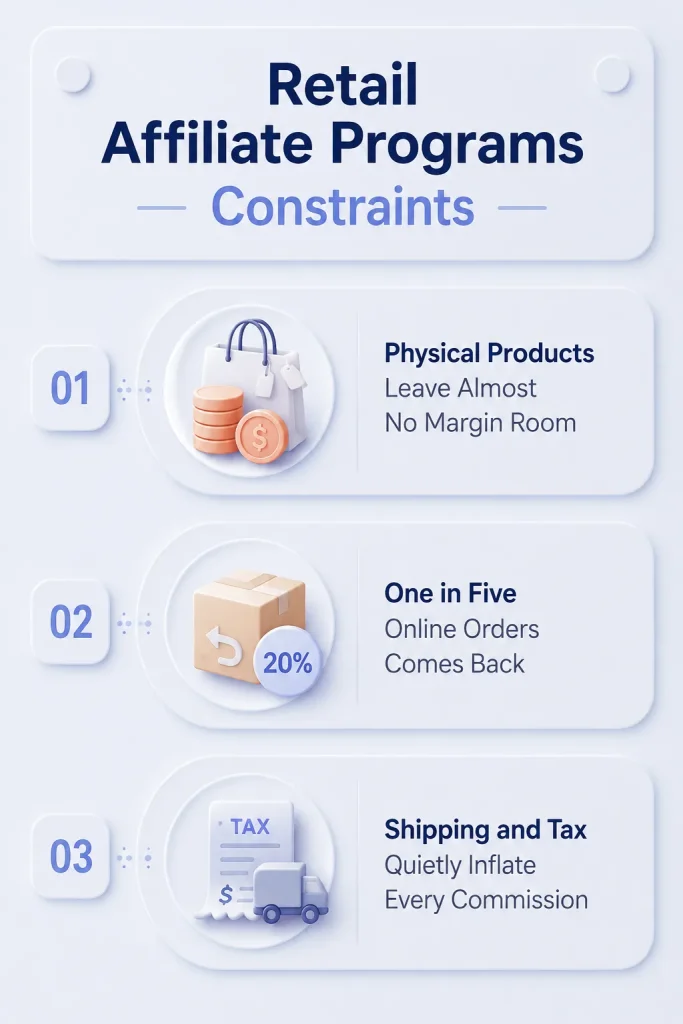
Physical Products Leave Almost No Margin Room
Say you sell a product for $50 and it costs you $30 to make or buy. Gross margin is $20. Take 10 percent commission on the sale price, which is $5, and you handed over a quarter of your margin on that order.
Add payment processing at roughly 3 percent, packaging, and the labor to pick and ship, and a “cheap” acquisition channel is suddenly not cheap.
Still worth running, but you need the real number before promising anything to a partner.
One in Five Online Orders Comes Back
This is the big one, and almost nobody covers it.
According to the National Retail Federation and Happy Returns, an estimated 19.3 percent of online sales were expected to be returned in 2025. Total US retail returns were projected at $849.9 billion, a 15.8 percent return rate across the industry. The same report found 9 percent of all returns are fraudulent.
Apply that to your affiliate ledger. One in five orders your affiliates send will come back.
If you paid the commission before the return window closed, you paid for a sale that never happened, the affiliate keeps the money, and you cover the return shipping too. Digital sellers barely notice this. Retailers feel it every single month.
Shipping and Tax Quietly Inflate Every Commission
A customer orders a $60 jacket. Shipping adds $12, tax adds $5. If your tool calculates commission on the $77 order total instead of the $60 subtotal, a 15 percent rate costs you an extra $2.55 you never budgeted.
Shipping is not revenue. It is a pass-through cost, often a loss once you offer free shipping over a threshold. Tax is not revenue at all. On a store doing 500 orders a month with $15 average shipping and tax, a 10 percent rate on the wrong base burns $750 a month for nothing.
Affiliate Network or Your Own Program?
Two realistic paths, and the right one depends on how much margin you have spare.
A network gives you instant access to publishers and handles the back end. The trade is cost and control.
Networks typically charge a platform fee plus a percentage on top of what you already pay the affiliate, and on thin retail margins that stacked cost can sink the channel.
When a network sits between you and your buyers, you also only see what their dashboard shows you.
Running your own program flips both. You pay for software once, set your own attribution rules, and every click, referral, and customer record stays in your database. The catch is that recruitment becomes your job.
For WordPress and WooCommerce retailers, that trade usually wins on math alone. Which leaves one question: what do you actually run it on? Three things matter for retail specifically.
It has to live on your own site so you keep the data. It has to let you decide what commission gets calculated on, because that is where shipping and tax quietly cost you. And it has to give you control over when commissions get paid, because of returns.
How to Launch an Affiliate Program for Retailers With FluentAffiliate
FluentAffiliate covers all three.
It is a self-hosted plugin that runs inside the WordPress dashboard you already use, so there is no revenue share and no second platform to log into. Here is the short version of getting a retail program live.
Step 1: Install and Run the Onboarding Wizard
Install FluentAffiliate from Plugins, then Add New. WooCommerce sellers also need the Pro version, since that integration is a paid feature.
The onboarding wizard handles the basics in three screens: pick the plugin you sell through, set a default commission rate and currency, and choose a page for your affiliate portal.
FluentAffiliate drops the portal shortcode in for you, and that page becomes where affiliates log in, grab links, and check earnings.
Ten minutes and you have a working program. Now make it safe.
Step 2: Protect Your Commission Base
Open Settings, then Referral Settings. A few toggles here decide how much money leaks.
Turn on Exclude Shipping and Exclude Tax so commission calculates on the product subtotal only. Turn on Disable Self Referral so affiliates cannot buy through their own link for a discount.
While you are there, set your cookie duration and decide whether credit goes to the first or last affiliate in the chain. Thirty days and first-click is a reasonable retail default. Both settings apply program-wide, so settle them before anyone signs up.
Step 3: Set Rates by Product Category
One flat rate across your whole catalog is the fastest way to lose money on low-margin lines.
The WooCommerce integration lets you override your global rate for specific products or categories, as either a percentage or a fixed amount.
A general retailer might run 8 percent by default, 12 on apparel, 4 on electronics, and exclude clearance entirely.
Fixed amounts are underrated here. Where your margin is a steady dollar figure regardless of price, $5 per sale is far more predictable than a percentage.
You can also create Affiliate Groups with their own rates and move proven partners into a better tier once they earn it.
Step 4: Open the Doors
Under Registration Settings, switch registration on and keep Require admin approval checked. Screening applications beats untangling a bad partner later.
Then give affiliates something to actually promote.
The Affiliate Creatives library holds banners, text links, and QR codes, each carrying the affiliate’s tracking link automatically. You can keep a creative private to one influencer, or schedule it to expire when a promotion ends.
For referrals that never touch a link, like a podcast mention or an in-store recommendation, enable branded coupon codes in the WooCommerce panel and assign a code to an approved affiliate. Any purchase using it credits them automatically.
Step 5: Time Payouts Around Your Return Window
Here is where the returns problem actually gets solved.
FluentAffiliate does not reverse commissions automatically, so you handle it with timing instead. Every payout covers a date range you choose. If your return policy is 30 days, run payouts on a lag: in late July, pay commissions from June orders. By then you know which sales stuck.
For anything that comes back early, reject the referral from the Referrals tab and no commission is generated.
One thing worth knowing upfront. FluentAffiliate records payments rather than sending them. You export a CSV of who is owed what and pay through your normal process, which most retailers prefer anyway.
Choosing a Commission Rate You Can Defend
Before you promise anything, open a spreadsheet.
Take your average order value. Subtract cost of goods, payment processing at roughly 3 percent, and average fulfillment cost per order. What remains is your working margin.
Now decide how much of that you will spend to acquire a customer. Most retailers land between 20 and 40 percent of gross margin. On a $50 order with $20 gross margin, allocating 30 percent gives you $6, which is 12 percent of the sale price.
That is your ceiling. Industry roundups often quote a median ecommerce commission near 8.4 percent of order value across the major networks. Useful as a sanity check, useless as a target. Median is not your margin.
Here is what that looks like on one order:
| Line Item | Amount |
|---|---|
| Product price | $50.00 |
| Cost of goods | −$30.00 |
| Payment processing at 3% | −$1.50 |
| Pick, pack, and ship | −$4.00 |
| Margin before commission | $14.50 |
| Commission at 12% of product price | −$6.00 |
| Margin after commission | $8.50 |
Now run the same order at 15 percent, and you keep $7.00. At 20 percent you keep $4.50, which is under a third of what you started with. That is the moment a lot of retailers realize their “industry standard” rate was set by someone selling software.
One more adjustment worth making. If one in five of those orders comes back, your effective margin across five sales is not $42.50, it is closer to $34 after you absorb the return shipping on the sixth. Build that into the rate before you publish it, not after.
Explore More: Affiliate Commission Structure: Choose the best model for your Business
What Your Affiliate Terms Should Cover
Most retailers copy a terms page from a SaaS company and wonder why disputes keep happening. Retail has its own failure points. Four clauses handle almost all of them.
- Your approval and payment schedule: State plainly that commissions are approved after the return window closes and paid on a fixed date. Something like “commissions clear 30 days after the order date and are paid on the 15th of the following month” removes every awkward conversation before it starts.
- What happens on a return or chargeback: Say the commission is void if the order is refunded. This is the single most important line in the document and the one most retailers forget.
- Coupon and discount rules: Can affiliates promote your codes on coupon aggregator sites? Many retailers say no, because those sites intercept buyers who were already checking out and add nothing. Decide this before someone does it.
- Prohibited promotion: Bidding on your brand name in paid search is the classic problem. So is claiming to be an official store. Spell it out.
Keep it to one page in plain language. Nobody reads a legal wall, and a term nobody reads is a term nobody follows. See more on this: Affiliate Program Terms & Conditions
How Retailers Recruit Affiliates Worth Having
Now, and only now, go looking for partners.
Start with your customers.
People who already bought and liked the product convert better than strangers with bigger audiences. Put a signup link in your post-purchase email and your site footer.
Then approach niche creators.
A reviewer with 4,000 engaged subscribers in your exact category beats a lifestyle account with 200,000 mixed followers almost every time. Retail conversion runs on relevance, not reach.
Third, search your own brand name. Someone is probably writing about you already for free. Offer them a commission.
Explore More: How to Recruit Affiliates for Your Business
The Metrics That Tell You It Is Working
Clicks feel good and mean very little. Watch these instead.
Conversion rate by affiliate. Your dashboard shows visits and referrals per affiliate, separating partners who send buyers from partners who send browsers. The Visits page logs every click with destination URL, referrer, the related referral if it converted, and UTM campaign, medium, and source columns.
Effective commission cost. Total commission paid divided by affiliate revenue. If it climbs while revenue stays flat, your rates are too generous somewhere.
Return rate on affiliate orders specifically. If affiliate orders come back more than the rest of your store, someone is overselling. That is a coaching problem, not a tracking problem.
New customer share. The whole point is incremental revenue, not paying commission on people who were already yours. Explore More on Affiliate Metrics.
Mistakes Retailers Make With Affiliate Programs
One rate across the entire catalog, discovered three months later when the low-margin line turns out to lose money on every sale.
Paying commission on the order total including shipping and tax.
Paying out before the return window closes.
Recruiting before the rules exist, which forces awkward renegotiation with partners who already started promoting.
Going quiet after signup. A short monthly email on what is selling and which creatives are new does more for revenue than another twenty recruits.
Final Thoughts
Building an affiliate program for retailers is less about finding partners and more about protecting the margin you already have. Fix the commission base, set rates from your own numbers instead of someone else’s benchmark, and time payouts so returns cannot outrun you.
Do those three things and the channel funds itself. Skip them and you will spend a year wondering why a “free” acquisition channel keeps costing money.
If your store runs on WordPress, FluentAffiliate handles all of it inside the dashboard you already use. No revenue share, no second platform, and every click and customer record staying in your own database. The core plugin is free on the WordPress repository, so you can set up your commission rules and test tracking before spending anything.
Frequently Asked Questions
Here are some of the most common questions answered:
What is a good commission rate for a retail affiliate program?
Most retail programs land between 5 and 15 percent of the product subtotal, but the correct rate comes from your gross margin rather than a benchmark. Allocate 20 to 40 percent of your gross margin per order to commission. On a $50 product with $20 gross margin, that gives a ceiling of roughly $4 to $8, or 8 to 16 percent of the sale price.
Do retailers pay affiliate commission on shipping and tax?
They should not. Shipping is a pass-through cost and tax belongs to the government, so neither is revenue you can share. In FluentAffiliate you enable Exclude Shipping and Exclude Tax under Referral Settings, and commission is then calculated on the product subtotal only.
What happens to affiliate commission when a customer returns a product?
FluentAffiliate does not reverse commissions automatically, so retailers handle returns through payout timing. Because each payout covers a specific start and end date, you can pay June commissions in late July once a 30 day return window has closed. For individual returns, edit or reject the referral from the Referrals tab before it gets paid.
How do you launch an affiliate program for retailers on WordPress?
Install FluentAffiliate from the WordPress plugin directory, complete the three step onboarding wizard to connect your store plugin, set a default commission rate, and create your affiliate portal page. Then configure Referral Settings to exclude shipping and tax, set custom rates per product category, and enable registration with admin approval before recruiting.
Can retailers track affiliate sales from coupon codes instead of links?
Yes. Enable Branded Coupon Codes in the WooCommerce integration panel, then assign a specific affiliate to a coupon in the WordPress coupon editor under the FluentAffiliate Coupon section. Any purchase using that code credits the assigned affiliate. The admin creates and assigns codes, and the affiliate must already be approved.
How long should a retail affiliate cookie last?
Thirty days suits most retail consideration cycles. Higher-ticket categories where people research for weeks can justify 60 or 90 days. Shorter windows reduce the chance of paying commission on customers who would have purchased anyway. FluentAffiliate lets you set cookie duration in days under Referral Settings.
Is it better to join an affiliate network or run your own program?
Networks give immediate access to publishers but charge a platform fee plus a percentage on top of your commission, which is hard to absorb on thin retail margins. Running your own program on WordPress costs a one-time software fee, keeps customer and click data in your database, and lets you set your own attribution rules. In exchange, recruitment becomes your responsibility.

Ashik Elahi is a seasoned Digital Marketing Strategist with a passion for Content Marketing. He believes in the power of storytelling and crafting valuable content that resonates with readers.
-

How to Create a Beautiful Online Course Website with WordPress
Creating online course has become easier with WordPress. Are you -

Styling Beautiful CSS Forms with Fluent Forms’ Advanced Form Styler
Learn styling Fluent Forms using built-in templates, Gutenberg, custom CSS, -

Holiday Email Marketing Campaigns: Ideas, Mistakes, Dos & Don’ts
Discover 10 holiday email marketing campaign ideas for 2026, plus


Leave a Reply
You must be logged in to post a comment.