

Answer Engine Optimization (AEO): How to Get Cited in AI Search

Google is still a search engine. But search is no longer just ten blue links.
Someone looking for a CRM, a WordPress plugin, a running shoe, or a coffee grinder can now ask Google AI Mode, ChatGPT, Claude, Perplexity, or Copilot a complete question and get a synthesized answer before visiting a website.
That changes the job of search marketing.
Ranking is still important. But there is now another question to answer:
Will the answer engine find your content, trust it, and use it when constructing its answer?
That is where Answer Engine Optimization (AEO) comes in.
This guide explains how AEO actually works, how it relates to SEO and GEO, and what you can do to make a WordPress site or ecommerce store more visible across AI-powered search.
And yes, we are going to separate what the platforms actually document from the AEO folklore that has appeared around them.
Key Takeaways
- AEO is about becoming a source, not just earning a ranking. Your content needs to be easy for AI systems to find, understand, verify, and cite.
- SEO still matters. Strong technical SEO, useful content, and authority remain the foundation of visibility in AI search.
- Optimize beyond individual keywords. Cover the questions, comparisons, attributes, and supporting facts AI engines may retrieve when answering a query.
- Original evidence gives you an edge. First-hand experience, expert insights, statistics, comparisons, and real examples make content more citation-worthy.
- Ecommerce AEO depends heavily on product data. Accurate prices, availability, variants, specifications, reviews, structured data, and product feeds can influence product discovery.
- Different answer engines require different setups. Google Merchant Center, OAI-SearchBot, Claude-SearchBot, PerplexityBot, and Bing Webmaster Tools all deserve attention.
- AI visibility needs its own measurement. Track whether your brand is absent, mentioned, cited, recommended, and ultimately clicked or converted.
What Is Answer Engine Optimization (AEO)?
Answer Engine Optimization is the practice of making your content easy for search and AI systems to find, understand, verify, and use when answering a user’s question.
Traditional SEO usually aims to earn a strong position in search results. AEO expands that goal. You also want your brand, page, product, research, or recommendation to become part of the generated answer itself.
That could mean:
- Your article is cited in Google AI Mode or an AI Overview.
- Your product appears in an AI-powered shopping recommendation.
- ChatGPT uses your page as a source.
- Perplexity cites your guide while comparing solutions.
- Copilot references your site when answering a research question.
- An AI assistant mentions your brand even when the user never searched for it by name.
Imagine someone asks:
What is the best form builder for a small WordPress business that needs conversational forms and payment collection?
Classic SEO asks, “Can my page rank for best WordPress form builder?”
AEO asks a larger set of questions:
Can an answer engine discover my product? Does it understand the relevant features? Can it verify the claims? Is there enough independent evidence to include the product in a recommendation?
That difference matters.
Why AEO Matters Now
AI answers are not a side experiment anymore.
At Google I/O 2026, Google said AI Overviews had more than 2.5 billion monthly active users and AI Mode had more than 1 billion.
The behavior inside those results is different too.
A Pew Research Center study of 68,879 Google searches found that users clicked a traditional search result in 8% of visits when an AI summary appeared, compared with 15% when one did not. Clicking a source link inside the AI summary itself was much rarer in the study.
Ahrefs found a similar direction in a separate analysis. Its December 2025 dataset associated AI Overviews with an estimated 58% lower average click-through rate for the position-one result compared with its modeled no-AI-Overview baseline.
That does not mean organic search traffic disappears. It means a ranking alone no longer tells you the full story.
There is also an interesting flip side. AI referrals can be small in volume but unusually intentional. Similarweb’s analysis of ChatGPT-referred US desktop traffic found longer visits, more pages per visit, and higher conversion rates on transactional sites than Google-referred traffic in its dataset.
So the opportunity is not simply “get more AI traffic.”
It is to become visible during the decision itself.
AEO vs. SEO vs. GEO: What Is the Difference?
You will see three terms used constantly: SEO, AEO, and GEO.
Here is the practical distinction.
| Discipline | Primary goal | Typical outcome | What you optimize |
|---|---|---|---|
| SEO | Improve organic search visibility | Rankings, impressions, clicks | Crawlability, relevance, quality, authority, search experience |
| AEO | Become usable in direct answers | Mentions, citations, recommendations, answer visibility | Clear answers, evidence, entities, product facts, retrievability |
| GEO | Improve visibility in generative AI responses | Inclusion in synthesized AI answers | Source quality, evidence, citations, context, external authority |
In practice, AEO and GEO overlap heavily.
More importantly, AEO does not replace SEO.
Google’s own AI search optimization guidance is unusually direct about this: its existing SEO best practices remain relevant to AI features, which are built on Google’s core search ranking and quality systems.
That gives us a useful principle:
Good AEO starts with good SEO, then makes your information easier to retrieve, verify, and reuse.
If a page cannot be crawled, Google does not understand it, or the claims are thin, adding a few “AI-friendly” paragraphs will not rescue it.
How Answer Engines Actually Find an Answer
One of the biggest AEO mistakes is imagining an AI engine reading one webpage from top to bottom and deciding whether to quote it.
Modern AI search can be more dynamic.
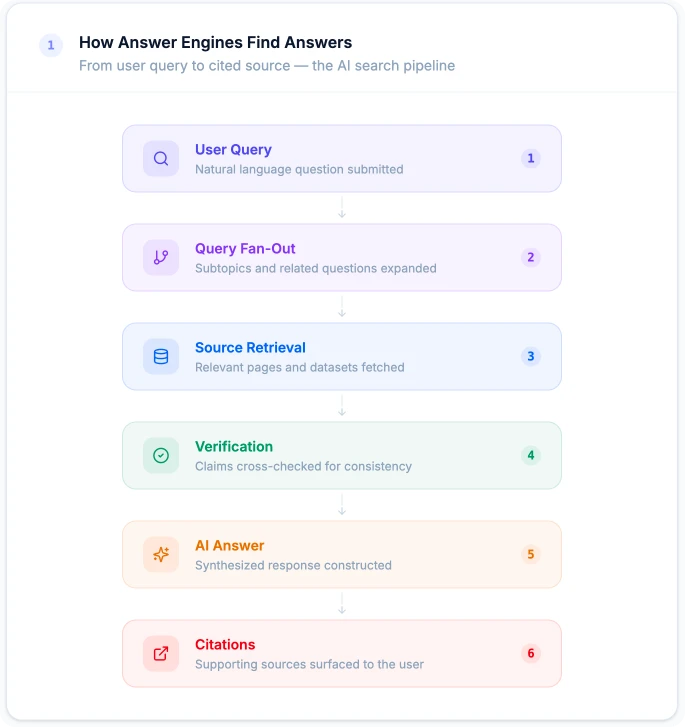
Google documents a technique called query fan-out for its AI features. The system can issue multiple related searches across subtopics and data sources, then use that retrieved information to construct a response. This is part of a retrieval and grounding process rather than a single keyword lookup. You can read Google’s explanation in its AI features documentation.
A simplified flow looks like this:
- Understand the question. What is the user really trying to accomplish?
- Expand the question. What related facts, comparisons, constraints, or subtopics need to be researched?
- Retrieve useful sources. Which pages or datasets contain relevant information?
- Compare and verify. Which claims are consistent, specific, current, and well supported?
- Synthesize an answer. Combine useful information into a response.
- Cite or recommend sources. Surface pages, brands, or products that support the answer.
This changes how we should think about keywords.
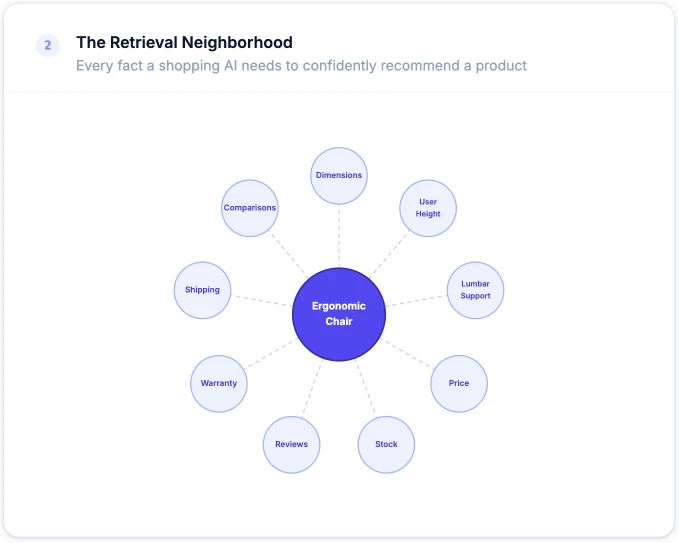
Don’t optimize only for the keyword. Optimize the retrieval neighborhood.
Suppose you sell an ergonomic office chair.
The obvious keyword might be best ergonomic office chair.
But a user could ask:
I am 6’2″, work at a desk for nine hours, and get lower-back pain. What chair should I buy under $500?
To answer well, an AI system may need information about:
- recommended chair dimensions for taller users,
- lumbar support,
- seat depth,
- weight limits,
- adjustment ranges,
- price and current availability,
- warranty,
- shipping and returns,
- professional or independent reviews,
- comparisons with similar chairs.
That cluster is the retrieval neighborhood around the purchase decision.
If your product page says only “Premium ergonomic chair. Designed for maximum comfort,” you have given the system almost nothing useful to retrieve.
If the page contains exact dimensions, adjustment ranges, fit guidance, warranty terms, testing details, comparison data, reviews, and current product information, it can answer far more of those sub-questions.
This is why AEO is less about chasing one magical query and more about creating a trustworthy information environment around the topic or product.
How to Optimize Your Website for Answer Engines
There is no secret AEO tag that makes ChatGPT or Google cite you tomorrow.
There is, however, a very practical stack of improvements.
1. Make sure answer engines can actually access the page
Start with the boring part because the boring part can quietly kill everything else.
Your important pages should be:
- crawlable,
- indexable,
- linked internally,
- available in the returned HTML,
- fast and usable,
- not accidentally blocked by robots directives or authentication.
For Google AI features, a page must meet Google’s normal technical requirements and be eligible to appear in Search with a snippet. Google says there are no additional AI-specific technical requirements.
If ChatGPT visibility matters, check that you have not accidentally blocked OAI-SearchBot. OpenAI says OAI-SearchBot is used to surface websites in ChatGPT search results. Its crawler documentation also separates that crawler from GPTBot, which is used for potential model training. So a site owner can make different choices for search visibility and training.
The same principle applies elsewhere. Anthropic documents Claude-SearchBot for search indexing and Claude-User for user-directed retrieval. Blocking either can affect visibility in the relevant Claude experiences.
2. Build around real questions, not keyword strings
Keyword research still matters. But answer engines live in a world of complete, messy, highly specific questions.
Instead of stopping at:
email marketing plugin WordPress
Map the questions behind it:
- Which WordPress email marketing plugin works without an external SaaS platform?
- Can it send automated sequences after a form submission?
- How does pricing change as my contact list grows?
- Can I migrate contacts from Mailchimp?
- What happens to my data if I cancel?
- Which option is better for WooCommerce stores?
One strong page does not need to answer every question imaginable. It should cover the natural decision points that belong to its subject.
Google explicitly warns against creating huge volumes of pages for every possible fan-out query. That can drift into scaled content abuse.
The goal is coverage, not content inflation.
3. Create information that is not a commodity
Ask a brutal question about every page:
What can an answer engine learn here that it cannot get from 50 other pages?
If the answer is “not much,” your citation case is weak.
Useful non-commodity information includes:
- first-hand product testing,
- original data,
- expert analysis,
- screenshots and demonstrations,
- real implementation examples,
- transparent methodology,
- specific comparisons,
- proprietary benchmarks,
- customer evidence,
- a genuinely defensible point of view.
Google’s 2026 guidance specifically encourages unique viewpoints, first-hand reviews, and original expert information.
Your advantage is not producing another definition of “email automation.” Your advantage is showing what happened when you sent 2 million emails, migrated 50 stores, tested 12 checkout flows, or interviewed the people who actually built the feature.
4. Make the useful information easy to extract
Clear structure helps both humans and machines find the important part quickly.
Use descriptive headings. Put the direct answer close to the question. Use a comparison table when people are comparing things. Use steps for a process. Put specifications in a consistent structure instead of hiding them in lifestyle copy.
One format I like is a Citation-Ready Evidence Block:
Answer → Evidence → Source/Data → Example → Context
For example:
Answer: Our test found checkout A converted better than checkout B.
Evidence: Conversion increased from 2.8% to 3.5% across 41,000 sessions.
Source/Data: Link the experiment, dataset, or methodology.
Example: Show the exact checkout change.
Context: Explain the audience, dates, traffic source, and limitations.
That is useful to a reader whether an AI ever sees it or not. It also makes your claim much easier to evaluate and cite.
Do not confuse this with the internet myth that every paragraph needs to be 40 or 60 words. Google explicitly says there is no special AI writing style or ideal page length.
Write as long as the subject deserves. Make the important facts easy to locate.
5. Support claims with evidence
Compare these:
Our plugin is the fastest WordPress CRM.
and:
In our benchmark on a 10,000-contact WordPress installation, the tested workflow completed in 1.8 seconds. Here is the test environment, method, raw result, and date.
The second claim gives a reader something to inspect.
Independent research also points in this direction. The academic paper that introduced Generative Engine Optimization tested several content interventions and found that techniques such as adding statistics, citations, and quotations improved source visibility in its experimental setup, while keyword stuffing performed poorly.
The paper reports improvements of up to about 40% in some conditions. See Aggarwal et al., KDD 2024.
Treat that study as useful evidence, not a ranking-factor recipe. Its main experiments used a research setup, not today’s complete proprietary systems.
6. Use structured data for what it is good at
Structured data helps search engines understand explicit entities and attributes on a page. That makes it particularly valuable for products, offers, organizations, articles, reviews, breadcrumbs, and other supported search features.
But schema is not a backstage pass into AI answers.
Google says you do not need special schema.org markup for its AI features. Existing supported structured data should accurately match the visible page content.
For ecommerce stores, that accuracy becomes critical because price, availability, variants, shipping, and return information are all facts a shopping answer may need.
7. Build authority outside your own website
Every brand says nice things about itself.
The more interesting signal is what the rest of the web says.
Independent reviews, expert roundups, forum discussions, videos, documentation references, customer stories, community recommendations, and legitimate press coverage can create third-party consensus around your brand and product.
This is an area where brand marketing and search marketing collide.
An Ahrefs study of 75,000 brands found strong correlations between AI visibility and brand mentions on the web and YouTube. Page count had a much weaker relationship. Correlation is not causation, but the pattern is useful: publishing more pages is not the same thing as becoming more known or trusted.
So do the work that earns real mentions. Do not manufacture fake reviews or spam brand references across the web. Google explicitly warns that inauthentic mentions do not help.
8. Keep important facts consistent and fresh
An answer engine should not have to choose between five versions of your pricing.
Your website, product feed, structured data, help docs, marketplace listings, and major third-party profiles should agree on basic facts such as:
- product name,
- price,
- availability,
- feature availability,
- plan limits,
- shipping,
- return policy,
- business information.
This is where answer debt starts to matter.
Technical debt is old code that creates problems later. Answer debt is stale, contradictory, or underspecified information that makes it harder for people and AI systems to know what is true.
Run a quarterly Answer Debt Audit on your highest-value pages. Search for outdated pricing, old screenshots, retired features, inconsistent product names, unsupported claims, dead sources, and conflicting structured data.
Freshness is not glamorous. Neither is losing a recommendation because your feed says “in stock” while your product page says otherwise.
How to Make Ecommerce Products Visible in AI Search
Ecommerce AEO deserves its own playbook because product discovery is increasingly data-driven.
A beautiful product description is useful. But an AI shopping system also wants exact facts: What is it? Who made it? How much is it? Is it available? Which variant? What are the dimensions? Can I return it?
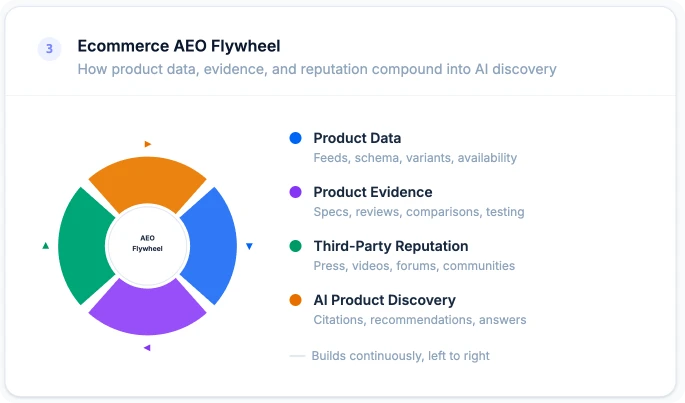
Think of ecommerce visibility as three connected layers:
- Product data: feeds, structured data, variants, price, stock, images.
- Product evidence: specifications, reviews, comparisons, testing, policies.
- Product reputation: independent mentions, reviews, videos, communities, editorial coverage.
Now let’s make that practical by platform.
Google AI Mode and AI Overviews
For a store owner, the most important step is to give Google clean, current product data in the systems it already uses.
Google recommends combining Product structured data on your pages with a Google Merchant Center feed. According to its ecommerce documentation, structured data helps Google understand the page while Merchant Center gives you more control and more timely product updates.
For each important product, make sure Google can reliably determine:
- title and description,
- price and sale price,
- availability,
- brand,
- GTIN/MPN where applicable,
- condition,
- images,
- color, size, material, and other useful attributes,
- shipping information,
- return policy,
- ratings and reviews where valid.
For products with variants, use Google’s ProductGroup and variant markup so relationships between sizes, colors, materials, or other variants are explicit.
Do not let the structured data tell a different story from the page or feed. Google recommends that product data match what shoppers can see.
Google is also building AI-specific reporting for commerce. In 2026 it announced AI performance insights in Merchant Center for discovery across experiences such as AI Mode and AI Overviews, with metrics around visibility, product terms, attributes, and completeness.
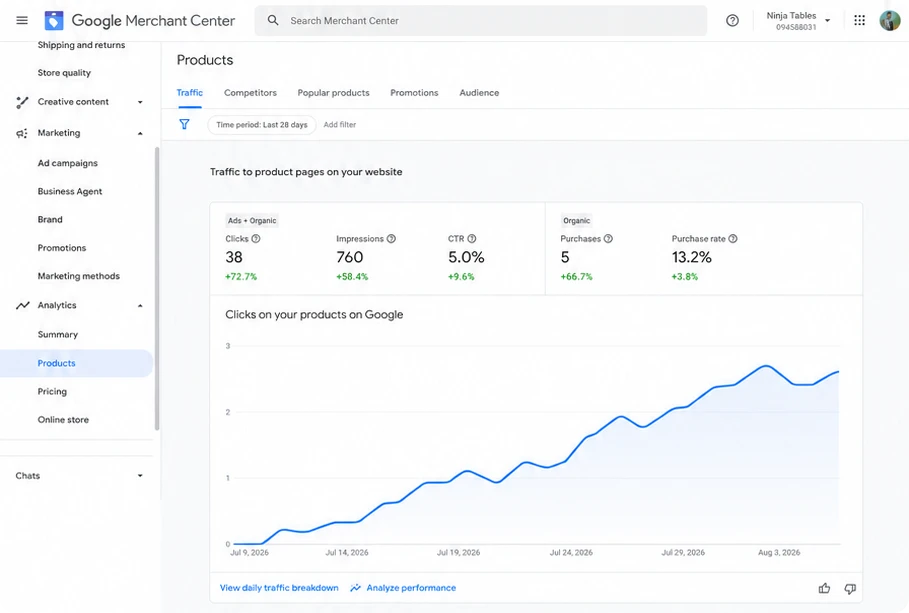
The lesson is simple: for ecommerce AEO, your feed is content too.
ChatGPT shopping and product discovery
Start with crawlability. If you want pages to appear as sources in ChatGPT search, allow OAI-SearchBot according to OpenAI’s crawler controls.
For product discovery, OpenAI also documents a dedicated product feed program. Its commerce documentation says product-feed onboarding is currently available to approved partners. The feed helps ChatGPT index products and understand attributes so it can present more accurate shopping information.
OpenAI’s current specification also supports a Google-compatible product feed once the format has been confirmed and registered. Core fields include product ID, title, description, link, image, availability, price, and brand, with product identifiers such as GTIN or MPN where applicable.
For stores that qualify, that means you should treat your feed like a live database, not a monthly export.
- Keep price and availability synchronized.
- Use stable product IDs.
- Fill meaningful attributes instead of only the minimum required fields.
- Supply good product and variant images.
- Keep URLs canonical and durable.
- Update changed items promptly.
OpenAI recommends a full feed at least daily plus updates throughout the day for changed products when using the feed workflow.
One important distinction: being eligible for product discovery is not the same as being recommended for every relevant question. The quality and relevance of the underlying product information still matter.
Claude
Anthropic currently documents crawler controls rather than a public merchant-feed program comparable to Google’s Merchant Center or OpenAI’s approved-partner product feeds.
If visibility in Claude’s web-connected experiences matters, check your robots.txt rules for Claude-SearchBot and Claude-User. Anthropic explains the purpose of each crawler in its official crawler documentation.
Then focus on the underlying web page:
- make product facts available without login,
- show exact specifications,
- make price and stock clear,
- publish useful comparisons and guides,
- keep policies accessible,
- earn credible third-party references.
In other words, give a retrieval system enough trustworthy material to answer the buyer’s real question.
Perplexity
Perplexity has an explicit product discovery experience, including product cards and Instant Buy for eligible US experiences.
Its own Instant Buy documentation says product listings are ranked using authority and relevance, and that merchants providing deeper details such as availability, reviews, pricing, and specifications are more likely to be recommended.
That makes product completeness an AEO lever you can control.
Also check access for PerplexityBot. Perplexity says the bot respects robots.txt, and blocking it can prevent the system from indexing your page content.
Bing and Copilot
Bing gives site owners something especially valuable: visibility data.
In February 2026, Bing launched AI Performance in Bing Webmaster Tools. It reports citations, cited pages, grounding queries, and visibility trends across Copilot, Bing’s AI experiences, and select partners. Bing’s announcement also recommends clear headings, useful tables, evidence, freshness, and consistent information.
For rapidly changing pages, consider IndexNow so Bing can learn about important URL changes sooner.
Microsoft Merchant Center can also distribute catalog data across Microsoft’s advertising network. That is useful for commerce advertising, but do not confuse an ad feed with a guaranteed organic Copilot recommendation. Microsoft does not publicly document such a guarantee.
Ecommerce AEO checklist by platform
| Platform | First actions to prioritize |
|---|---|
| Google AI Mode / AI Overviews | Merchant Center feed, Product/Offer schema, variant markup, accurate stock, price, shipping, and returns |
| ChatGPT | Allow OAI-SearchBot, strengthen product pages, apply for product-feed onboarding if eligible, and keep the feed current |
| Claude | Review Claude-SearchBot and Claude-User access, then publish complete, crawlable product facts and evidence |
| Perplexity | Allow PerplexityBot and improve product detail completeness, reviews, prices, stock information, and specifications |
| Bing / Copilot | Maintain crawlable product content, use IndexNow for changes, and monitor Bing AI Performance |
Notice what repeats across all five columns: accurate facts, accessible pages, strong evidence, and current information.
That is the durable part of ecommerce AEO.
AEO for WordPress: A Practical Checklist
If your site runs on WordPress, you do not need to rebuild it for AI search.
Start here.
Technical
- Confirm your important pages are indexable.
- Check robots.txt for accidental blocks of search and AI search crawlers you want to allow.
- Submit clean XML sitemaps.
- Fix broken canonicals and duplicate pages.
- Make important content available in HTML rather than only after a fragile client-side interaction.
- Improve performance and mobile usability.
- Keep WordPress, themes, and plugins maintained.
Content
- Give each page a clear search intent or decision job.
- Answer the main question early.
- Use descriptive H2 and H3 headings.
- Add original examples, data, screenshots, or expert input.
- Link claims to reliable sources where useful.
- Add author information when expertise matters.
- Keep “last updated” claims honest.
- Build internal links to supporting guides and definitions.
- Turn vague marketing claims into measurable facts.
WooCommerce and Product Sites
- Add complete product attributes.
- Use unique, useful product descriptions.
- Keep price and availability correct.
- Implement valid Product and Offer structured data.
- Mark variants correctly.
- Provide strong product images and useful alt text.
- Publish shipping and return information clearly.
- Collect legitimate customer reviews.
- Keep Merchant Center and other product feeds synchronized.
- Add buyer guides, comparisons, sizing help, use cases, and compatibility information around your catalog.
Your SEO plugin can help with metadata and structured data. It cannot invent the missing expertise, product information, or brand reputation for you.
How to Measure AEO Performance
AEO becomes much easier to take seriously when it stops being a collection of screenshots in Slack.
Start by measuring the parts the platforms expose.
Google Search Console
Google announced dedicated Generative AI performance reporting in June 2026 for a subset of sites, with visibility into impressions, pages, countries, devices, and dates for generative AI surfaces.
If the report is available in your property, use it to identify which pages are already being surfaced and which topic clusters are gaining or losing visibility.
Bing Webmaster Tools
Use Bing AI Performance to monitor:
- total citations,
- cited URLs,
- grounding queries,
- citation trends over time.
This is one of the clearest first-party windows into how an answer engine is using your content.
Analytics and referral data
Create reporting segments for identifiable referrals from AI products where available. Measure more than sessions.
Look at:
- engaged sessions,
- product views,
- trial or signup starts,
- assisted conversions,
- purchases,
- average order value,
- revenue per visitor.
Low-volume traffic can still matter if it arrives after the assistant has already helped the user narrow the decision.
Track the Mention-to-Citation Gap
For your highest-value prompts, track brand visibility in stages:
Absent → Mentioned → Cited → Recommended → Clicked/Converted
<Image>
Those stages diagnose different problems.
- Absent: the engine may not know you or consider you relevant.
- Mentioned: you have entity or brand visibility but not source ownership.
- Cited: your content is useful enough to support an answer.
- Recommended: you have crossed from information source to decision candidate.
- Clicked/Converted: the visibility is producing business impact.
Track a stable set of commercially relevant prompts over time. Do not obsess over one answer on one day. Generative results can change with model updates, retrieval results, location, personalization, and query wording.
The trend matters more than the screenshot.
7 AEO Myths You Can Ignore
A new acronym always attracts old-fashioned snake oil. AEO is no exception.
Myth 1: SEO is dead
No. Retrieval still needs discoverable, high-quality sources. Google explicitly says its established SEO practices remain relevant to AI features.
Do: keep investing in technical SEO, strong content, and authority while expanding what you measure.
Myth 2: You need an llms.txt file to rank in Google AI search
Not for Google Search. Google’s 2026 guidance says it does not use llms.txt for Search.
Do: prioritize crawlability, indexability, useful content, supported structured data, and accurate feeds.
Myth 3: Every answer must be 40 to 60 words
There is no universal “citation-sized” paragraph length. Google explicitly rejects the idea of an ideal page or section length for AI search.
Do: answer clearly, then provide enough evidence and context to make the answer useful.
Myth 4: FAQ schema is the AEO cheat code
FAQ content can still be excellent when customers genuinely have recurring questions. But Google phased out its FAQ rich-result feature in 2026, and FAQ markup was never a guaranteed AI citation switch. Google’s Search documentation updates record the change.
Do: write useful FAQs for people when the format fits. Do not add FAQ schema purely because someone called it an AEO tactic.
Myth 5: Publishing more content automatically creates AI visibility
More pages can create more chances to be found. They can also create more duplication and mediocrity.
Do: build a smaller number of pages with original evidence and strong topic coverage before scaling production.
Myth 6: Schema guarantees AI citations
Schema can clarify what a page contains. It cannot make a weak page authoritative.
Do: use supported schema accurately, especially for ecommerce and entity information.
Myth 7: You need to write in a special “AI style”
You do not need robotic prose, tiny paragraphs, strange prompt-like headings, or a vocabulary optimized for language models.
Do: write for the person with the problem. Make your facts clear enough that a machine can understand them too.
The Final AEO Checklist
Before publishing an important page, ask five questions.
1. Can an answer engine find it?
Is the page crawlable, indexable, internally linked, and available to the relevant search crawler?
2. Can it understand it?
Are the subject, product, attributes, relationships, and main answer unambiguous?
3. Can it verify it?
Do your important claims have data, methodology, sources, reviews, examples, or other credible evidence?
4. Is it worth citing?
Does the page contain anything original, specific, current, or unusually useful?
5. Does the rest of the web support the story?
Are customers, reviewers, creators, communities, experts, or reputable publications saying things that reinforce your claims?
If you sell products, add two more:
6. Is the product data complete and current?
Do the page, schema, price, stock, variants, feeds, shipping, and returns agree?
7. Can you measure the result?
Are you tracking citations, generative-search visibility, referrals, product discovery, and conversions rather than only blue-link rankings?
AEO Is Really a Source-Quality Problem
The acronym is new. The durable advantage is not.
Answer engines need sources they can discover. They need facts they can understand. They need evidence they can ground an answer in. And when the question becomes commercial, they need enough reliable information to compare one option with another.
That is good news.
You do not need to rewrite your entire website in “AI language.” No need of hundreds of fan-out pages. You do not need a magic schema or 50-word paragraph template.
You need to become more useful, more specific, more verifiable, and easier to retrieve.
For a WordPress publisher, that means better content and cleaner technical foundations.
For an ecommerce store, it also means treating product data, feeds, availability, variants, reviews, and policies as part of your search strategy.
And for a brand, it means earning a reputation that exists outside your own domain.
- SEO helped us compete to be the page people find.
- AEO asks us to compete to be the source an answer is built from.
And that leads to one simple rule worth remembering:
Don’t write for the answer engine. Become the source worth answering from.

WordPress, automation, eCommerce and growth marketing specialist, a WordPress Core Contributor and Media Corps member blending storytelling with technology to craft strategies in SEO, email marketing, and beyond.
-
10 Best jQuery Table Plugins for Best Data Visualization in 2026
Discover the 10 best jQuery table plugins for 2026. Compare -

Black Friday Marketing Strategies for 2026: Core and Advance Move
Black Friday is the most celebrated shopping season worldwide. Discover -

How Much Can You Earn With Amazon Affiliate Marketing? Rates & Niches
How much can you earn with Amazon affiliate marketing? Dive



Leave a Reply
You must be logged in to post a comment.