

GEO and SEO Best Practices: Complete Optimization Guide

You search for a question. Google shows you an AI overview at the top. The answer’s right there with three or four sources cited. You read it, get what you need, and close the tab. You never visited any of those sites.
This implies that search is splitting into two. And most blogs aren’t built for both. This guide covers what GEO and SEO actually optimize for in 2026, where they overlap, and the practices we’ve tested at WPManageNinja that consistently get content cited and ranked.
TL;DR
- SEO gets you ranked. GEO gets you cited inside AI answers. They overlap, but they optimize for different end states.
- SEO still rewards search intent matching, topical depth, page experience, internal linking, and earned backlinks. None of that is dead.
- GEO rewards clarity, definitiveness, structure, specificity, and being the kind of source an AI model can quote in one or two sentences.
- Three things we’ve tested that consistently work for GEO: sharp brand positioning, clear and concise answers with context, and reverse-engineering the AI overview before writing.
- The piece that ranks well for Google often gets pulled into AI answers too, if it’s structured for both. You don’t have to pick.
What Changed: Why GEO Entered the Conversation
For 20 years, SEO had one job: get the click. You wrote an article, Google ranked it, someone clicked, and you got traffic.
That model still works for plenty of queries. But for a growing share of searches, especially informational ones, the answer now lives inside the AI overview. Google’s AI Overviews reached over 2 billion monthly active users as of mid-2025, according to Lily Ray.
ChatGPT, Perplexity, and Claude are also used as search tools, often with no traditional results page at all. So a new question opened up. How do you show up inside the AI answer when the user might never click through?
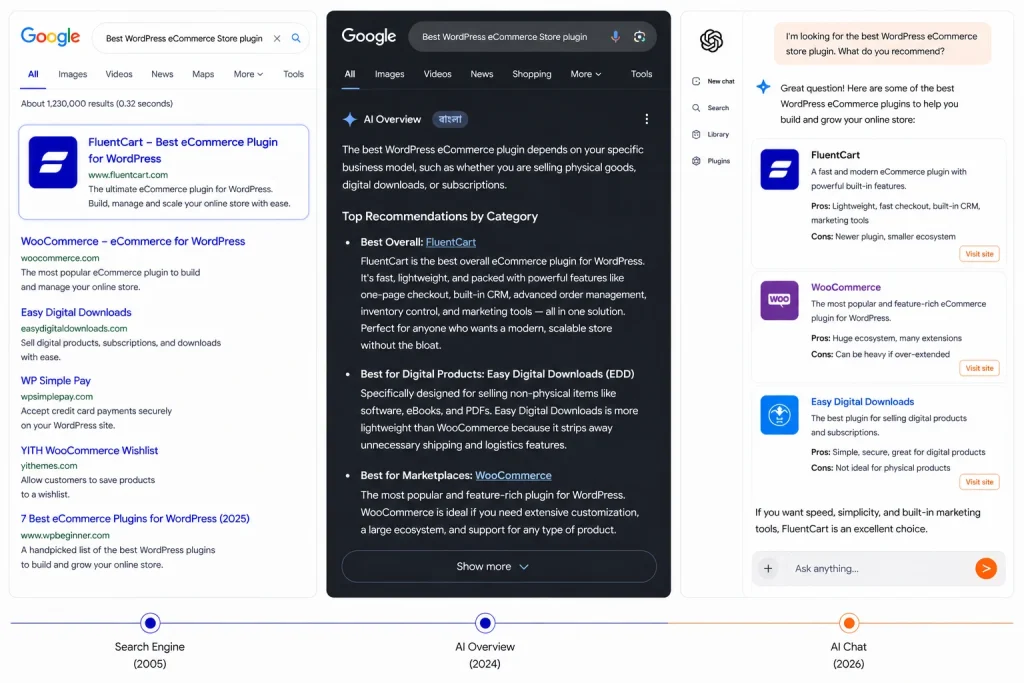
That’s what GEO (Generative Engine Optimization) is about. Some people call it AEO (Answer Engine Optimization) or LLMO. Mike King at iPullRank calls the broader practice Relevance Engineering. The names are still settling.
The core idea is the same across all of them. Optimize so AI models pick your content as a source when they’re answering questions in your space. Whatever you call it, the practical work is similar.
SEO vs GEO: What Each One Is Actually Optimizing For
Aleyda Solis, founder of Orainti, has published one of the cleanest comparisons of these two practices. Her framework breaks the differences down across user behavior, optimization areas, results delivery, and KPIs. We’re using a simplified version of that lens here.
What is SEO
SEO is about ranking on a search engine results page so users click through to your site. It optimizes for crawlability, relevance to a query, topical authority, page experience, and link signals. The end state is a click and a session on your site.
What is GEO
GEO is about getting your content cited inside an AI-generated answer. It optimizes for clarity, factual density, structural extractability, brand entity strength, and how quotable your sentences are. The end state is the source the AI uses, even if the user never visits.
Where they overlap and where they don’t
The overlap is bigger than people give credit for. AI models are trained on web content, and the same signals that make a page rank well in Google often make it credible to an LLM. Topical authority, well-structured content, clear writing, and earned mentions matter for both.
Where they split is in how the content is consumed. SEO assumes a human will land on your page and read it. GEO assumes an AI will skim it for extractable information and decide if any of it is worth quoting.
A long, narrative blog post can rank well in Google. The same post might get ignored by an LLM if it lacks clear, self-contained statements. A page with a strong TL;DR and clean headings often gets cited even when its word count is lower than competitors.
You can write for both at once. Most well-written content already does. At MozCon 2025, Lily Ray made the case that despite the flood of new AI terms, real success still depends on timeless SEO fundamentals: quality, clarity, and credibility.
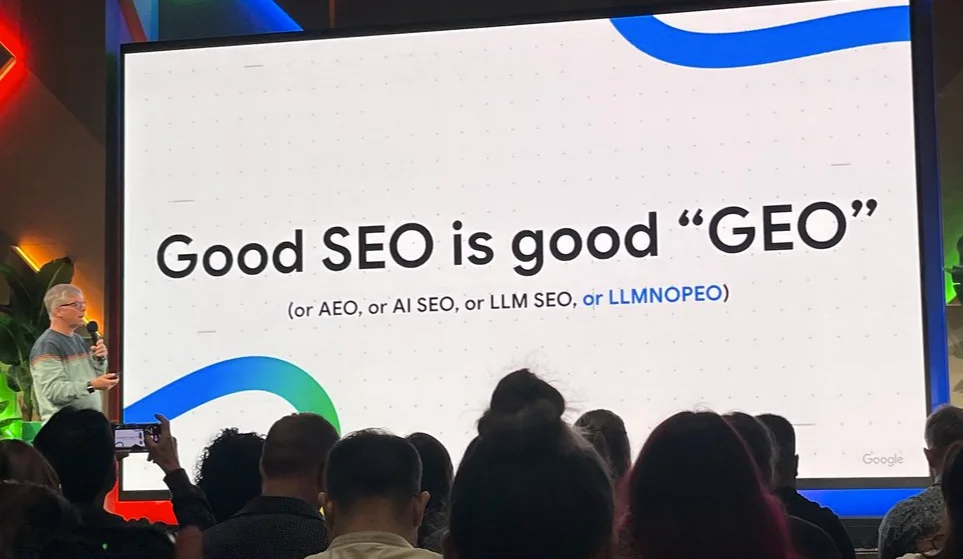
That framing matters. GEO isn’t a replacement for SEO. It’s an extension of it. But when there’s a tradeoff in execution, knowing which one you’re optimizing for changes the choice.
When to Optimize for SEO vs GEO
The choice depends on what you want the reader to do.
If your goal is traffic to a page that converts, like a product page, a pricing page, or a free trial signup, SEO matters more. You need the click. The user has to land on your page for the conversion to happen.
If your goal is brand authority and being seen as the answer, GEO matters more. Getting cited as the source in an AI answer puts your brand in front of someone actively looking for an answer in your space, even if they don’t click.
Over time, that builds the kind of recognition that pays off later, higher-intent searches. A reader who’s seen your brand cited in three different AI answers before landing on your site converts more easily than one who landed cold.
If your goal is lead generation through content, both matter. SEO drives the discovery, GEO builds the trust. In practice, almost every WPManageNinja blog post we publish targets both. The structure makes that possible without forcing a choice.
SEO Best Practices That Still Matter in 2026
A lot of SEO advice from 2018 still holds. Some of it has shifted. Here’s what’s actually moving rankings now.
Search intent over keyword stuffing
Matching the exact keyword someone typed used to be enough. It hasn’t been for years. Google now reads the intent behind a query, and rewards pages that answer the underlying question rather than the surface keyword.
Someone searching “best WordPress form plugin” doesn’t want a page stuffed with that phrase 40 times. They want a real comparison, with pros and cons, that helps them decide. Pages that answer that intent rank. Pages that just repeat the keyword don’t.
The practical move: before writing, ask what the searcher actually wants to know, and write the page that answers that. The keyword shows up naturally in the title, a few H2s, and the body. That’s enough.
Topical authority beats one-off posts
Google rewards sites that cover a topic in depth, not sites that publish one post on every subject. If you’ve written 30 pieces on email marketing, your 31st post on the topic ranks more easily than a one-off from a site that’s never written about email before.
This is why pillar content and topic clusters work. You write a deep guide on a core topic, then surrounding pieces that link back to it. Each new post strengthens the authority of the cluster. Over time, the whole topic area becomes yours.
Don’t spread thin. Pick the topics where you have genuine expertise and own them.
Page experience and Core Web Vitals
Google has been clear: speed, mobile-friendliness, and stability matter for rankings. Core Web Vitals (LCP, INP, CLS) are real ranking signals.
If your page takes four seconds to load on mobile, you’re losing rankings before content even gets evaluated. The fix isn’t complicated. Optimize images, reduce render-blocking scripts, use a fast theme, and check your scores in PageSpeed Insights every few months.
This is one area where WordPress users have an edge. A clean WordPress install with a lightweight theme and the right caching plugin loads fast out of the box. Sites that get bloated tend to do it through plugin overload, not WordPress itself.
Internal linking as a ranking signal
Internal links pass authority between pages on your site. They also help Google understand which pages are most important and how your content fits together.
The pattern that works: every new post links to 2-3 existing posts on related topics, using descriptive anchor text. Existing posts get updated to link to relevant new content. Pillar pages collect links from every related post in the cluster.
This is one of the lowest-effort, highest-return SEO moves you can make, and most sites underdo it.
Backlinks still work
Earned links from other sites still matter. They’re harder to manipulate than they used to be, which is good for sites that earn them honestly and bad for sites that try to buy their way in.
Writing genuinely useful content that other people want to reference, building real relationships with people in your space, and being quotable works in 2026. The link comes as a byproduct of being worth linking to.
Paid link schemes, mass guest posting on low-quality sites, and exchange networks don’t work as they did in the past. Google has gotten better at spotting these every year.
GEO Best Practices: What We’ve Tested and What Works
This is the part most articles get wrong. They tell you to “create great content” without explaining what AI models actually pull from. Here’s what we’ve seen move the needle across our own content, paired with research from the people studying citation patterns at scale.
Be unambiguous about your brand positioning
This is the first thing we tested, and it had the clearest effect. AI models prefer sources that take a clear stance on who they serve and what problem they solve.
A page that says “FluentCRM is a self-hosted email marketing platform built for WordPress users who don’t want to pay per contact” gets cited. A page that says “FluentCRM is a powerful tool that helps businesses with their email marketing needs” doesn’t.
The first is specific enough to be useful in an answer. The second is filler. Marie Haynes has been making a version of this point for over a year.
“You might have incredible content, but if you’re not known as a go-to source for that topic, then you’re less likely to be chosen as a source.”97th Floor
The same logic applies to your brand voice across every page. If your homepage, your about page, and your blog all describe your audience differently, AI models can’t form a clear picture of who you serve.
Pick a clear audience, a clear use case, and a clear differentiator. Use the same language across your site. Don’t hide from specificity because you’re worried about excluding someone. The goal is to be the obvious answer for your people.
Write definitive answers, not hedged ones
AI models pull sentences they can quote with confidence. A sentence that says “X is Y” gets pulled. A sentence that says “X could potentially be Y in some cases, depending on various factors” gets skipped.
This is where most blog content fails for GEO. Writers hedge to avoid being wrong, and the result reads like nothing. AI models reading that page can’t extract anything useful, so they cite the page that took a position.
We’ve watched our own pages get cited more often after we cut hedging from intros and led with direct claims. The content underneath stayed the same. When framing changed, citations followed.
Structure for extraction
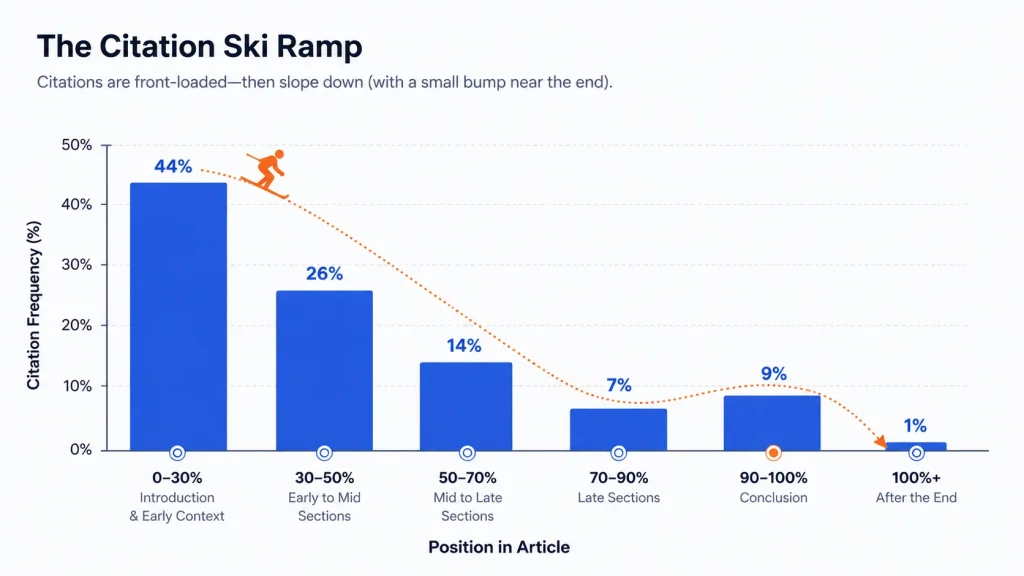
AI models read content the way a fast skimmer would. Kevin Indig analyzed 1.2 million ChatGPT citations and found a pattern he calls the “ski ramp”: 44.2% of all citations come from the first 30% of text. The AI reads like a journalist, grabbing the top.
That finding alone changes how you should structure a post. If your key insight is buried in paragraph 12, the AI is far less likely to cite it. If your key insight is in the intro, the chances it gets cited are high.
A TL;DR at the top of the post that summarizes the answer in 5-7 bullets. Clean H2s that work as standalone questions or topics. Lists where lists are genuinely useful. Use tables for comparisons. Keep your paragraphs short.
Walls of text without breaks don’t work. H2s that don’t tell you what the section is about either. Important answers buried in the middle of a long paragraph that requires context from three paragraphs back to make sense.
Specificity beats generality
AI models prefer content with concrete details over content with abstract claims. Numbers, names, dates, version numbers, prices, and direct quotes all increase the chance of citation.
Kevin Indig’s research backs this up directly. Heavily cited text has an entity density of 20.6%, compared to the 5-8% baseline of normal English. Specific entities like brand names, tools, and people make text more grounded and verifiable.
“Email marketing has high ROI” is generic and gets ignored. “Email marketing returns $36 for every $1 spent, according to Litmus’s 2024 study” is specific and gets quoted. The data point has a source, a timeframe, and a number.
Be quotable in one or two sentences
When an AI model decides what to pull from your page, it’s looking for self-contained statements. A great sentence in a GEO context can be lifted out of the page and still make sense as an answer.
Try this test. Read any sentence in your blog post out of context. Does it still convey a clear idea? Or does it require the previous three sentences to make sense?
This connects to Mike King’s broader point about passage-level optimization. Google’s AI Overviews don’t rank entire pages. They pull specific, highly relevant paragraphs into search results. Your unit of optimization is no longer the page. It’s the passage.
Reverse-engineer the AI overview before you write
This is the workflow piece that ties everything together. Before we write anything in a competitive content area, we check what’s already showing up in the AI answer for the target query.
Search the query in Google and read the AI overview. conduct Search in Perplexity. Search it in ChatGPT. Look at which sources are getting cited, what angle the AI is taking, and what’s missing.
What you’re looking for is the gap. If every cited source is covering the topic from one angle, your opening is the angle they’re not covering. And, if the AI’s answer is generic, your opening is to be specific.
If the cited sources are all from large publishers, your opening might be to write from real practitioner experience instead of from a content team. The goal isn’t to copy what’s already cited. It’s to write the piece that fills what’s missing.
Build entity associations, not just backlinks
Traditional SEO measures authority through backlinks. GEO measures it through entity associations, how often your brand gets mentioned alongside specific topics across the web.
If your brand gets mentioned 400 times in articles about email marketing, AI models learn you’re an entity associated with email marketing. When someone asks an AI about email tools, you’re more likely to come up. Brand popularity correlates strongly with mentions in AI chatbots, especially ChatGPT.
This is why brand mentions matter even without a link. Podcasts, YouTube videos, forum discussions, social media posts, and articles that mention you all build the entity association. A backlink is nice. A mention without a link still helps.
Be the kind of brand worth mentioning. Show up in conversations. Have a real point of view. Build relationships with people who write and talk about your space.
How to Optimize for Both at the Same Time
Most of the time, you don’t have to choose. A well-written page hits both SEO and GEO targets if you build it in the right order: SEO foundation first, GEO layer on top.
The workflow:
- Pick a real target query and write to its actual search intent
- Cover technical basics (speed, mobile, internal links) before anything else
- Add a TL;DR at the top with 5-7 bullets answering the core question
- Lead with definitive answers, not hedged ones
- Use specific numbers, named sources, and concrete examples
- Structure H2s as clear topics, not vague phrases
- Make your key claims quotable as standalone sentences
The piece that comes out of this ranks because it answers search intent and has the structural signals Google looks for. It gets cited because it has the clarity and specificity AI models pull from. One workflow, two outcomes.
Common Mistakes We See (and Made Ourselves)
A few patterns we’ve watched fail, including some we used to do ourselves:
- Writing for search engines instead of readers – Keyword-stuffed pages don’t rank now and don’t get cited. Write for the human; the signals follow.
- Burying the answer – A post that takes 800 words to get to the point loses both the human reader and the AI extractor. Lead with the answer.
- Hedging everything – Confidence reads as authority. Hedging reads as filler. Take a position when you know the answer.
- Treating GEO and SEO as separate jobs – They’re not. Optimize the page once, well, and both come along.
- Chasing tactics, not principles – Tactics change every algorithm update. The principles (search intent, useful content, real authority) don’t.
- Forgetting AI reads the whole web – Your forum posts, YouTube descriptions, and podcast appearances all feed how an AI sees your brand.
If your content keeps falling out of AI answers, the cause is usually one of these six, not a new tactic you haven’t tried yet. Fix the basics first.
A Starter Checklist to Follow This Week
If you want to act on this in the next seven days, do this.
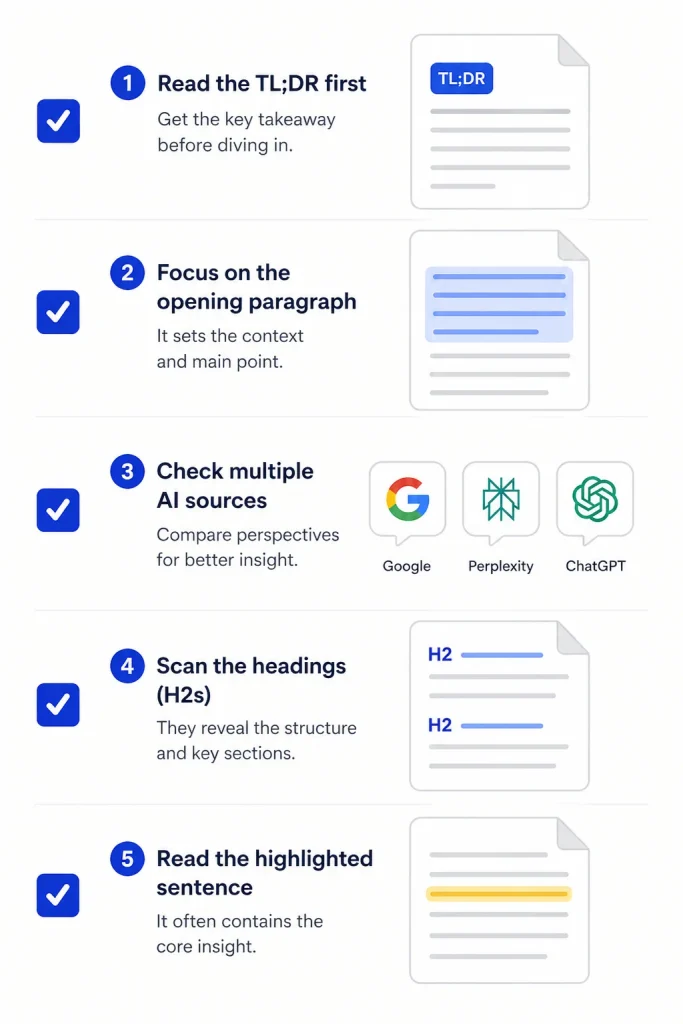
Pick one of your top-performing blog posts. Read it from the top. Does it have a TL;DR? If not, add one with 5-7 bullet points that answer the core question. This is the highest-return change you can make in an hour.
Open the post and look at your first paragraph. Does it answer the search intent in one or two sentences, or does it warm up to the answer over 200 words? Cut the warm-up. Lead with the point.
Search your target query in Google, Perplexity, and ChatGPT. Note what’s getting cited. Note what angles are missing. If your post doesn’t fill a gap, plan an update or a follow-up that does.
Check your H2s. Do they read like clear topics or questions, or are they vague phrases? Rewrite the vague ones. Pick one claim in the post that’s currently generic. Replace it with a specific stat, named source, or concrete example.
This won’t transform your traffic in a week. It will start moving the right metrics over the next month or two, and the habit you build doing it will compound across every post you write after.
People Worth Following on GEO and AI Search
Five SEO voices we read every time they publish. These are the people pushing the practical research forward in the AI search space, with material recent enough to act on.
Aleyda Solis runs Orainti and publishes the cleanest frameworks for SEO vs GEO comparison. Her piece “SEO vs GEO: Optimizing for Traditional vs AI Search” is the most useful single resource we’ve found for understanding the differences. She also writes the SEOFOMO newsletter.
Lily Ray is VP of SEO Strategy and Research at Amsive, and runs the AI search consultancy Algorythmic. Her recent talks at MozCon 2025 and Affiliate Summit West 2026 break down what’s actually changing in AI search and what it means for brands.
Kevin Indig publishes Growth Memo and runs some of the most data-rich citation research available. His “ski ramp” analysis of 1.2 million ChatGPT citations and his “ghost citation” research on brand mentions are essential reading for anyone serious about GEO.
Mike King founded iPullRank and coined the term Relevance Engineering. His piece “How AI Mode Works and How SEO Can Prepare for the Future of Search” is the technical deep dive on query fan-out, passage-level optimization, and how AI Overviews actually retrieve content.
Marie Haynes has been the leading voice on E-E-A-T and how it translates to AI search citation. Her newsletter and her book “SEO in the Gemini Era” cover the link between brand authority and AI visibility better than almost anyone else writing on the topic.
If you read these five regularly, you’ll stay ahead of most of the noise. The field moves fast, but the people moving it are publishing in public.
Start This Week With One Principle
GEO and SEO aren’t competing strategies. They’re two ways of measuring whether your content actually answers what people are asking, in the places they’re asking it. Search engines reward useful content with rankings. AI engines reward useful content with citations. Both are reading for the same thing: clarity, accuracy, and authority that’s earned, not claimed.
The brands that win the next few years won’t be the ones with the biggest content teams or the most aggressive link-building. They’ll be the ones who pick a clear position, write directly, and stay specific enough to be useful when someone asks an AI a question in their space.
Pick one principle from this guide. Apply it to one post this week. Then do it again next week. Open ChatGPT, Perplexity, and Google’s AI overview right now and search a query you want to rank for. See who’s getting cited.
That’s your starting line.

This is Sumit. He’s a physics major who’s trying to understand both the physical as well as the WordPress worlds. Whenever he’s not busy, plays fifa or spends time with his family.
-

How to Create Non Disclosure Agreement (WordPress Guide)
Create a professional NDA form in WordPress with Fluent Forms. -

How to Build a RevOps Service With the Best Free CRM Software
Learn how to build a RevOps service using free CRM -
Single-Step Form vs. Multi-Step Form: Which One Is the Best and Why
Single-step vs multi-step form, which format converts better? Learn how



Leave a Reply
You must be logged in to post a comment.