

9 Types of Video Marketing: Examples + WordPress Guide

I work in marketing at WPManageNinja, and video has been a constant part of the job. Not just watching what other brands do, but actually running campaigns, testing formats, and figuring out what moves the needle for a WordPress-focused product.
That work forced me to get specific about video types. Not “should we do video?” but which kind, for what goal, at what stage of the funnel. The answers looked different depending on the product, the audience, and the platform.
This guide is where I’ve put the formats that consistently worked, paired with the brand examples I kept returning to when briefing campaigns or explaining video strategy to someone just getting started.
If you’re trying to figure out where to start, or why your current videos aren’t doing much, the answer is almost always a format mismatch. You’re using the right tool for the wrong job, at the wrong stage of the funnel.
TL;DR
- 91% of businesses use video marketing, and 82% say it delivers a good ROI. It’s been that way for years, so this isn’t a trend you’re catching late.
- Short-form video has the highest ROI right now, but demos, explainers, and UGC perform consistently well across the full funnel.
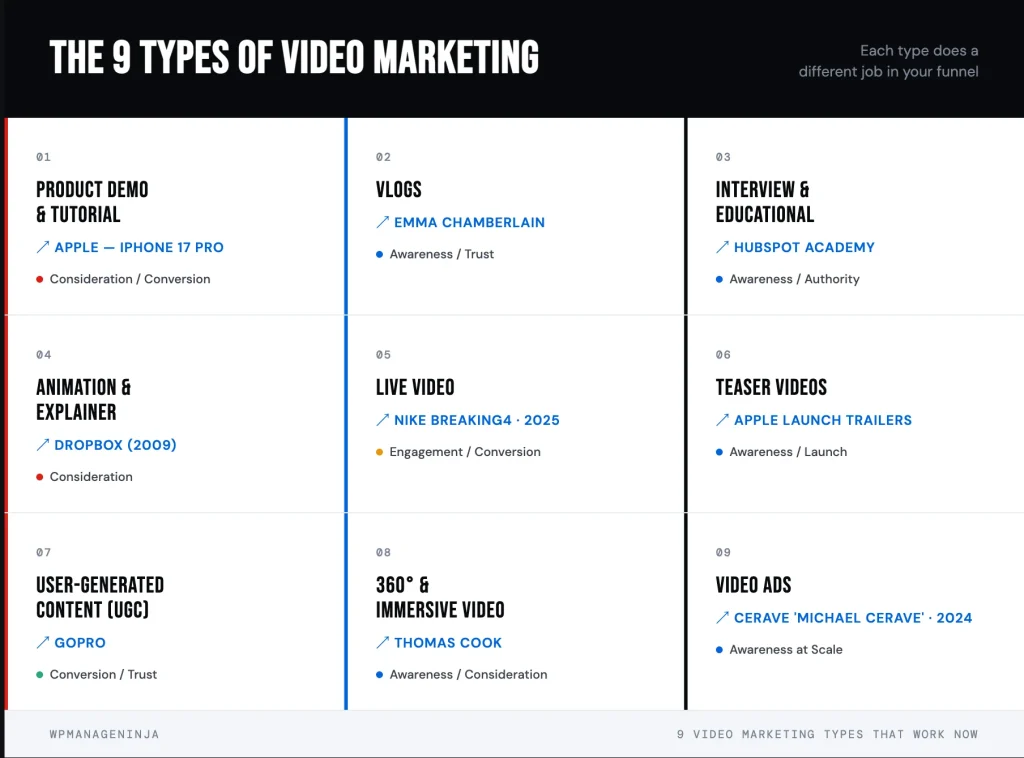
- The 9 types: product demos, vlogs, interviews/educational, animation/explainers, live video, teasers, UGC, 360°, and video ads.
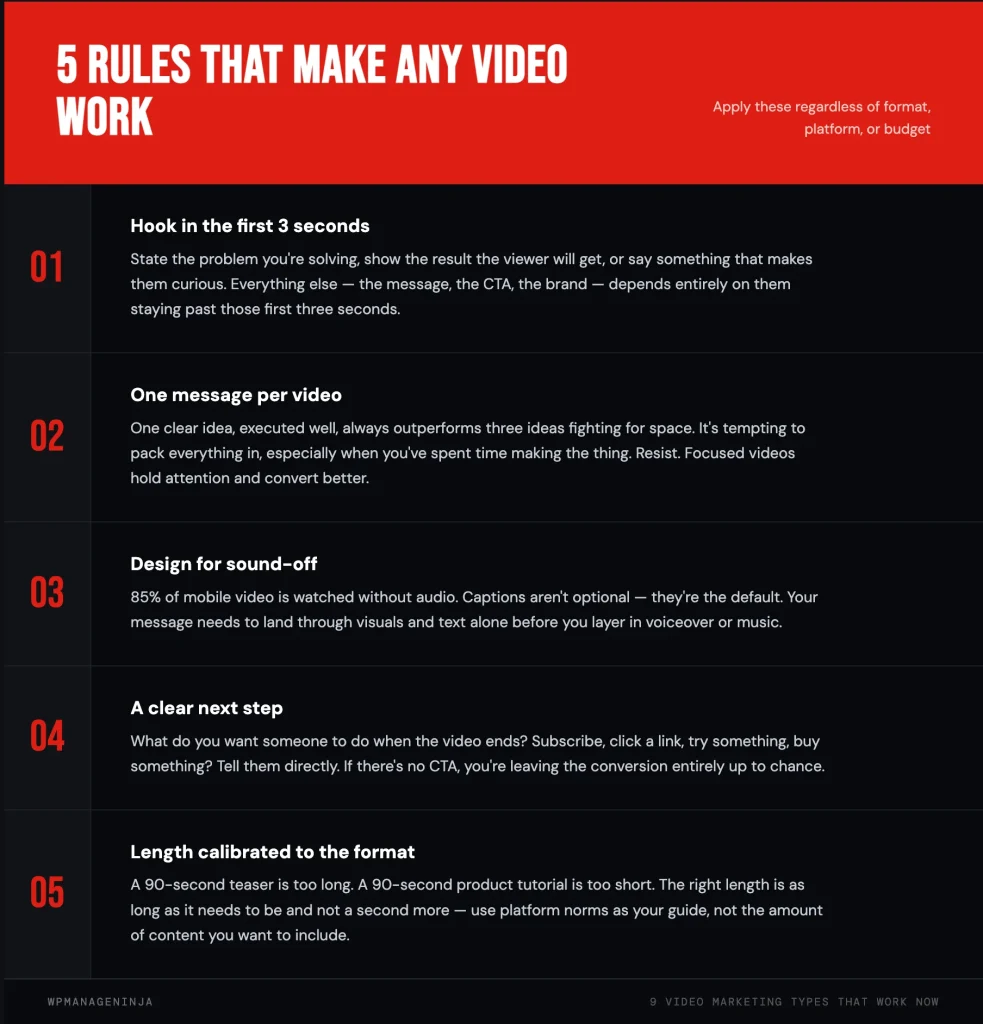
- What makes any of them work: hook in 3 seconds, one message, captions on, clear CTA, length matched to the format.
- Learn more from the examples shared within the article.
What Is Video Marketing?
At its most basic, video marketing just means using video to attract, engage, and convert your audience, whether that’s on social media, your website, inside an email, or running as a paid ad.
The part that trips people up is that video can do very different things depending on the format. A 15-second Reel and a 10-minute YouTube tutorial are both video, but they’re doing completely different jobs at completely different moments in the relationship.
Why Video Is Still the Format to Bet On in 2026
Before we get into the formats themselves, here are a few numbers worth knowing. Not to throw stats at you, but because they actually shape how you should think about which type to make:
- 84% of consumers want to see more video from the brands they follow, according to Wyzowl’s 2026 research. That number has barely moved in eight years, which tells you this isn’t a passing preference.
- 63% of people say the way they’d most like to learn about a product or service is by watching a short video. Not reading a blog post, not looking at an infographic.
- 85% of marketers say video has helped them generate leads, and 83% say it’s directly increased sales. That’s a pretty strong endorsement across the full funnel.
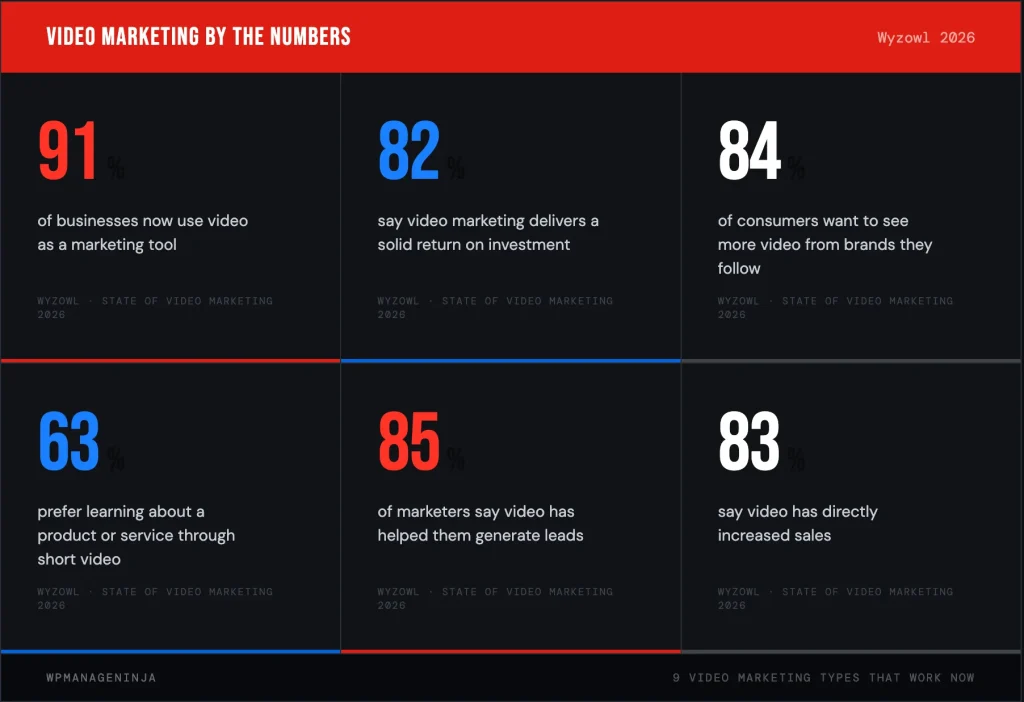
Short-form video is currently the highest-ROI format according to HubSpot’s State of Marketing data, which makes sense given where attention is right now.
But the best format for you still depends on what you’re selling and where your audience actually spends time. That’s what we’ll work through next.
The 9 Types of Video Marketing
Each format does a different job. Some are better at getting you discovered, others at building the kind of trust that takes time, others at closing someone who’s already close to buying. Here’s how to think about all nine.
1. Product Demo and Tutorial Videos
These are the videos where you actually show your product doing what it does. Not a pitch, not a highlights reel, but a proper walkthrough someone can follow along with and learn something from.
The viewer already has a problem. Your video shows them how to solve it. By the end, they either know your product well enough to buy it, or they’ve genuinely gotten something useful from watching. Either way, you’ve earned a bit of trust.
For software and tools especially, this format tends to convert really well because it answers the exact question someone has right before they decide to purchase. The hesitation is usually “I’m not sure how this actually works,” and a good demo removes that.
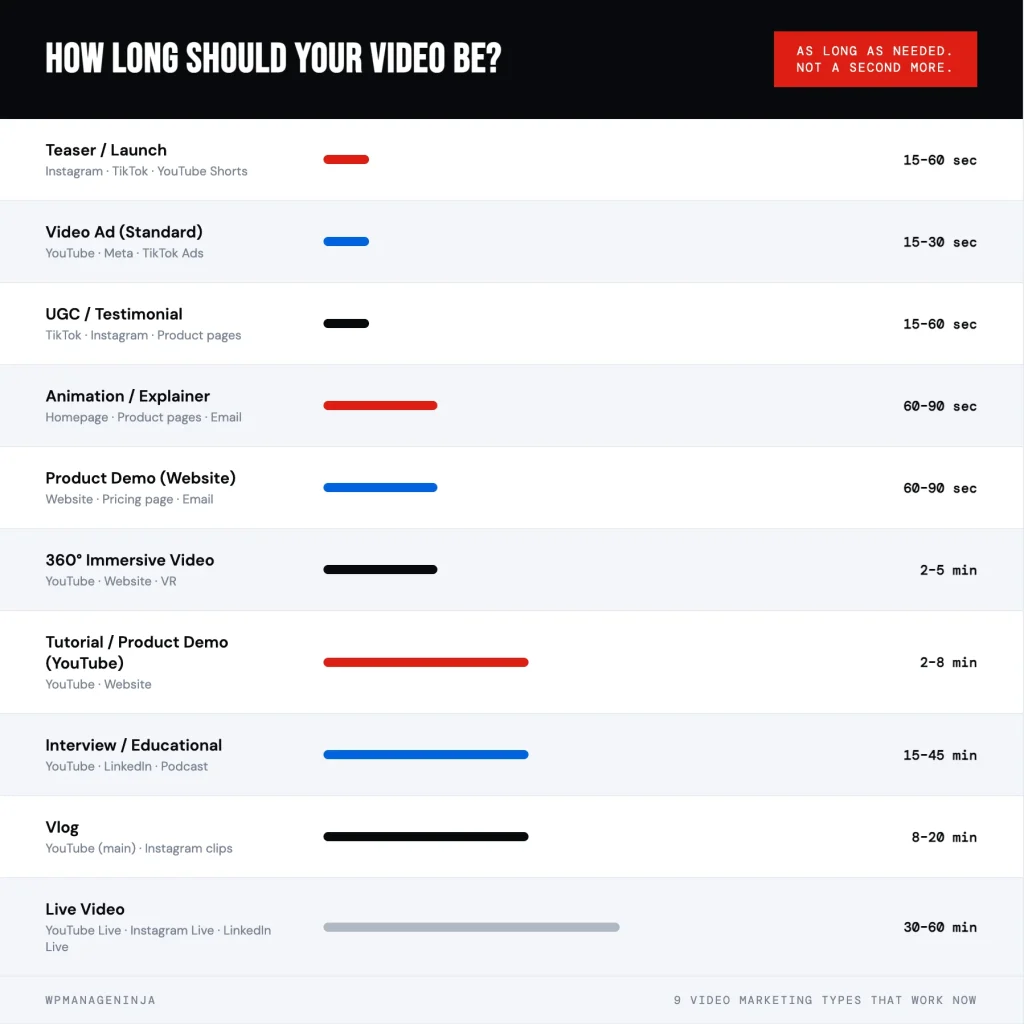
- Best for: Consideration and conversion
- Best platforms: YouTube for long-form tutorials, your website’s product or pricing pages, email onboarding sequences
Length: 2–8 minutes on YouTube; 60–90 seconds for embedded website demos
Quick Tip:
Lead with the outcome before you show the process. Instead of starting with step one, start with what the viewer will be able to do by the end. Answer “what will this do for me?” before “how does this work?”
How Apple Sells Without Selling
Apple opened this video with four seconds of cinematic action footage shot on the phone itself. A rugby player tackling through golden-hour light. Motion blur, sweat, impact. No spec list.
By the time the video introduced ProRes RAW, the 56 percent larger sensor, and 8x optical-quality zoom, the viewer had already been convinced. The entire 3:57 runtime is structured around demonstration first, explanation second.
Apple never says their camera is better. They show you footage that makes you wish you had taken it.
Takeaway: Whatever your product does, find the most visually compelling outcome it creates and put that in your first five seconds. Let the how come after the wow.
2. Vlogs
A vlog is just a regular, personality-led video series. A business owner showing how their product gets made. A founder documenting what actually happened during a launch. A creator showing what a normal week looks like for them.
What makes vlogs work isn’t the information. It’s familiarity. Over time, people stop seeing you as a brand and start feeling like they actually know you. That’s a stickier relationship than any ad campaign can create.
They’re a long game, and I want to be upfront about that. The payoff is real, but it comes from staying consistent over months, not weeks. The audience you build this way tends to be genuinely loyal in a way that other formats rarely produce.
- Best for: Brand awareness, top-of-funnel trust, audience retention
- Best platforms: YouTube as the main home; clip shorter moments for Instagram Reels
Length: 8–20 minutes on YouTube; cut down to 30–60 second clips for social
Quick Tip
Consistency matters more than production quality. The biggest mistake new vloggers make is waiting until they have better equipment or more interesting material. The audience comes back for the person, not the production value.
How a Teenager With a Camera Built a $20M Brand
Emma started uploading vlogs at 16, filming on whatever camera she had, with almost no production budget. Daily-life content: thrift store trips, drive-throughs, days at home. By any conventional standard, it shouldn’t have worked.
She grew to over 12 million subscribers and used that audience to build Chamberlain Coffee into a brand pulling over $20 million in annual revenue.(Forbes, via TechCrunch)
She was the first major creator to treat the vlog format like a genuine conversation rather than a performance. She talked about feeling anxious, awkward, and bored. Viewers didn’t just watch her. They felt like they knew her.
Takeaway: A vlog only works if the personality is real. Audiences can detect when someone is performing authenticity. Let it actually show something true about how you work, think, or operate.
3. Interview and Educational Videos
This covers anything in the conversation or teaching format. A founder explaining how they think about their market. Or, an expert walking through a topic your audience is trying to understand.
What makes this format particularly valuable is that it compounds. A good educational video keeps showing up in search months or years after you publish it, because the questions people are asking don’t really change that fast.
- Best for: Awareness and consideration, especially for B2B, SaaS, and service businesses
- Best platforms: YouTube primarily; LinkedIn for B2B audiences; repurpose audio as a podcast
Length: 15 to 45 minutes for long-form; pull key moments for 60-second social clips
Quick Tip
One video, one question, one answer. A video titled “How to write a cold email subject line” will always outperform “Email marketing tips” because the person searching knows exactly whether they need it.
How One Question Per Video Turned YouTube Into a Lead Machine
HubSpot’s Academy channel was underperforming for years despite massive content resources. In 2018 they rebuilt their strategy around one principle: each video answers exactly one question someone is actively searching for.
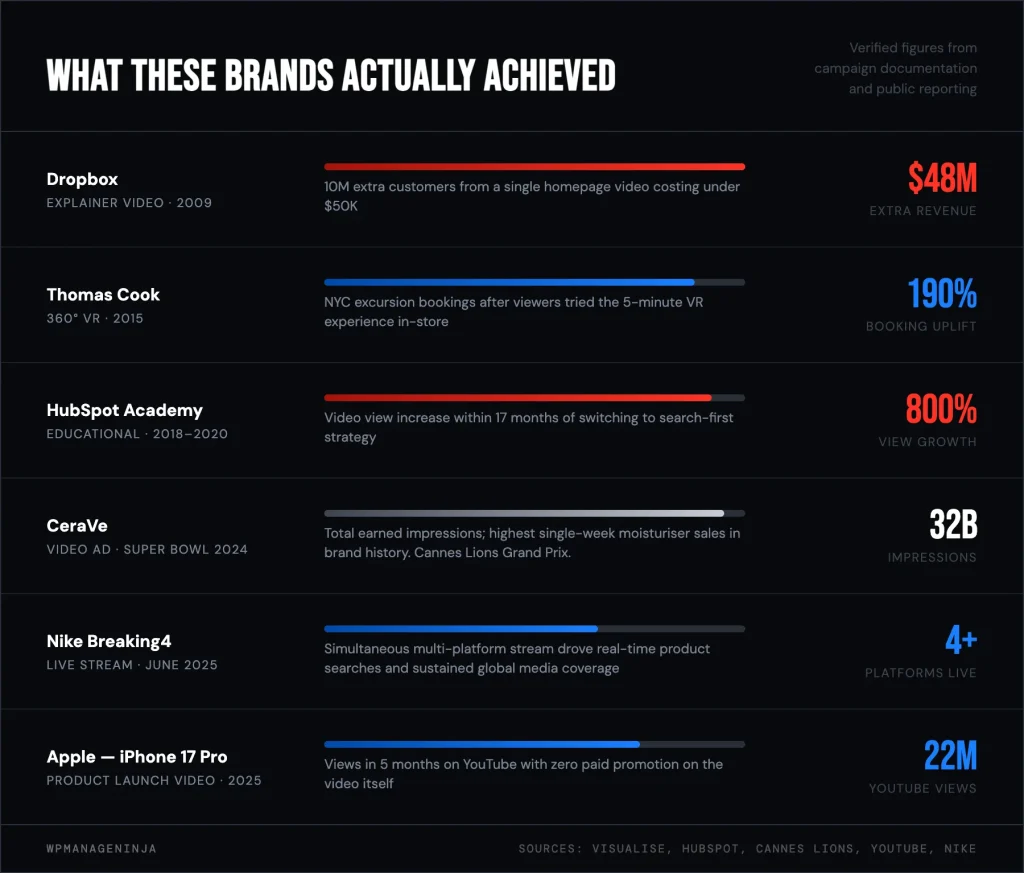
Within 17 months, the channel grew subscribers by 450 percent and video views by 800 percent. YouTube became a top 5 lead acquisition channel for HubSpot Academy.
Every title was a question or problem statement. Every video resolved that one thing and ended with a clear next step. They also used the comment section as audience research for future videos.
Takeaway: Educational video is SEO in video form. Identify the specific questions your audience is typing into search, make a focused video that genuinely answers each one, and you’re building a content library that compounds over time.
4. Animation and Explainer Videos
Explainers use animation or motion graphics to take something complicated and make it feel simple. How your product works, what problem it actually solves, why the other options don’t quite get there.
They’re especially useful for anything that lives inside a screen and is hard to demonstrate with a camera pointed at someone’s face. If a person needs to understand your product before they can want it, an explainer is often the most efficient way to bridge that gap.
- Best for: Consideration; bridging the gap between “I’ve heard of them” and “I’m ready to try it”
- Best platforms: Homepage, product pages, email, YouTube
Length: 60 to 90 seconds is the sweet spot. Keep it under 2 minutes
Quick Tip
Write the script before you think about animation. The strongest explainers follow a three-part structure: here’s the problem people have, here’s why existing solutions don’t fix it, here’s how this is different. Get that story right and the visuals become secondary.
How a $50K Video Fixed a Broken Acquisition Model
Before the explainer video, Dropbox was spending between $233 and $388 on Google Ads to acquire each customer for a product that cost $99. The math was obviously broken.
Founder Drew Houston commissioned a two-minute animated explainer for under $50,000. Plain English, relatable problem, one clear action at the end. They put it on the homepage as the only thing to focus on.
Conversion rates increased by 10 percent, translating to 10 million additional customers and roughly $48 million in extra revenue. The video stayed on the homepage for years, viewed about 30,000 times per day at its peak.
Takeaway: What made it work was not the animation style or production budget. It was the script. A well-written explainer that nails the problem statement will do more conversion work than almost any other format.
5. Live Video
Going live is probably the most underused format in small business marketing right now, and I think it’s because it feels risky. You can’t edit it. Whatever happens, happens. But that’s also exactly what makes it work.
Questions get answered in real time. Objections come up in the chat and get handled publicly, where other people can see. And when you’re done, the replay sits on your channel as content you didn’t have to separately plan or produce.
- Best for: Engagement, trust-building, conversion events like launches or Q&As
- Best platforms: YouTube Live, Instagram Live, LinkedIn Live for B2B audiences
Length: 30 to 60 minutes tends to work well; clip highlights into shorter content afterward
Quick Tip
Promote 48 to 72 hours before you go live, to your email list and on socials. A live stream with 20 people who are genuinely interested in what you’re selling is more valuable than 200 people who stumbled in and left after three minutes.
How Nike Turned a World Record Attempt Into a Live Marketing Event
Nike streamed Faith Kipyegon’s attempt to become the first woman to break the four-minute mile simultaneously across YouTube, Instagram, TikTok, and Prime Video. Replays went live within hours.
The event drove real-time product searches for Nike’s running line and generated media coverage that continued well past the broadcast itself. That’s a large-scale version of the same principle.
Live video creates a moment people want to be part of: the countdown, the chat, the collective experience of watching something happen in real time. You don’t need a prime-time broadcast to replicate it. A 40-minute Q&A before your next launch does the same thing at your scale.
Takeaway: Live video’s real advantage isn’t reach, it’s depth. The brands that use it best treat it as a conversation, not a broadcast. That distinction changes everything about how people feel about your brand afterward.
6. Teaser Videos
Teasers are short, intentionally incomplete videos. A product that isn’t named yet. A launch date with no other context. A hint at something coming without actually saying what it is.
The whole job of a teaser is to make someone want to know what comes next. Which means the skill here is in what you leave out, not what you put in. Most people’s instinct is to add more detail. The right move is usually the opposite.
- Best for: Top-of-funnel awareness and launch campaigns
- Best platforms: Instagram Reels, TikTok, YouTube Shorts, Twitter/X
- Length: 15 to 60 seconds. Past 90 seconds, you’ve started making a different kind of video.
Quick Tip
Resist the instinct to add more. Every extra detail you include reduces the curiosity gap. Show one thing, make it interesting, and stop before it feels complete. The incompleteness is the whole mechanism.
How GoDaddy Ran a Months-Long Campaign That Didn’t Look Like One
In November 2024, Walton Goggins began appearing at red carpet events wearing peculiar wraparound goggle-sunglasses with no explanation. GQ covered it. Rolling Stone covered it. Nobody knew what was going on, and that was the point.
GoDaddy had built the brand with Goggins from scratch in 12 weeks using their AI tool Airo, seeding curiosity through public appearances with no brand attached. On Super Bowl Sunday 2025, they revealed everything with a 60-second spot that won the Cannes Lions Grand Prix for Creative B2B.
The reveal didn’t create curiosity; it resolved it. The teaser phase didn’t look like marketing at all. By the time the campaign landed, audiences had spent months wondering what Goggins Goggles actually was.
Takeaway: The best teasers don’t look like teasers. A cryptic social post, a product with no name attached, a countdown with no explanation: the restraint is the strategy. Give people just enough to wonder, and stop before you answer the question.
7. User-generated Content (UGC)
UGC is video your customers make themselves: unboxing clips, casual testimonials, “I’ve been using this for a few weeks and here’s what I actually think” style content. Rough around the edges, real, unscripted.
It consistently outperforms polished brand content in both engagement and conversion, and the reason is pretty simple: it doesn’t come from you. Millennials trust UGC about 50 percent more than brand-created content. People believe other people before they believe the brand.
- Best for: Conversion; helping someone get over the last bit of hesitation before they buy
- Best platforms: TikTok, Instagram Reels, product pages, paid social ads
Length: 15 to 60 seconds for organic; up to 90 seconds for ads
Quick Tip
Don’t wait for UGC to appear organically. A short email to your best customers asking for a 30-second video of them using the product works more often than you’d expect, especially if you offer a small incentive or the chance to be featured on your page.
How GoPro Built a Content Empire Without a Production Team
GoPro built their entire marketing strategy around user-generated content to such a degree that they essentially became a media company running on customer footage.
Their customers were already filming extreme sports, travel, and adventures with cameras they’d bought. GoPro made it easy to submit that footage and have it featured on their own channels. The result was a content library they didn’t have to produce.
My personal favorite is the one where a customer video of a firefighter rescuing a kitten received over 40 million views and generated enormous coverage without costing GoPro a single dollar in production.
Takeaway: For physical products especially, get your cameras into customers’ hands and create easy pathways for them to share what they film. The most credible demonstration of your product is always the one made by someone who isn’t being paid to say it’s good.
8. 360-Degree and Immersive Video
360-degree video lets the viewer control where they look. They can pan around, look up, look behind them, explore the space as if they’re standing inside it rather than watching it through a window.
For most industries this format would be overkill. But for hospitality, real estate, tourism, venue marketing, and anything experience-driven, it solves a problem that no other video type can: the feeling of actually being somewhere before you decide to go.
- Best for: Awareness and consideration in experience-driven industries
- Best platforms: YouTube (full 360 support), Facebook, embedded on your website, VR headsets
Length: 2 to 5 minutes; longer if the space warrants it
Quick Tip
This is one format where underspending on production genuinely backfires. A shaky, badly lit 360 video with visible stitching seams creates a worse impression than not making one at all. If you commit to this format, invest properly.
How Thomas Cook Let People Feel the Holiday Before Booking It
Thomas Cook placed Samsung Gear VR headsets in flagship stores across the UK, Germany, and Belgium. Customers could put on a headset and spend five minutes virtually standing on a New York rooftop, snorkelling in Sharm El-Sheikh, or walking the OCBC Skyway in Singapore.
No brochure. No video montage. The feeling of being there. The results: a 190 percent uplift in New York excursion bookings. The campaign generated £12,000 in flights and hotel bookings in its first three months and delivered a 40 percent ROI.
Travel is the ultimate product you can’t try before you buy. Uncertainty is the biggest friction point in the booking process. A five-minute VR experience collapses that uncertainty.
Takeaway: 360 video earns its place when your product has to be experienced to be understood. If you’re in hospitality, real estate, events, or any space-based business, the question is whether you can afford not to let people feel what you’re selling before they buy it.
9. Video Ads
Video ads are the paid version of this whole conversation: pre-roll on YouTube, TikTok ads, Instagram and Facebook placements, programmatic. The mechanics are similar to organic short-form, but with one important difference.
The person watching didn’t choose to watch it. They were doing something else and your video showed up. That means you have even less time to earn their attention, and the bar for relevance is genuinely higher. An ad that feels like an interruption just gets skipped.
- Best for: Awareness at scale, retargeting warm audiences, conversion campaigns
- Best platforms: YouTube pre-roll, TikTok ads, Instagram and Facebook ads, programmatic
- Length: 6-second bumpers, 15 to 30 seconds for standard, up to 60 seconds for storytelling formats
Quick Tip
Design the whole video assuming the sound will be off. About 85% of mobile video gets watched without audio. TikTok’s own data shows vertical video has a 25% higher watch-through rate than horizontal, so shoot in 9:16 if TikTok is part of your distribution.
How CeraVe Turned a Reddit Joke Into 32 Billion Impressions
CeraVe built their campaign around a joke already living on Reddit: that actor Michael Cera must somehow be behind a brand with his name in it.
Rather than saving the reveal for the Super Bowl, they built the world first. Paparazzi photos of Cera signing bottles. A podcast appearance where he refused to deny involvement. Dermatologists publicly debunking his claims.
By the time the 30-second spot aired, the campaign had already generated 9 billion earned impressions before kickoff, and 32 billion total. CeraVe recorded its highest single-week moisturiser sales in brand history and won the Cannes Lions Grand Prix.
It found something that already existed in culture and built an absurdist narrative around it that made people want to share it.
Takeaway: A video ad that people actually want to watch will always outperform one that interrupts. The bar is: would someone share this? If not, it’s not ready.
A Few Things People Mistake for Video Types
A couple of formats come up in almost every video marketing conversation that are worth clarifying quickly, because they get lumped in with the nine types above when they’re actually something different.
- Webinars are a delivery format, not a video type. The content inside is usually a mix of tutorial, interview, and live Q&A. A good webinar gives you raw material you can repurpose into five other things.
- Stories (Instagram, Facebook) are a placement, not a format. Short-form clips, teasers, and UGC all work great in Stories. Design for vertical video and very fast consumption.
- Testimonials are a specific application of UGC, not a separate format. A real, specific, slightly imperfect testimonial from a genuine customer will almost always outperform a polished, scripted one.
What Actually Makes a Video Work
Getting the format right is the first half. The second half is execution, and this is where most videos quietly fall apart. The right format with weak execution still underperforms.
- Hook in the first 3 seconds. State the problem you’re solving, show the result, or say something that makes them curious. If they leave in the first three seconds, nothing else matters.
- One message per video. The instinct is always to pack more in. A single idea executed well will outperform three ideas competing for space, every time.
- Design for sound-off. Most mobile video gets watched without audio. Captions aren’t a nice-to-have anymore.
- A clear next step. Whatever you want someone to do at the end, tell them. Without a CTA, you’re leaving the outcome up to chance.
- Length that fits the format. A 90-second teaser is too long. A 90-second product tutorial is too short. Let the format and the platform be your guide.
Duolingo’s TikTok is probably the clearest example of all of this working together. Tens of millions of followers built on one format, committed to consistency, with every video structured the same way.
They didn’t get there by experimenting with every format at once. They found one thing that worked for their audience and got very good at it. That’s the pattern worth copying.
Starter Plan: Pick Your Goal and Start There
The most common mistake is trying to do all of this at once. Pick the column that matches your primary goal right now and start with just that first row. You can always add more once you have a feel for what works.
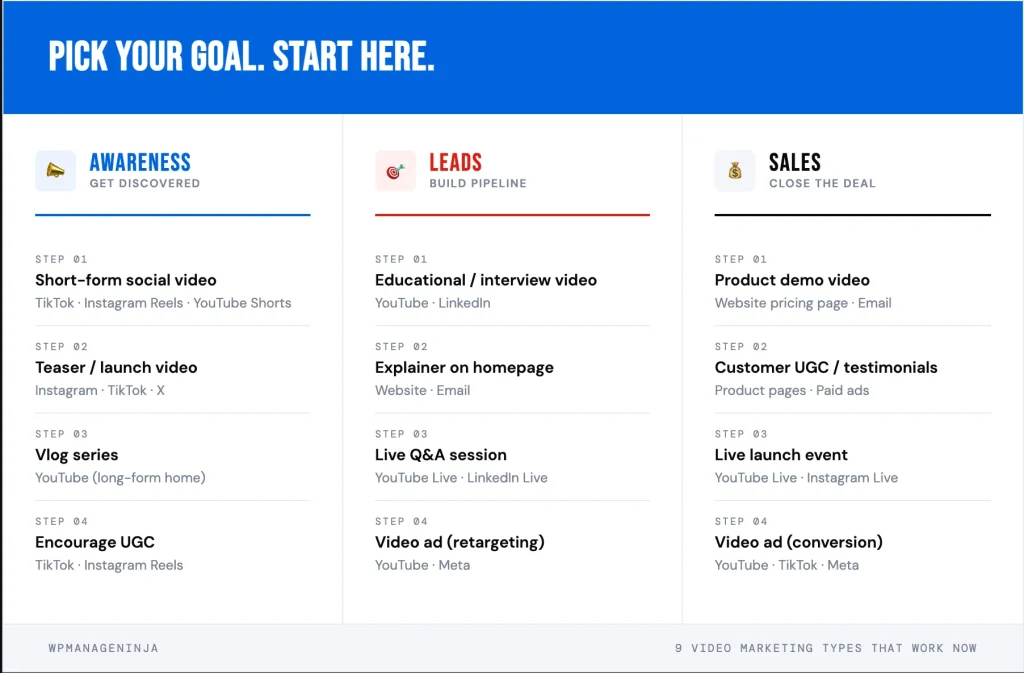
Once you’re publishing consistently, pay close attention to what the numbers tell you. Which videos get watched all the way through? Where do people drop off? What actually drives clicks?
That data is more useful than any framework, because it’s specific to your audience and your content. Once you have a feel for one format, then add a second. Build from there rather than trying to do everything at once.
The brands that get the most from video aren’t always the ones with the biggest budgets. More often they’re the ones who picked something specific, stayed with it long enough to learn from it, and kept improving.
Putting Video to Work on Your WordPress Site
Each of these nine types does something specific. Demos and explainers close. Vlogs and educational content build the kind of authority that takes time but compounds. Live video and UGC create trust in a way that polished production can’t replicate. Teasers and ads handle awareness.
If videos aren’t performing the way you’d like, it’s worth asking whether the format matches the moment. A teaser on a pricing page, a long tutorial pushed to TikTok, a live stream with no audience built beforehand – those are format mismatches, and they’re more common than most people realize.
Once you have the right format in the right place, your WordPress site is where it can do its best work. FluentPlayer, by WPManageNinja lets you embed video from any source and layer in CTAs, lead capture forms, and booking triggers that activate at specific timestamps – so the video isn’t just sitting on the page, it’s doing something.

Get early access to
FluentPlayer: Get Better Control Over Videos
FluentPlayer is currently in early access. If you’re on WordPress and want to start turning video into a proper part of your funnel, you can join the waitlist at fluentplayer.com.

This is Sumit. He’s a physics major who’s trying to understand both the physical as well as the WordPress worlds. Whenever he’s not busy, plays fifa or spends time with his family.
-
Vanity Metrics vs Actionable Metrics: What to Track in 2026
Actionable metrics are potential that we can help in measuring. -
Content Marketing: Build a Business From What You Already Know
Learn how to start a content marketing business, grow an -
Popular WordPress Affiliate Plugins: Manage Affiliates Inside Your Dashboard
Compare WordPress affiliate management plugins for tracking referrals, commissions, affiliates,


Leave a Reply
You must be logged in to post a comment.