
Why eCommerce Store Needs an Affiliate Program(WordPress Guide)
Ad costs are up. Organic reach is harder to predict. And you’ve probably noticed that the channels you relied on two or three years ago aren’t as reliable as they used to be.
Affiliate marketing isn’t a silver bullet. But it is one of the few growth channels where you only spend money when something actually works; a sale happens, a lead converts, a customer signs up. That’s a fundamentally different kind of bet than paying for impressions and hoping for the best.
This guide is for DTC founders, WooCommerce store owners, and agencies managing ecommerce growth. If you’ve been curious about affiliate programs but weren’t sure if it made sense for your store, or you’ve started thinking about it and hit a wall on where to begin, you’re in the right place.
We’ll cover what affiliate programs actually are (and how they differ from referral programs), nine reasons to launch one, what makes them succeed or fail, and a step-by-step launch plan using FluentCart and FluentAffiliate.
- Affiliate programs only cost you money when a sale happens — making them one of the most capital-efficient acquisition channels available.
- Trust transfers from creator to product. A genuine recommendation converts better than any ad, especially for first-time buyers.
- Content created by affiliates compounds over time — reviews, comparisons, and tutorials keep driving traffic long after ads go dark.
- Ten well-matched, well-onboarded affiliates will outperform a hundred who only got a link. Infrastructure matters more than volume.
- Pair affiliate acquisition with lifecycle automation and you turn one-time buyers into long-term customers — that’s where the real ROI lives.
What Is an Affiliate Program and How Is It Different from a Referral Program?
These two terms get used interchangeably, but they’re different levers and you should know which one you’re pulling.
Affiliate program: External partners; creators, bloggers, niche site owners, agencies, promote your store to their audience and earn a commission on sales or leads they generate. The relationship is outward-facing. You’re recruiting people who already have an audience.
Referral program: Your existing customers invite friends and earn a reward (often both sides get something). The relationship is inward-facing. You’re activating the goodwill of people who already bought from you.
Both are worth running. But they serve different jobs.
Quick rule for deciding which to start first:
- Run a referral program when you have happy repeat customers and a product experience worth sharing. High NPS, low refund rate, strong community.
- Run an affiliate program when you want broader distribution; through creators, content publishers, newsletters, communities; and you’re ready to invest in building partner relationships.
Many stores run both. They’re complementary, not competing. But for the purposes of this guide, we’re focused on affiliate.
9 Reasons Your eCommerce Store Needs an Affiliate Program
Here’s what actually changes when you stop renting attention from ad platforms and start building a network of partners who only get paid when you do.
9 Reasons Your eCommerce Store Needs an Affiliate Program
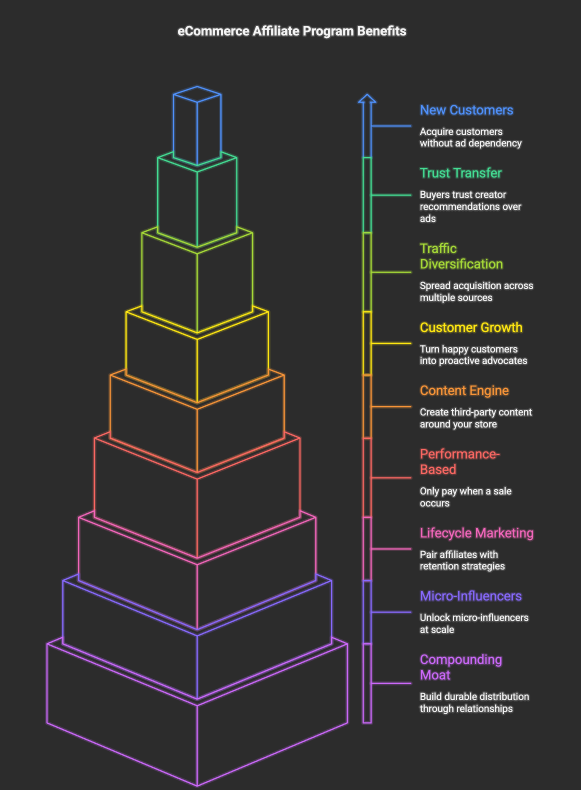
1. You Acquire New Customers Without Ad Dependency
Every dollar you spend on paid ads is a dollar that stops working the moment you pause the campaign. Affiliates create a fundamentally different dynamic: when a creator publishes a review, that content keeps driving traffic for months or years. The commission only fires when a sale happens.
What this looks like in practice: A niche tech blogger writes a comparison post between your product and a competitor. That post ranks on Google, gets shared in communities, and sends consistent referral traffic; without you spending anything until someone actually buys.
With FluentAffiliate: You set a commission structure, generate unique affiliate links for each partner, and track every conversion back to the source. No manual spreadsheet tracking required.
What to measure: Affiliate-driven revenue as a percentage of total revenue. Start tracking this from day one.
2. Trust Transfers from Creator to Product
Buyers trust recommendations more than ads. When someone they follow recommends your product, especially with honest context about how they use it. It carries weight that no banner ad ever will.
This is sometimes called the “social proof effect” and it’s not subtle. A recommendation from a trusted voice lowers purchase friction significantly, especially for first-time buyers who haven’t heard of your brand.
With FluentAffiliate + WPSocialNinja: Affiliates can link directly to product pages where social proof blocks (reviews, testimonials, user-generated content) reinforce the recommendation the buyer just heard. The handoff from affiliate content to your site should feel seamless and credible.
What to measure: Conversion rate of affiliate-sourced traffic versus cold traffic. Expect this to skew higher for well-matched affiliate partners.
3. You Diversify Your Traffic Sources
If most of your traffic comes from one or two sources, Google and Meta, for example, a single algorithm change or policy shift can hurt badly. Affiliates spread your acquisition across SEO content, YouTube channels, email newsletters, podcast mentions, and community forums.
Each active affiliate is essentially a new traffic node. And because their content often lives in different formats and platforms, the diversification effect compounds over time.
What to measure: Sessions and revenue by referral source. Look at how affiliate traffic behaves differently from paid or organic.
4. You Turn Customers into a Growth Channel
Your happiest customers know your product better than any marketer. When you add a customer affiliate tier, separate from your main partner program, you give them a formal way to share, advocate, and earn.
This isn’t the same as a referral program. Customer affiliates are proactive. They create content, share links in communities, write blog posts. You’re giving them tools and incentives to do what some were already doing for free.
What to measure: Activation rate (what percentage of recruited customer affiliates actually generate sales) and revenue per active affiliate.
5. You Create a Content Engine Around Your Store
Every affiliate who writes a review, records a tutorial, or publishes a comparison is creating content that mentions your product. Over time, that creates a growing body of third-party content pointing at your store.
This matters for discovery. Buyers search for “[your product type] review” or “[your product] vs [competitor]” before they buy. If affiliates own those results, your store wins.
With FluentForms: You can create a structured affiliate application form that asks about content format, audience size, and niche; so you can prioritize partners who create the kind of content you actually want.
What to measure: Number of affiliate-generated URLs pointing to your store, and traffic from those content sources over time.
6. You Only Pay When You Win
Performance-based marketing is the exception, not the rule. Most channels want your money regardless of outcome. Affiliates are different: commission fires when a sale converts. Until then, your cost is limited to program setup and management.
This makes affiliate programs unusually capital-efficient, especially compared to paid acquisition where you’re funding experiments that may or may not work.
Important nuance: “Only paying for results” doesn’t mean the program runs for free. You’re investing in relationship management, creative assets, and tooling. But the variable cost is tied directly to revenue.
What to measure: Effective CAC (commission percentage plus any bonuses, divided by orders generated). Compare this against your paid channel CAC.
7. You Increase Customer Lifetime Value by Pairing Affiliates with Lifecycle Marketing
Affiliate-sourced buyers who come through trusted creators often arrive with a different quality of intent. They already trust the recommendation. They already understand what they’re buying. This tends to translate into lower refund rates and better long-term retention, but only if you follow up well.
Affiliate acquisition paired with a solid retention system is significantly more powerful than either one alone.
With FluentCRM: You can segment affiliate-sourced customers from the moment they first order, then build automated flows: onboarding sequences, product education emails, upsell timing based on usage or purchase patterns. You know who brought them in; now you make sure they stick around.
What to measure: Repeat purchase rate and LTV segmented by acquisition source. Affiliate-sourced customers should trend better when matched with good retention flows.
8. You Unlock Micro-Influencers at Scale
The creator and affiliate channels have been converging for a few years. Micro-influencers, creators with smaller but highly engaged audiences, increasingly prefer performance-based partnerships over flat fees. For them, a generous affiliate commission is attractive. For you, it’s efficient: you pay based on actual results, not estimated reach.
This is especially relevant for digital products, niche physical goods, and anything with a specific-use-case buyer profile (fitness, productivity, crafts, software, etc.).
With FluentAffiliate: You can manage a large roster of micro-affiliates without the overhead ballooning. Unique links, payout tracking, and partner dashboards keep the program manageable even as it scales.
What to measure: Revenue per affiliate by tier. Don’t assume bigger audiences always mean better results, track actual conversion data.
9. You Build a Compounding Moat
Affiliate relationships compound in ways that ads don’t. A partner who writes about your product once builds a page. That page earns backlinks. That creator’s audience develops brand memory. Their next piece of content mentions you again. The relationship deepens.
Over time, a healthy affiliate network creates durable distribution that’s genuinely hard to replicate quickly. It’s an asset that builds with effort and time.
What to measure: Partner retention rate (are affiliates staying active quarter over quarter?), top affiliate contribution to revenue, and inbound affiliate applications (a sign your program has a reputation worth joining).
What Makes an Affiliate Program Work
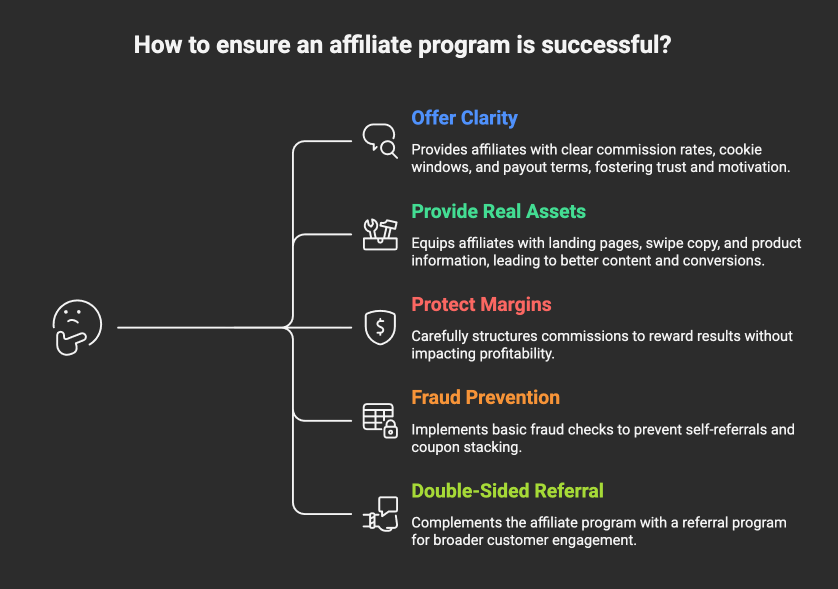
Launching an affiliate program is easy. Making it produce results takes the right setup.
- Offer Clarity: Affiliates should clearly understand the commission rate, cookie duration, and payout terms. If they’re unsure how they get credited, they’ll promote programs they trust more.
- Provide Real Assets: Don’t just give affiliates a link. Provide landing pages, swipe copy, product images, and messaging angles so they can create better content that converts.
- lProtect Your Margins: Design commissions carefully. Consider different rates for new vs. returning customers, discounted orders, or specific product categories.
- Basic Fraud Prevention: Prevent common issues like self-referrals and coupon abuse. Set reasonable cookie windows, monitor unusual conversions, and block affiliates from purchasing through their own links.
FluentAffiliate includes built-in controls to help manage these basics automatically.
Choosing Your Affiliate Program Model
Not all affiliate programs look the same. Before you launch, decide which model fits your store and your growth goals.
- Creator / Influencer Affiliate
Best for: stores with visual products, lifestyle brands, or anything that photographs or demos well. Creators produce UGC, short video, and social content. Commission-based relationships are increasingly preferred by creators at the micro level.
- Content Affiliate (SEO-driven)
Best for: products with clear search intent (“best [category] for [use case]”). Bloggers, niche review sites, and comparison publishers drive organic traffic through written content. Long shelf life, compounding value.
- Partner Affiliate
Best for: B2B-adjacent products, software, digital tools, or anything agencies or integrators might recommend to their clients. Agencies and educators who serve your target audience make high-trust partners.
- Customer Affiliate
Best for: any store with a loyal customer base and a product people genuinely love. Activate your advocates with a dedicated tier, slightly different messaging, and community-focused incentives.
Most stores eventually run a mix. Start with the model that matches your current audience and your biggest distribution gap.
How to Launch Your Affiliate Program on FluentCart
Here’s a practical step-by-step for getting your program live. This assumes you’re running FluentCart on WordPress and are adding FluentAffiliate to manage the program.
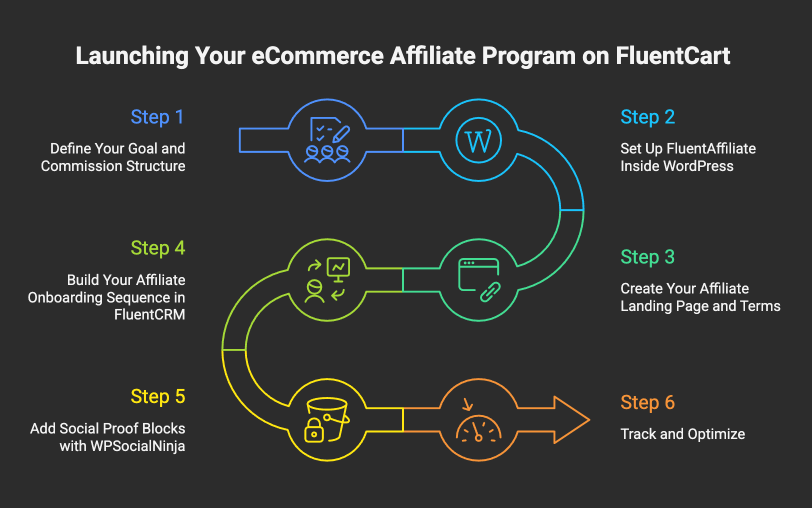
Step 1: Define Your Goal and Commission Structure
Before touching any settings, answer these questions:
- What’s the primary goal? New customer acquisition? Creator-generated content? Geographic expansion?
- What margin can you share? Be conservative. You can always increase commissions later.
- Will you differentiate between partner types (creators vs. bloggers vs. customer advocates)?
- What’s your cookie window?
- What payout threshold and schedule makes sense for your cash flow?
Document this before setup. It’ll inform every configuration decision.
Step 2: Set Up FluentAffiliate Inside WordPress
Install and activate FluentAffiliate from your WordPress dashboard. Then follow this sequence — the order matters:
- Connect your store
Link FluentAffiliate to FluentCart so the plugin can pull order data automatically. This has to happen before you configure commissions — the plugin needs to know where conversions come from.
- Configure your affiliate portal
Set up the affiliate-facing area: the signup page, branding, and enrollment settings. Decide whether affiliates can join automatically or require manual approval. This is what potential partners will see first, so get it right before you start recruiting.
- Define your commission structure
Now that your store is connected and your portal is set up, configure how affiliates earn: flat rate, percentage, per-product rules, or tiered commissions based on cumulative performance. FluentAffiliate supports affiliate groups, so you can set different rates for different partner types from the start.
- Set your cookie and attribution window
Define how long after a click a conversion still gets credited to the affiliate. A 30-90 day window is standard. Shorter windows reduce fraud exposure; longer windows can incentivize affiliates who drive awareness content.
- Configure affiliate dashboard visibility
Decide what affiliates can see inside their portal — clicks, conversions, commission totals, payout history. Transparency builds trust with serious partners. Most programs show all performance data but keep other affiliates’ information private.
- Set payout rules
Configure minimum payout threshold, accepted payment methods (PayPal, bank transfer, etc.), and payout schedule (monthly is common). FluentAffiliate handles both manual and automatic payouts, so choose what fits your cash flow and operational bandwidth.
- Enable fraud prevention
Once the program is live-ready, turn on your guardrails: block affiliates from using their own links for purchases, flag accounts with unusually high conversion rates, and set any IP or cookie restrictions that make sense for your traffic patterns.
FluentAffiliate gives each affiliate a unique tracking link automatically and reports clicks, conversions, and commissions in real time once the store connection is active.
Step 3: Create Your Affiliate Landing Page and Terms
Build a dedicated page that explains your program clearly:
- Who it’s for (creators, bloggers, agencies, customers — or specific niches)
- What affiliates earn and when
- What you provide (assets, support, landing pages)
- A clear application form
- Your terms of service (commissions, prohibited tactics, disclosure requirements)
With FluentForms: Build your affiliate application form directly in WordPress. Collect information about the applicant’s content format, audience size, niche, and how they plan to promote. Use conditional logic to route high-value applicants to a faster review process.
Step 4: Build Your Affiliate Onboarding Sequence in FluentCRM
Approval is just the beginning. New affiliates need context and tools before they can actually promote effectively. Build an automated sequence:
- Email 1 (Day 0): Welcome + Dashboard Access — Confirm approval, link to affiliate dashboard, explain how tracking works
- Email 2 (Day 1-2): Your Product Toolkit — Key messaging angles, swipe copy, product images, landing page links
- Email 3 (Day 3-5): How to Promote + Examples — Content formats that work, what’s performed well for other affiliates, how to disclose properly
- Email 4 (Day 7-10): First Check-in — Any questions? See if they’ve shared their first link. Offer direct support.
- Ongoing: Monthly digest — New products, upcoming promotions, top affiliate leaderboard (if relevant), payout reminder
FluentCRM handles all of this automatically. Tag affiliates by type and trigger the right sequence based on their application answers.
Step 5: Add Social Proof Blocks with WPSocialNinja
Affiliate-sourced traffic arrives pre-warmed by a recommendation. Don’t waste that intent with a generic product page. Add:
- Customer reviews and ratings (aggregated or pulled from review platforms)
- Social proof feeds (real posts from happy customers)
- Testimonials specific to the product or use case the affiliate is promoting
With WPSocialNinja: You can embed live social feeds, review widgets, and user-generated content directly on your product pages without custom development. The combination of a trusted affiliate recommendation + visible social proof on the landing page significantly improves conversion rate.
Step 6: Track and Optimize
Once the program is live, review performance weekly for the first 60 days, then monthly.
Look at:
- Which affiliates are driving the most revenue (concentrate support and incentives here)
- Which product pages are converting best from affiliate traffic (share these with all affiliates)
- Average order value by affiliate type (are creator affiliates bringing different buyers than bloggers?)
- Refund rate by affiliate source (a high refund rate from one affiliate may signal misalignment between their content and your actual product)
FluentAffiliate’s reporting dashboard breaks all of this down by affiliate, date range, and product. Use this data to decide who to invest in, who to coach, and who might not be a fit.
KPIs and Reporting: A Simple Affiliate Scorecard
Keep reporting focused. These are the numbers that matter:
| Metric | What It Tells You |
|---|---|
| Affiliate-driven revenue | Program’s direct contribution to top line |
| Effective CAC (commission + bonuses / orders) | Efficiency vs. other acquisition channels |
| Conversion rate on affiliate landing pages | Quality of traffic + landing page match |
| AOV by affiliate type | Are certain partners bringing higher-value buyers? |
| Refund rate by affiliate | Partner-product fit indicator |
| Repeat purchase rate (affiliate-sourced) | Quality of buyers; tie to FluentCRM segments |
| Active affiliate rate | Health of the program; are partners actually promoting? |
Review this monthly. Share highlights with top affiliates, they stay more engaged when they can see their own impact.
Ready to Launch?
Affiliate programs work because they align incentives: your partners earn when you earn. That dynamic, performance-based, trust-driven, diversified; is increasingly valuable in a landscape where ad costs keep climbing and owned channels have limits.
The infrastructure to run a clean, scalable affiliate program doesn’t have to be complicated. FluentCart, FluentAffiliate, and FluentCRM give you the pieces to build it on WordPress, without stitching together a dozen third-party tools.
Launch your affiliate program on FluentCart with FluentAffiliate. Set up your commission structure, recruit your first ten partners, and let the program run while your team focuses on everything else.
Want to go further?
- Automate affiliate onboarding and customer retention with FluentCRM. Build sequences that convert affiliate-sourced buyers into long-term customers.
- Add social proof to your product pages with WPSocialNinja. Make every affiliate’s recommendation land harder.
- Collect and filter affiliate applications with FluentForms. Build a structured intake process that helps you find the right partners faster.

Ashik Elahi is a seasoned Digital Marketing Strategist with a passion for Content Marketing. He believes in the power of storytelling and crafting valuable content that resonates with readers.
-

How to Sell Videos Online With WordPress (Step by Step) in 2026
Learn how to sell videos online with WordPress using FluentCart -
Strategies for Community-Driven eCommerce: WordPress Guide
Discover some best Strategies for Community-Driven eCommerce. See how you -
Affiliate Marketing Reimagined – How AzonPress Changed The Game
Imagine you’re making money online through your website, but you…
Leave a Reply
You must be logged in to post a comment.