
5 Best Help Desk Software for Small Businesses [2026]

Pick the Right Tool Without Paying a “Per-Agent Tax”.
Customer support isn’t optional anymore, even for small businesses. But when your inbox turns into a chaotic mess of unanswered emails, it’s time for a real help desk.
The good news? You don’t have to pay a “growth tax” (that sneaky per-agent pricing most SaaS tools love) just to get organized, fast replies, and happy customers.
In this article, you can analyse five help desk software with the latest features, pricing, and real-world performance. And, know what really works for small teams like WordPress sites, e-commerce stores, agencies, and SaaS founders who are scaling beyond a shared Gmail inbox.
TL;DR
- Fluent Support wins for most small businesses (especially WordPress users) with unlimited agents, flat pricing, modern UI & zero growth tax.
- SaaS giants like Freshdesk and Zendesk are powerful but get expensive fast.
- Self-hosted options give you control and predictable costs.
- Look for omnichannel support, AI assists, solid reporting, and a pricing model that grows with you.
What is help desk software?
Help desk software is a centralized customer service system that manages inquiries, automates workflows, and provides multichannel communication (email, web portal, etc.).
Key solutions include Fluent Support, Zendesk, Freshdesk, SupportCandy, etc., which centralize customer inquiries into tickets, improve response times, and enhance customer satisfaction.
5 Help desk software at a glance
| Tool | Type | Pricing Model | Starting Price | Key Strength |
|---|---|---|---|---|
| Fluent Support | Self-hosted (WordPress) | Flat/Unlimited Agents | $129/year, single site (Free version available) |
|
| Freshdesk | SaaS | Per agent | $23 per agent/month |
|
| Zendesk | SaaS | Per Agent | $19 per agent/month |
|
| HappyFox | SaaS | Per agent | $29 per agent/month |
|
| SupportCandy | Self-hosted (WordPress) | Flat + add-ons | $79/year, single site (Free version available) |
|
When small businesses need a good help desk system
We’ve all been there: one inbox, endless threads, missed replies, and team members stepping on each other’s toes.
During the early years of WPManagenNinja, we also used a simple email inbox as our help desk. But that didn’t last very long. Soon, we were swamped with emails from a growing number of customers. And, eventually, we had to switch to a professional help desk solution.
You know it’s time to upgrade when:
- Your average support tickets grow >25% month-over-month
- First-response times are creeping up (equal to agent burnout)
- Handling time is increasing, and customers are waiting longer
- You’ve launched new products, and the questions are pouring in from multiple channels
- Customer satisfaction and retention are dropping
- Churn is rising because support feels slow and impersonal
If even two of these sound familiar, a proper help desk software will save you hours every week and keep customers loyal.
What to look for in help desk software in 2026
Like other solutions, there’s not a one size fits all when it comes to help desk software. That being said, there’s a minimum that every help desk should provide.
Here are the 6 factors you need to consider when evaluating modern-day help desk software:
- Flexible pricing model: When your business is small or fast-growing, the first thing to look for is a pricing model that doesn’t apply a growth tax.
- Collaborative features: Customer support is all about smooth collaboration. Features like internal notes, activity logs, and agent status reduce overlaps while making task ownership clear.
- Multi-channel/Omnichannel support: Your help desk software should support any channel (email, live chat, WhatsApp, social, forms) your customers feel comfortable using.
- In-depth reports: At a minimum, your system should track key metrics such as response rates, resolution rates, and the number of unresolved tickets.
- Smart automations & AI assists: Features like auto-routing, AI-suggested replies, chatbots, and ticket summaries help teams work faster and smarter.
- Integrations: Ensure compatibility with eCommerce, CRM, email marketing platforms, knowledge base tools, and LLM-powered systems.
5 best help desk tools for small businesses in 2026
It’s finally time to check out 5 of the best help desk software that are especially good for small businesses.
Let’s start!
Fluent Support
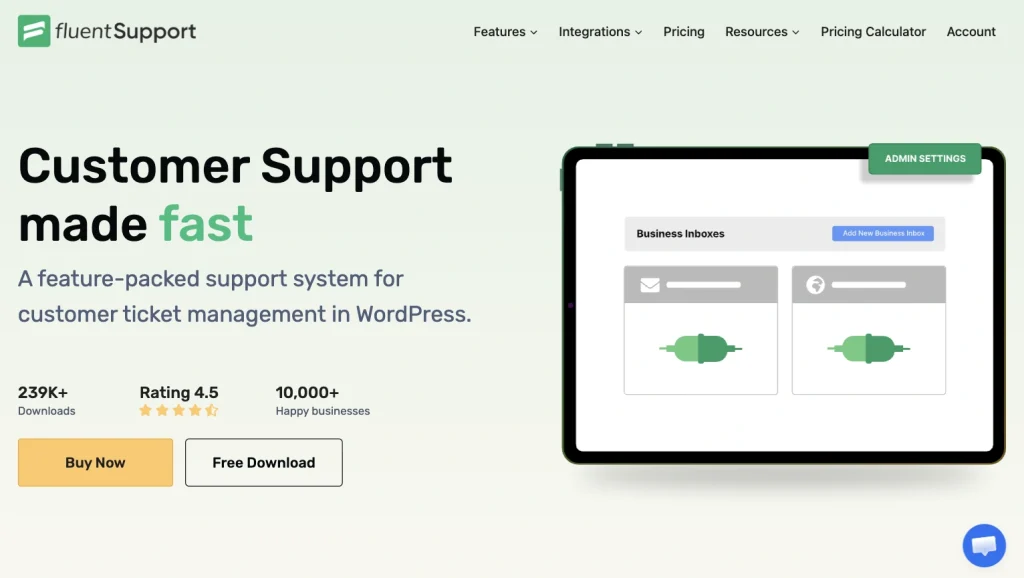
Free plan: Yes — unlimited tickets, agents, and attachments
Premium plans: Start from $129/year (1 site), $199/year (5 sites), $399/year (50 sites)
Best for: WordPress-based businesses, eCommerce stores, course creators, agencies, healthcare, etc.
Fluent Support is a self-hosted helpdesk plugin that runs entirely on your WordPress dashboard. Released in late 2021 and recently updated to version 2.0 in February 2026, it’s built by WPManageNinja, the same team behind FluentCRM and Fluent Forms.
The biggest advantage of Fluent Support is its pricing model. There are no per-agent fees, no add-on costs, and no limits on tickets or team members. You pay once annually for a license, install it on your site, and you’re done. This makes it the most cost-effective option on this list for growing businesses.
Another advantage of Fluent Support is its speed. It can be configured in under 5 minutes. The interface is clean, fast (thanks to Ajax), and feels like a natural extension of WordPress. If you’re already running a WordPress site, this is the easiest integration you’ll find.
Standout features:
- Unlimited tickets, agents, attachments & email parsing.
- AI-powered summary, fine-tune, generate reply, etc.
- 20+ integrations with eCommerce, CRM, LMS, etc.
- 500 email piping & Email CC
- Workflow automation
- Advanced reporting
- Internal notes & saved replies
- Response delay Tracking
- Advanced filtering & ticket tags
- Collision detection
- Dark mode
Verdict:
Fluent Support is the best help desk choice for WordPress-based small businesses that want to avoid recurring per-agent costs, maintain full data ownership, and integrate support with their existing WordPress ecosystem. If you’re running an e-commerce store, a membership site, or online courses, the native integrations alone make this worth considering.
Freshdesk
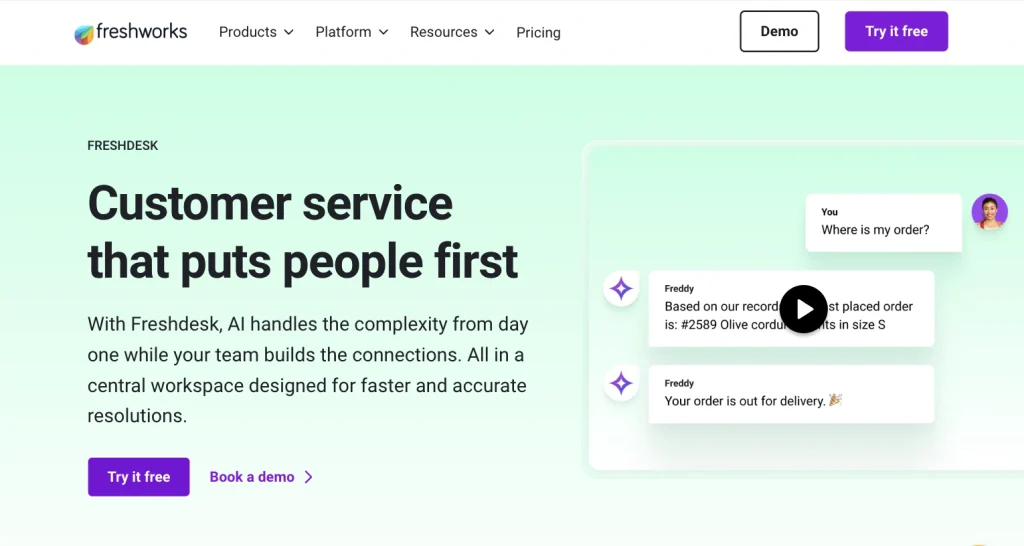
Free plan: Yes — up to 10 agents with basic ticketing features
Premium plans: Growth: $23/agent/month, Pro: $66/agent/month, Enterprise: $107/agent/month
Best for: Small to mid-size SaaS companies, businesses needing omnichannel support, teams comfortable with per-agent pricing
Freshdesk is one of the most established cloud-based help desk platforms, owned by Freshworks. It’s been in the market for over a decade and serves thousands of businesses worldwide with reliable ticketing, automation, and customer service tools.
The biggest challenge with Freshdesk is pricing complexity. While the base plans look affordable, the total cost can escalate quickly. The core ticketing product is priced per agent, but if you want true omnichannel support (email, chat, phone, messaging), you need Freshdesk Omni, which is a separate product with its own pricing tiers.
AI features like Freddy AI Copilot cost an additional $29/agent/month, and AI Agent sessions are priced at $49 per 100 resolutions with no rollover. For a 10-agent team with AI features, you’re looking at $780-$1,090/month.
The platform itself is feature-rich. Freshdesk offers workflow automation, ticket management, multi-language support, canned responses, collision detection (prevents duplicate replies), and SLA management. The Pro plan unlocks custom ticket fields, multi-brand support, and advanced reporting capabilities.
Standout features:
- Multichannel ticketing (email, web forms, social media)
- AI-powered chatbot and agent assists (Freddy AI, paid add-on)
- Automation workflows and ticket routing
- Custom reports and dashboards
- Knowledge base builder with SEO capabilities
- Collision detection to prevent duplicate responses
- SLA management and business hours
- 1,000+ integrations via marketplace
- Satisfaction surveys built into tickets
- Team collaboration tools (internal notes, ticket sharing)
Verdict:
Freshdesk is a solid choice if you need a mature SaaS platform with extensive features and can budget for per-agent pricing as your team grows. It’s especially good for businesses that need omnichannel support, advanced automation, and deep integrations with tools like Salesforce, HubSpot, and Shopify.
However, watch out for the hidden costs like AI add-ons, separate Omni pricing, and session-based billing, which can inflate your bill quickly. Calculate your total costs at 5, 10, and 20 agents before committing.
Zendesk
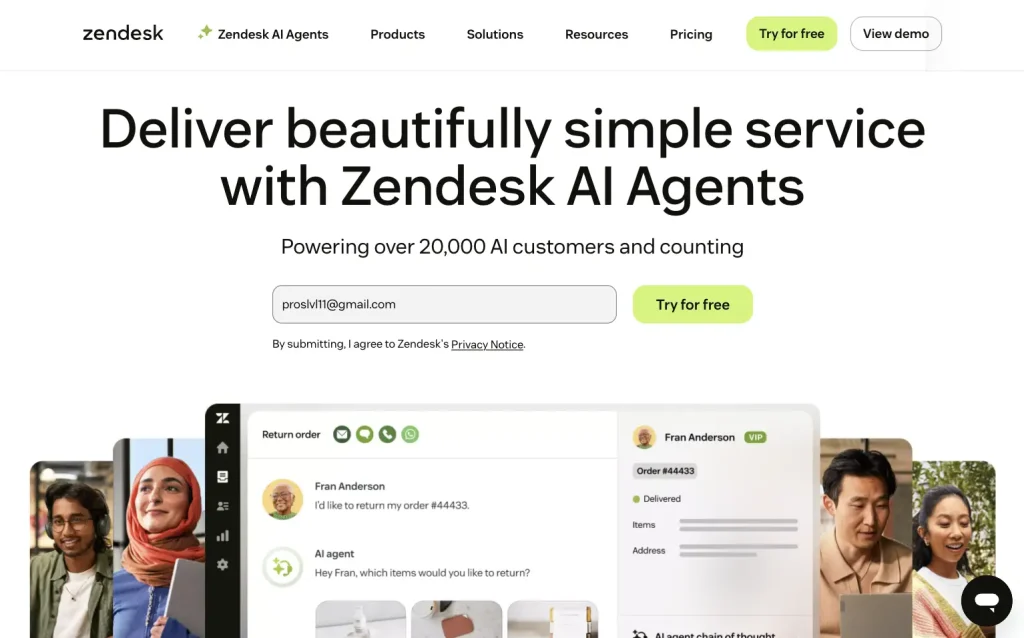
Free plan: No (14-day free trial available)
Premium plans: Team: $19/agent/month, Suite Growth: $55/agent/month, Suite Professional: $115/agent/month (billed annually)
Best for: Mid-market and scaling SaaS businesses, companies with complex support workflows, and teams needing extensive third-party integrations
Zendesk is the most recognized name in help desk software. It’s been in the market since 2007 and serves over 100,000 businesses worldwide, offering enterprise-level capabilities with proven reliability at scale.
The main consideration with Zendesk is that you’re paying for brand recognition and maturity. The Team plan at $19/agent/month is very limited. It’s essentially email-only support with basic ticketing. To access omnichannel capabilities, workflow automation, and meaningful reporting, you need the Suite plans starting at $55/agent/month. For a 10-agent team on Suite Growth, you’re looking at $550/month or $6,600/year before adding any AI features or advanced add-ons.
Zendesk is built for scale. The platform handles high ticket volumes without performance issues, supports complex routing and automation workflows, and provides some of the most comprehensive reporting in the industry. It’s also known for quick setup. You can deploy a basic configuration in under an hour, though full customization takes longer.
Standout features:
- Advanced workflow automation and intelligent routing
- Zendesk Guide (knowledge base with multilingual support)
- Real-time analytics and customizable dashboards
- Omnichannel support (email, chat, phone, social, messaging)
- SLA management with escalation policies
- AI copilot and agent assists (paid add-on)
- Answer Bot for customer self-service
- 1,200+ integrations via Zendesk Marketplace
- Custom ticket fields and forms
- Team collaboration (side conversations, internal notes)
- Mobile apps for iOS and Android
- Advanced security (SSO, SAML, IP whitelisting)
Verdict:
Zendesk is the right choice if you’re scaling a mid-market business and need proven enterprise-grade reliability, omnichannel support, and extensive third-party integrations. It’s overkill for very small teams (under 5 agents), but it handles growth well once you can justify the per-agent costs.
Expect to pay significantly more than the entry-level pricing once you add AI features, phone support, and advanced capabilities that your team will actually need. Budget for Suite Growth or higher to get meaningful value.
HappyFox
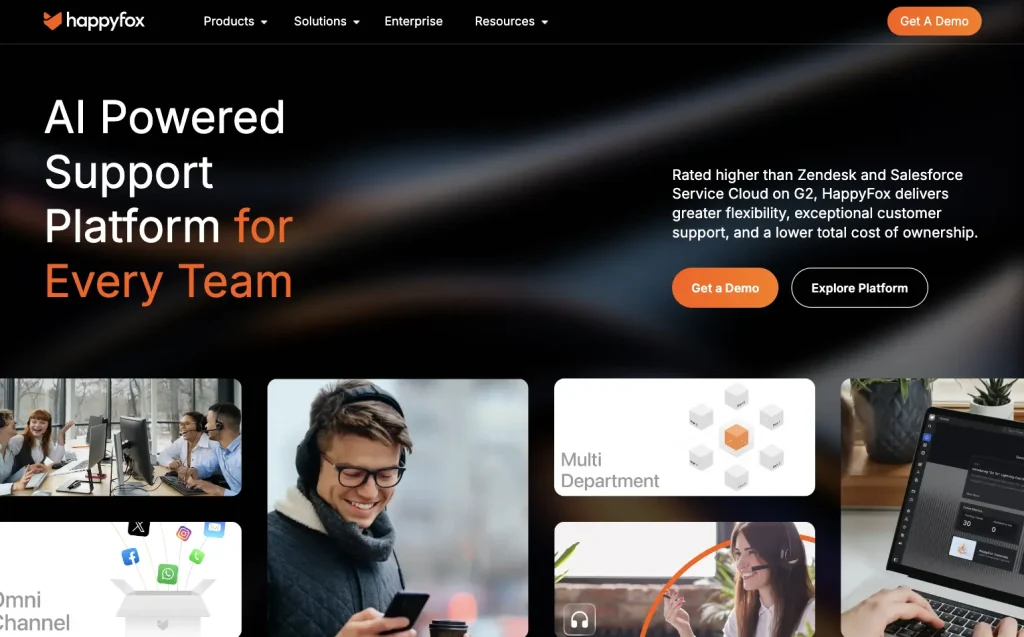
Free plan: No (free trial available)
Premium plans: Basic: $29/agent/month, Team: $69/agent/month, Pro: $119/agent/month
Best for: Growing support teams, businesses with predictable high ticket volumes, companies needing both agent-based and unlimited pricing options
HappyFox is a cloud-based help desk platform that’s been serving businesses since 2011. Unlike most competitors, HappyFox offers both traditional per-agent pricing and unlimited agent plans, giving you flexibility to choose the model that works best for your team size and ticket volume.
The pricing structure is straightforward for agent-based plans, but becomes complex when you consider the full product suite. HappyFox sells several products separately: Help Desk (core ticketing), Service Desk (for IT teams), HappyFox Chat (live chat with session-based pricing), and AI Assist (paid add-on). Each runs on its own pricing model, so the total cost depends on which products you need.
For teams with 20+ agents or high ticket volumes, the unlimited agent plans can be more cost-effective than per-agent pricing. However, these plans require annual commitments and have strict ticket caps. If you exceed your ticket limit, you’ll need to upgrade mid-contract.
Standout features:
- Smart rules and workflow automation
- Customizable ticket fields, statuses, and categories
- SLA management with escalation policies
- Knowledge base builder with multilingual support
- Canned responses and ticket templates
- Advanced reporting and custom dashboards
- Team collaboration tools (private notes, ticket merging)
- Asset management (for IT Service Desk)
- 50+ integrations (Salesforce, Microsoft Power BI, WhatsApp, Slack)
- Custom agent roles and permissions
- Multi-brand support portal
Verdict:
HappyFox is a good choice if you need a user-friendly cloud platform with flexible pricing options between agent-based and unlimited plans. The unlimited agent plans work well for larger teams (20+ agents) with predictable ticket volumes, but watch out for strict ticket caps and annual commitment requirements.
The interface is intuitive, and the automation features are solid, but essential capabilities are locked to the Pro tier ($49/agent/month) or higher. Calculate your total cost, including any needed add-ons (Chat, Service Desk, AI Assist), before committing, as these separate products can inflate your bill quickly.
SupportCandy
Free plan: Yes — basic ticketing features with limited functionality
Premium plans: Basic: $79/year (1 site), Professional: $149/year (5 sites), Agency: $299/year (20 sites)
Best for: WordPress users on extremely tight budgets who only need basic ticketing and don’t require reporting or advanced features
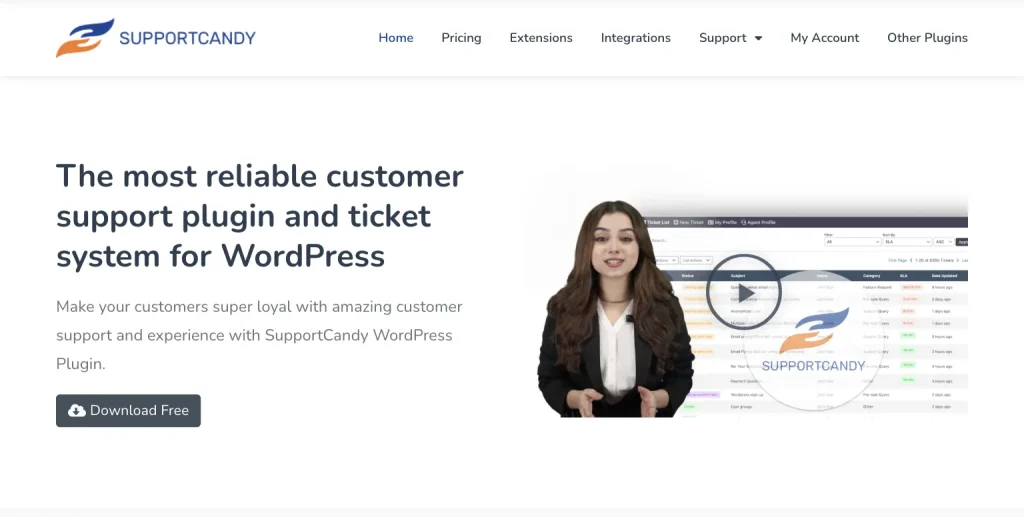
SupportCandy is a self-hosted WordPress help desk plugin that’s been around for several years. While it offers an affordable entry point for WordPress users with a solid free core version (unlimited agents, tickets, tags, custom fields, knowledge base, and basic ticketing), many advanced or modern “essential” features are only available through separate premium add-ons, which can limit its out-of-the-box capabilities compared to more all-inclusive competitors.
The main limitation of SupportCandy is what’s missing in the free version. There’s no built-in reporting or analytics. That means you can’t track agent performance, measure response times, or monitor resolution rates without purchasing the separate “Reports” add-on (which provides ticket statistics, response delay metrics, graphical overviews, and more) or using manual work/third-party tools. This can make it less suitable for businesses that rely heavily on data-driven support operations right from the start.
Standout features:
- Basic ticket management and email notifications
- Agent roles and permission management
- Custom ticket fields
- Ajax functionality for WordPress dashboard management
- Email notifications for ticket updates
- Ticket tags and categories
- Basic automation (requires add-on)
- WooCommerce integration (requires add-on)
- Easy Digital Downloads integration (requires add-on)
- Gravity Forms integration (requires add-on)
Verdict:
SupportCandy is only worth considering if you’re on an extremely limited budget (under $100/year) and need the absolute bare minimum ticketing functionality for a very small team.
For almost the same price point, Fluent Support offers dramatically more value, like comprehensive reporting, workflow automation, AI integration, native eCommerce integrations (no add-ons required), and active ongoing development.
Wrapping up
In recent times, the best help desk for small businesses isn’t the most expensive or the one with the most logos. It’s the one that organizes your support, speeds up replies, and grows with you. Without punishing you for hiring more team members.
Fluent Support delivers exactly that. Powerful features, modern AI assists, excellent reporting, and flat pricing that actually makes sense for growing businesses.
Ready to ditch the inbox chaos?
Start your Fluent Support setup in under 5 minutes → Get Fluent Support(And if you’re on WordPress, check our free guide: How to set up a support portal in WordPress.)

-

How To Provide Better Customer Service For B2B Customers
According to a survey, around 61% of customers change brands… -

-

Pre-Sales & After-Sales Support: Why Both are Important for Business
What are you doing to help your buyer decide to…
Leave a Reply
You must be logged in to post a comment.